
Rotate without scoring: the youth volleyball rule explained
The short answer
The youth volleyball rule to rotate without scoring means your team moves one position without a point being added, usually because the server has reached their limit. Often your team keeps the serve and the next player serves; sometimes the serve goes to the opponent. In Koach you do it with Rotate, or automatically.
The rule to rotate without scoring in youth volleyball is something different from the normal rotation after a side-out. Here you'll read which kinds of rotating there are, how it goes on court, which variants leagues use and how to make sure your team rotates on time.
What does rotating without scoring mean in volleyball?
In youth volleyball, "rotating" is used for three different things. Mix them up and you end up talking past the referee:
- The normal rotation on a side-out. If the receiving team wins the rally, it gets the serve and its players first rotate one position clockwise: the player in position 2 moves to 1 and serves. That's rule 7.6.2 of the FIVB rules and it applies everywhere. How the order runs is in rotation order.
- Rotating without scoring. Your team rotates while it is serving and has just won the rally. The rotation itself adds no point, and the server changes. That's the youth rule this article is about.
- Rotating with the bench. In some mini-volleyball leagues the subs move along in the rotation, so everyone plays about the same amount. In Alcorcón (Spain), with the alevines, when a team wins back the serve the player in the setter's spot goes to the bench and a bench player comes in to serve (normativa 2024-2025). The Brushy Creek Youth Volleyball League in the United States does something similar six against six: on gaining the serve, the right front player rotates off the court and a new player takes the serving position (league rules).
How does rotating without scoring work?
Take a rule of three serves and a team that plays six against six. Your right back serves at 10-12 and your team wins three rallies in a row: 13-12. Then this happens:
- The third point counts for your team as normal.
- Your team rotates one position clockwise, exactly as on a side-out: right front goes to right back, the server moves to middle back.
- The player now in right back serves at 13-12. The opponent doesn't rotate and gets no point.
For the referee and the scorer this is a normal step in the rotation: the next server has to be the next one in the order, and the players have to be in position at the serve. If someone else serves after the rotation, that's a service order fault. What it costs and how it's corrected is in serving out of order.
When you rotate depends on the limit in your league: after three, four or five serves, or after two points in a row. Those limits by country are in how many serves in a row.
Which variants of rotating without scoring are there?
What happens after the rotation differs per league. A few examples per variant, checked on 23 October 2026:
| Variant | Example |
|---|---|
| Your own team rotates and keeps the serve | Netherlands, C-youth 2nd and 3rd division (Publicatie 3.13) and Volley Stars levels 4 and 5 (rule card); Valladolid, mini-volleyball (rulebook) |
| The opponent gets the serve | Alcorcón, mini-volleyball: the opponent rotates and serves; Saratoga Springs (United States): automatic side-out after five points, without a point for the opponent (Youth Volleyball Rules); Brushy Creek (United States): automatic side-out after three or five serves, depending on the grade, without a point |
| A bench player comes in to serve | Alcorcón, alevines and benjamines; Brushy Creek, each time the team wins back the serve |
Other leagues choose differently again. So always check your own rulebook or the tournament invitation.
The Portugal rule: rotating after two points
In Germany, rotating after two points on your own serve is called the Portugal rule (Portugal-Regel). Exactly how it's worded differs per regional federation. The Bavarian federation prescribes it in U12 and U13, which play three against three, and in U14, which plays four against four: if a team wins two points in a row on its own serve, it rotates one position and keeps the serve. In U15 each district decides whether the rule applies (BVV, Durchführungsbestimmungen 2025/2026).
The rule counts points, not serves, but within one turn that comes down to the same thing: two points in a row is at most two serves. With two instead of three, a team rotates more often, so every kid gets to serve more often.
How do you keep track of rotating during a match?
What goes wrong is usually the same thing: nobody counts, and the same kid serves a fourth time. Three agreements help:
- Agree who counts. The referee, you or a bench player. At a tournament with changing referees it's smart to have your own bench count along too.
- Have the kids count out loud. Whoever serves calls out the number of their serve. Then the whole team knows when to rotate.
- Practise it. Play a game format with the same rule, so rotating without a point is no longer a surprise on Saturday. How to approach this per age is in coaching youth volleyball by age group; for kids who lose their way after rotating, see teaching volleyball rotations.
The Rotate button in Koach
On the live screen in Koach, in Simple mode, there is a row of four buttons below the court: Undo, Timeout, Sub and Rotate. Rotate moves your court one position on, without a point:
- The serve stays where it was. If your team was serving, the next player serves now.
- If Libero auto swap is on, the app adjusts the libero swap to the new position right away.
- It doesn't count as a rally, so it doesn't end up in your stats.
- You see the notification Rotated with Undo. Later you can also reverse it with the Undo button below the court.
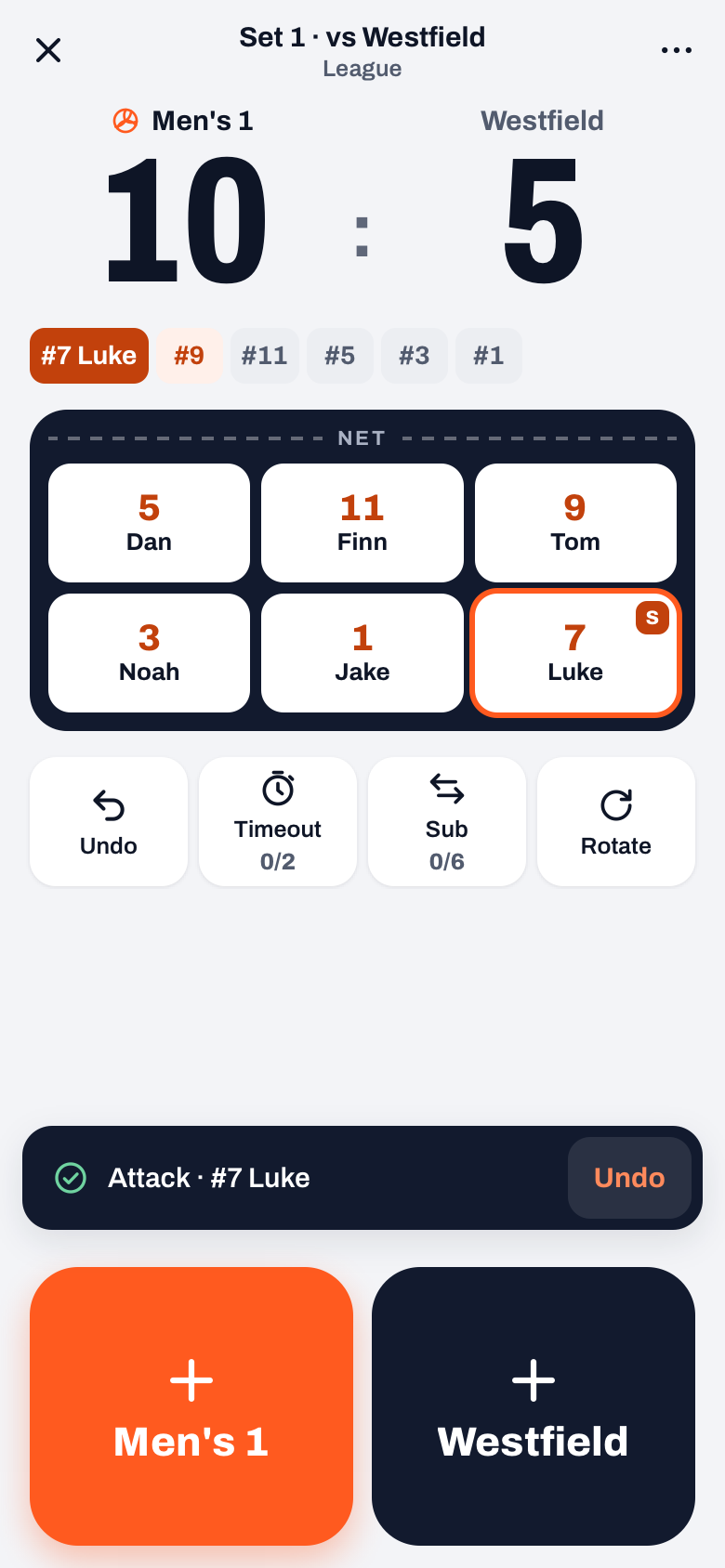
After a set is won the button is greyed out: you set up the lineup for the next set in the set break. In Expert, Rotate is not on screen; switch to Simple for a moment via the three dots at the top right. The score and everything you've recorded stay.
14 days free, no credit card. Score your next youth match and let the app count the service turns.
Try Koach with your youth teamRotate automatically or by hand?
If your rule is three, four or five serves, switch on Max. serves in a row, at the start under Match settings or during the match via the three dots and Match settings. If your team wins the last rally allowed, the app rotates by itself. For everything else you use the button:
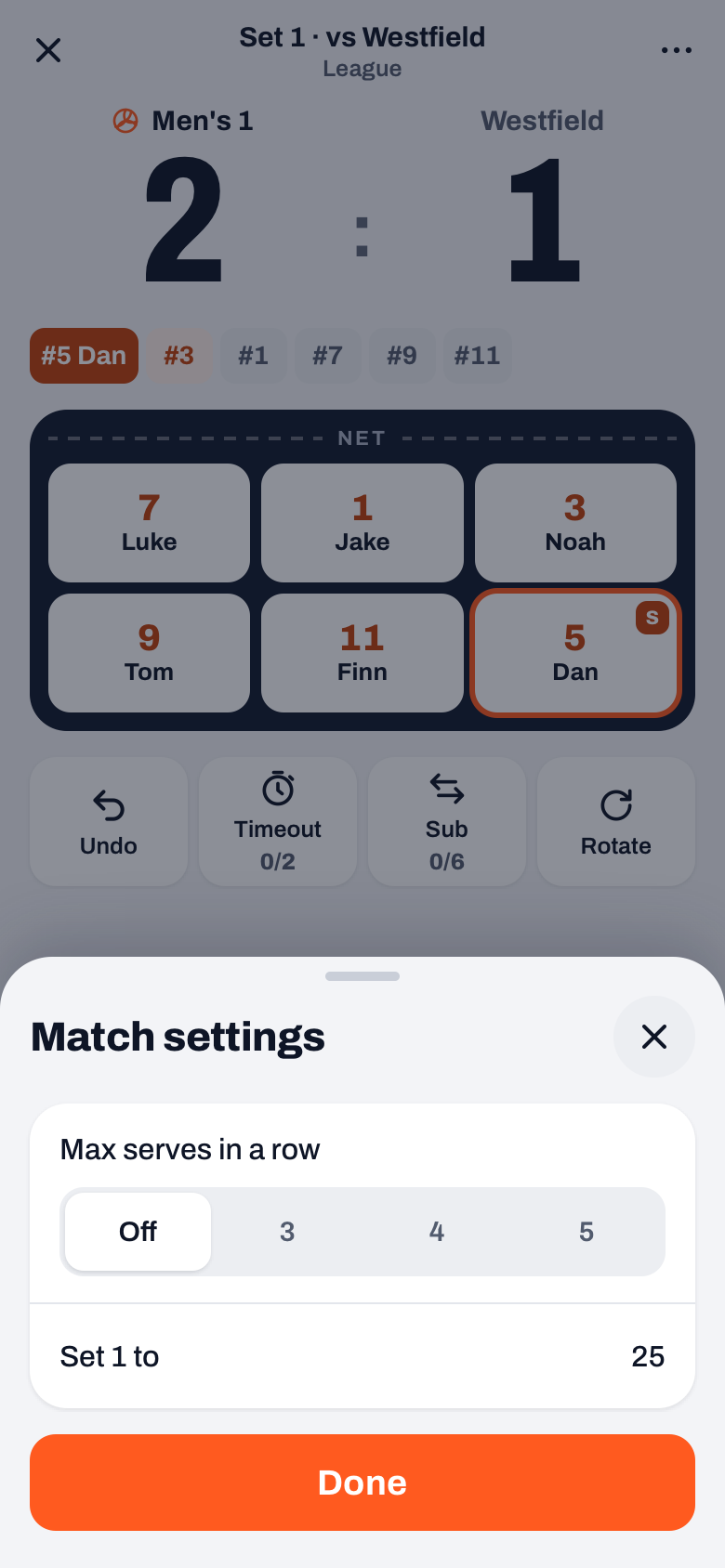
- Two points in a row, like the Portugal rule. There is no option 2. If you play six against six, leave the setting on Off and tap Rotate after the second point.
- The gym is one position ahead of the app. For example because the referee counted differently. Use Rotate to bring the court in line with what's on the floor.
- The serve goes to the opponent. Koach can't record that: in the app the serve only changes hands after a point.
- Small formats and a rotating bench. The lineup in Koach always rotates through six positions, and every bench player who comes in is a sub, of which the app counts six per set. If you play three against three or four against four, or the bench rotates along, keep track of the rotating by hand.
Set the rule before the first serve. During warm-up, check which variant the referee uses and pick it in the app. A forgotten rotation can still be fixed, but after three rallies nobody remembers who should have served.
Frequently asked questions
What is the Portugal rule in volleyball?
A German youth rule: if a team wins two points in a row on its own serve, it rotates one position and keeps the serve. The Bavarian federation BVV uses it in U12 and U13, which play three against three, and in U14, which plays four against four; in U15 the district decides. Other regions and countries have their own variants. If you play six against six, you tap Rotate in Koach after the second point; three or four against four you track by hand.
Does the opponent get a point when you rotate?
No. When you rotate without scoring, the last rally counts for your team as normal, and then your team rotates one position without a point being added. In the examples from the Netherlands, Bavaria and Valladolid, the serve stays with your team and the next player serves. In the Alcorcón mini-volleyball league and in Saratoga Springs and Brushy Creek (United States), the serve then goes to the opponent; Saratoga Springs and Brushy Creek state explicitly that the opponent gets no point for it.
Does Rotate in Koach count as a sub or as a rally?
No. Rotate only shifts the lineup one position, with no point, sub or timeout. It doesn't end up in your stats, and your sub counter stays where it was. If you tap it by accident, reverse it with Undo in the notification, or later with the Undo button in the row below the court.
What does Koach cost for a youth team?
You can try Koach free for 14 days, with no credit card and every feature. After that, choose Coach for €2.99 per month, for one team with two coaches, or Club for €9.99 per month if you have more teams. The player account is free. All prices are on the pricing page.

Let the app count the service turns
14 days free, no credit card. After one youth match you'll know whether it works.
Get started with KoachOr read first what the volleyball coaching app does.