
How many serves in a row in youth volleyball? Limits of 2 to 5
The short answer
Officially there is no limit on how many serves in a row a player gets: under the FIVB rules the same player keeps serving as long as their team wins the rally. Many youth leagues cap it, usually at three and sometimes at two or five; after that the team rotates or the serve goes over. The rule differs per league.
How many serves in a row a player gets in youth volleyball is a rule you won't find in the official rulebook, but you will find it in many youth leagues. Here you'll read what the FIVB says, which limits leagues choose, how to count the serves and how to keep track without tally marks.
How many serves in a row do the official rules allow?
Unlimited. In the official volleyball rules of the FIVB (2025-2028 edition), rule 12.2.2.1 says that the player who served serves again as long as their team wins the rally. Only when the opponent wins a rally does the serve change hands. That team first rotates one position, and the player who moves from right front to right back serves (rule 12.2.2.2). In theory, a strong server may serve a whole set in a row.
At senior level that rarely happens, because a good pass breaks the run. In youth volleyball it's different. A kid who gets the ball firm and low over the net can easily rack up eight or ten points in a row against a team that is still learning to pass. That's why many youth leagues have their own rule on top of the rulebook.
Which youth leagues have a limit: examples by country
There is no national or international standard. The rule differs per federation, per region and sometimes even per division. A few examples, checked on 23 October 2026:
- Netherlands. In the regional youth competition of the Nevobo, the Dutch volleyball federation, a player in the C-youth 2nd and 3rd division, which plays four against four, may serve at most three times in a service turn; after that the team has to rotate (Publicatie 3.13). In Volley Stars, the Nevobo's mini-volleyball, the same applies in levels 4 and 5 (three against three): after three serves by the same player, the team rotates (rule card 2026-2027).
- Germany, Bavaria. In U12 and U13 (three against three) and U14 (four against four), a team that wins two points in a row on its own serve rotates one position and keeps the serve. In U15 each district decides whether this Portugal rule applies (BVV, Durchführungsbestimmungen 2025/2026).
- Spain, Valladolid. In the mini-volleyball of the municipal school competition (benjamín and alevín, four against four), the same player serves at most three times; then the team rotates and the next player on the same team serves (Fundación Municipal de Deportes de Valladolid).
- Spain, Alcorcón. Here too, at most three serves per player, with two variants in one rulebook: in the school competition for older youth the team itself rotates, in the mini-volleyball competition the serve goes to the opponent after the third (normativa 2024-2025).
- United States, Saratoga Springs (Utah). In the city youth league, which plays six against six, five points in a row on your own serve are followed by an automatic side-out: the serving team still gets that fifth point, then the opponent gets the serve without a point. In a third set this already happens after three serves (Youth Volleyball Rules, autumn 2024).
- United States, Brushy Creek. In the Brushy Creek Youth Volleyball League, which also plays six against six, a server gets at most three serves in a row in the 3rd to 6th grade divisions and at most five in the 7th to 9th grade divisions. Then there is an automatic side-out, without a point for the opponent (league rules).
In these examples three is the number chosen most often, but not the only one, and most of the rules apply to small formats with three or four players per side. Tournaments often have their own agreement, usually in the invitation or the tournament rules. Not sure? Ask the referee or the organisers before the first match. How mini-volleyball rules work in general is in mini-volleyball rules, and what to train at each age in coaching youth volleyball by age group.
Why does the youth rule exist?
Rulebooks rarely explain it, but three reasons are obvious:
- Everyone serves. Without a limit, the strongest server sometimes serves half a set while the others watch. With a limit, every kid gets a turn.
- The rally stays the goal. A run of ten aces teaches the receiving team little, and the serving team just as little. After a few serves a new server steps up, and usually a rally follows in which the ball is actually played.
- The set stays close. A set that one server has taken to 2-14 is over for both teams. A limit keeps the gaps smaller.
For you as a coach there's a fourth reason: you see sooner which kids can't yet get the serve over the net under pressure. That's something you can train specifically; tips are in getting kids to serve over the net.
How do you count the maximum number of serves?
An example with a limit of three. Your number 7 steps up to serve at 5-5 and your team wins three rallies: 6-5, 7-5, 8-5. That was three serves, so the point at 8-5 is the last of their turn. If your team already loses the second rally, at 6-6, the turn is simply over, and the count starts again at one on their next turn.
Whether a rulebook talks about serves or about points in a row makes no difference within one service turn: every rally won is a point, and every rally lost ends the turn. Two points in a row in Bavaria therefore means at most two serves per player.
What happens after the last serve varies. In most of the examples above, the team itself rotates and the next player serves, with no point for the opponent. In the mini-volleyball of Alcorcón, in Saratoga Springs and in Brushy Creek, the serve goes to the other team. How rotating works and which other variants there are is in rotating without scoring in youth volleyball.
How Koach counts the limit for you
Keeping a tally on the sideline is hard: you're watching the rally, not your fingers. In Koach you switch the limit on once, and from then on the app counts along:
- Choose the limit. When you start a match, expand the Match settings row under Scoring and pick Off, 3, 4 or 5 at Max. serves in a row. You can also do it during the match: tap the three dots at the top right and choose Match settings.
- Watch the server. When your team is serving, the server's tile shows which serve it is, for example 2/3, and the same counter appears next to the serve order. On the last serve allowed it changes colour, so you see it coming.
- Let the app rotate. If your team wins that last rally, the court rotates one position by itself, the serve stays with you and the next player serves. The notification after the point then says, for example, 3 serves · rotated. If you tap Undo, the point and the rotation go back together.
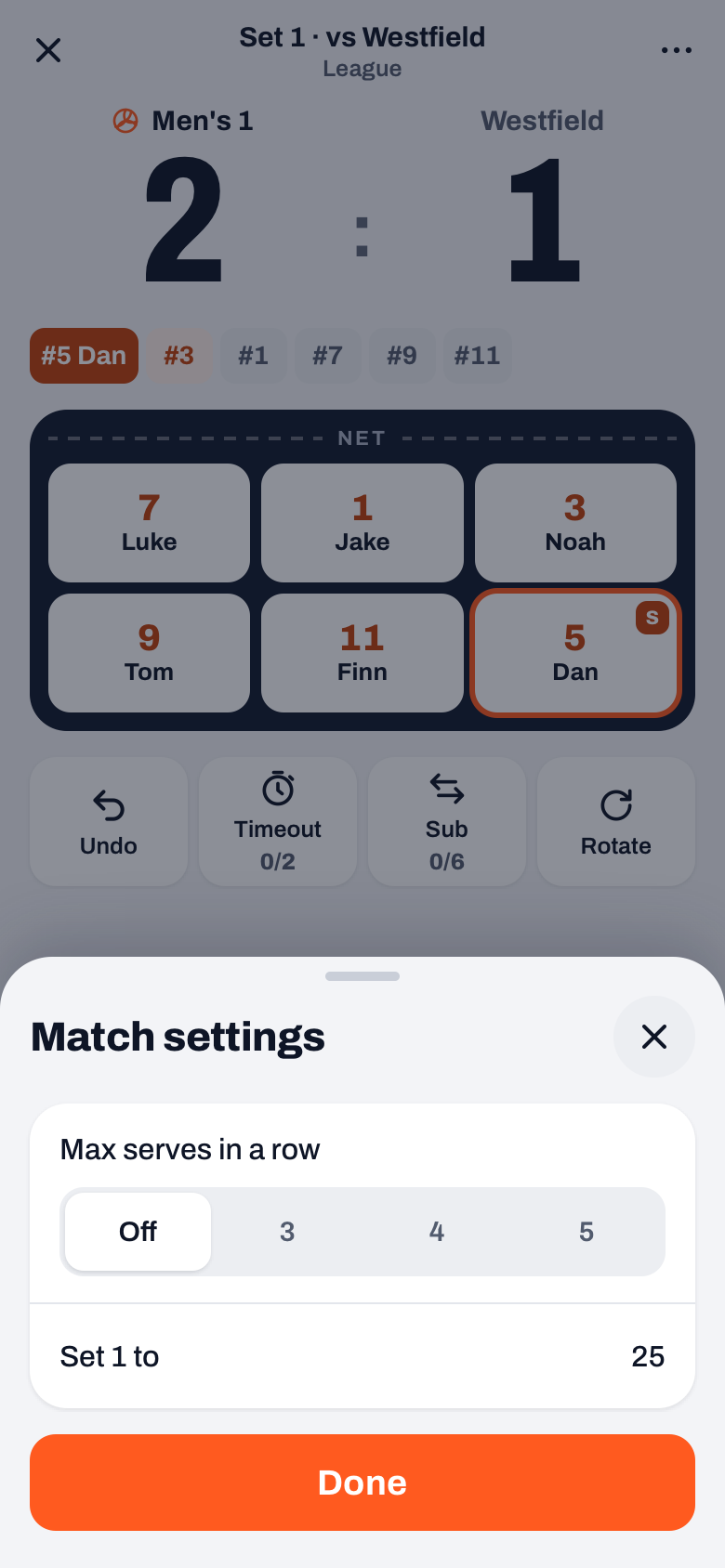
Three details. If that last rally wins the set, the app doesn't rotate anymore: the set is over. The app remembers your choice per team on this device, so the next match starts with the same limit, even if you go live straight from the Today card; if a second coach scores on another device, they switch it on there themselves. And the counter works in Simple and in Expert. How live scoring works in general is in tracking a volleyball match live.
14 days free, no credit card. Switch on the youth rule in your next match and see whether you still need tally marks.
Try Koach with your youth teamWhat Koach doesn't do automatically
The setting only knows Off, 3, 4 and 5, and the app works with the six-position court you also use in your lineup. Three situations therefore fall outside the automatic count:
- A limit of two, like the Portugal rule. There is no option 2. If you play six against six, leave the setting on Off and tap Rotate in the row below the court after the second point. The court rotates one position, the serve stays with you and no point is added.
- The serve goes to the opponent. The app can't follow that variant: in Koach the serve only changes hands after a point.
- Three or four players per side. In Koach the lineup always rotates through six positions. If you play four against four, like the Dutch C-youth in the 2nd and 3rd division, or three against three, the serve order in the app runs differently from the one in the gym. In that case, keep track of the service turns by hand. For youth teams that play six against six, the setting does fit.
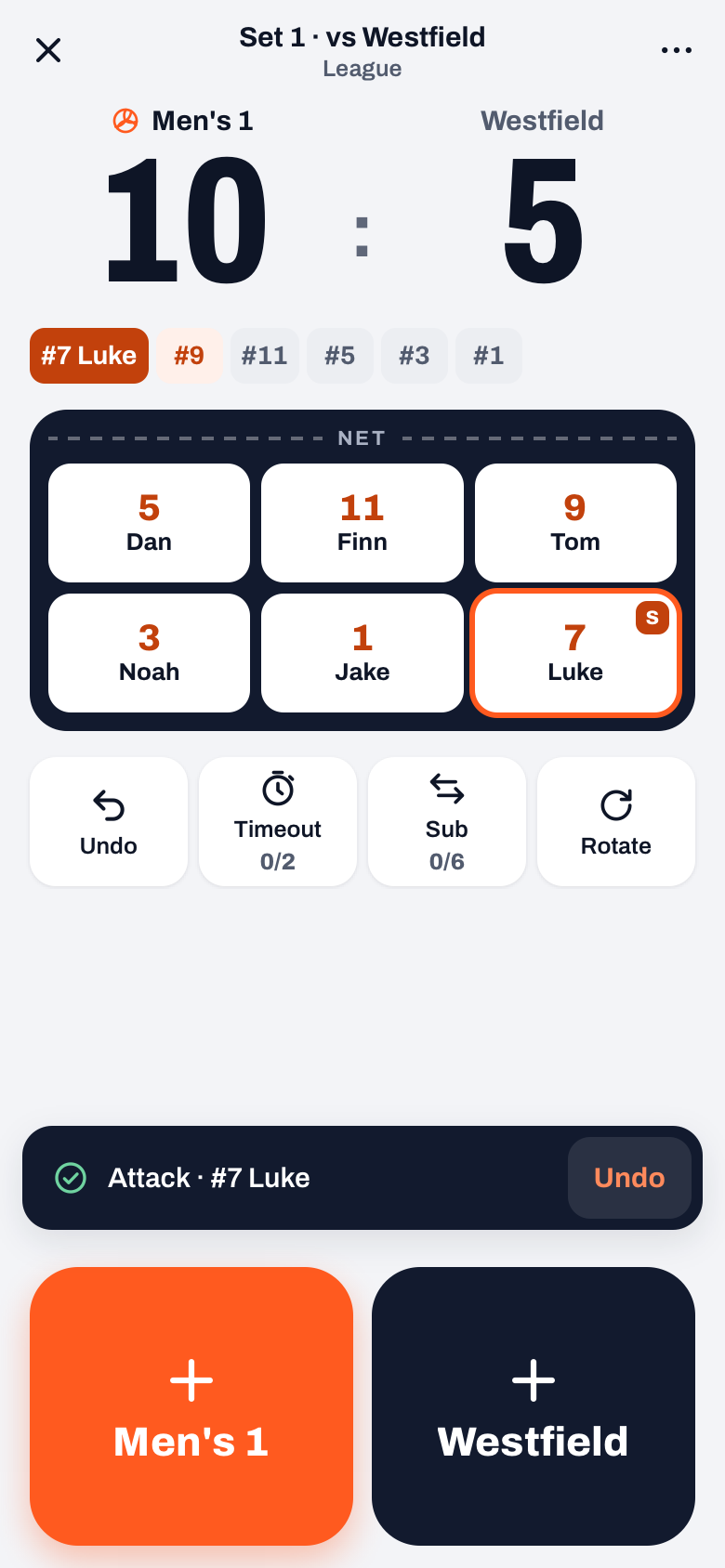
In Expert, the Rotate button is not on screen. If you have to rotate by hand, switch to Simple via the three dots; the score and everything you've recorded stay. After the match, the Serve runs block under Players for that match shows your servers' longest runs. More about runs as a statistic is in serving runs.
Agree on it during warm-up. Ask the referee which limit applies and who counts, then set it in the app right away. Then you don't have to think about it during the match, and your bench knows why the team suddenly rotates.
Frequently asked questions
How many times in a row can you serve in volleyball?
Under the official FIVB rules, as often as your team wins the rally: there is no limit. Many youth leagues do have one. In the Dutch C-youth 2nd and 3rd division it's three serves, in Bavaria a team in U12 to U14 rotates after two points in a row, and in Saratoga Springs (United States) the serve goes to the opponent after five points in a row. It differs per federation and league, so check the rulebook or the tournament invitation.
Does an ace count towards the maximum number of serves in a row?
Yes. Every rally your team wins while the same player is serving counts: an ace, an attack point after a poor pass by the opponent or an error on the other side. If your team loses a rally, the service turn is over and the count starts again on the next turn. Koach counts the same way.
What happens if we forget to rotate?
Then the same player serves once too often. The Nevobo calls the rule an addition to the rotation rule, so there that player is serving out of order; what such a fault costs is in serving out of order. How strict referees are in youth volleyball varies. With the youth rule switched on in Koach, you see the counter on the tile go up and the app rotates by itself.
Does the youth rule cost extra in Koach?
No, the setting is part of live scoring a match. You can try Koach free for 14 days, with no credit card and every feature. After that, Coach costs €2.99 per month for one team with two coaches; the player account is free. The prices are on the pricing page.

Switch on the youth rule in your next match
14 days free, no credit card. After one match you'll know whether you still need tally marks.
Get started with KoachOr read first what the volleyball coaching app does.