
What Happens If You Serve Out of Order in Volleyball?
The serve goes over, the rally is won, and three points later the scorer notices the wrong player had the ball. This is not a small thing: the rotation fault is the only rule in volleyball under which points you have already scored can disappear off the board.
Rotation fault or positional fault: not the same thing
Two rules look alike and get mixed up constantly:
- A positional fault (rule 7.5) means: at the moment the server strikes the ball, the players are not in the correct order relative to each other. Penalty: point and serve to the opponent, positions corrected. Nothing more. Everything about it is in the positional fault.
- A rotation fault (rule 7.7) means: the serve was not made in the correct serving order. Penalty: point and serve to the opponent, serving order corrected — and possibly the cancellation of points.
So the difference is in what went wrong: standing or serving. The order in which you are supposed to serve is fixed by the starting line-up you hand in before the set; how it runs through is in the rotation order.
The penalty: point, serve — and cancelled points
As soon as the rotation fault is spotted, the opponent gets a point and the serve, and the offending team has to restore its rotational order (7.7.1). On top of that comes rule 7.7.2, and that is the provision that turns matches upside down: the scorer determines the exact moment at which the fault was committed, and every point the offending team scored after that is cancelled. The opponent's points stay on the board.
If that moment can no longer be established — because the scorer did not keep a reliable record of the serving order, for example — then nothing is cancelled and only the standard penalty remains: one point and the serve to the opponent. In practice that is precisely why careful scorekeeping matters.
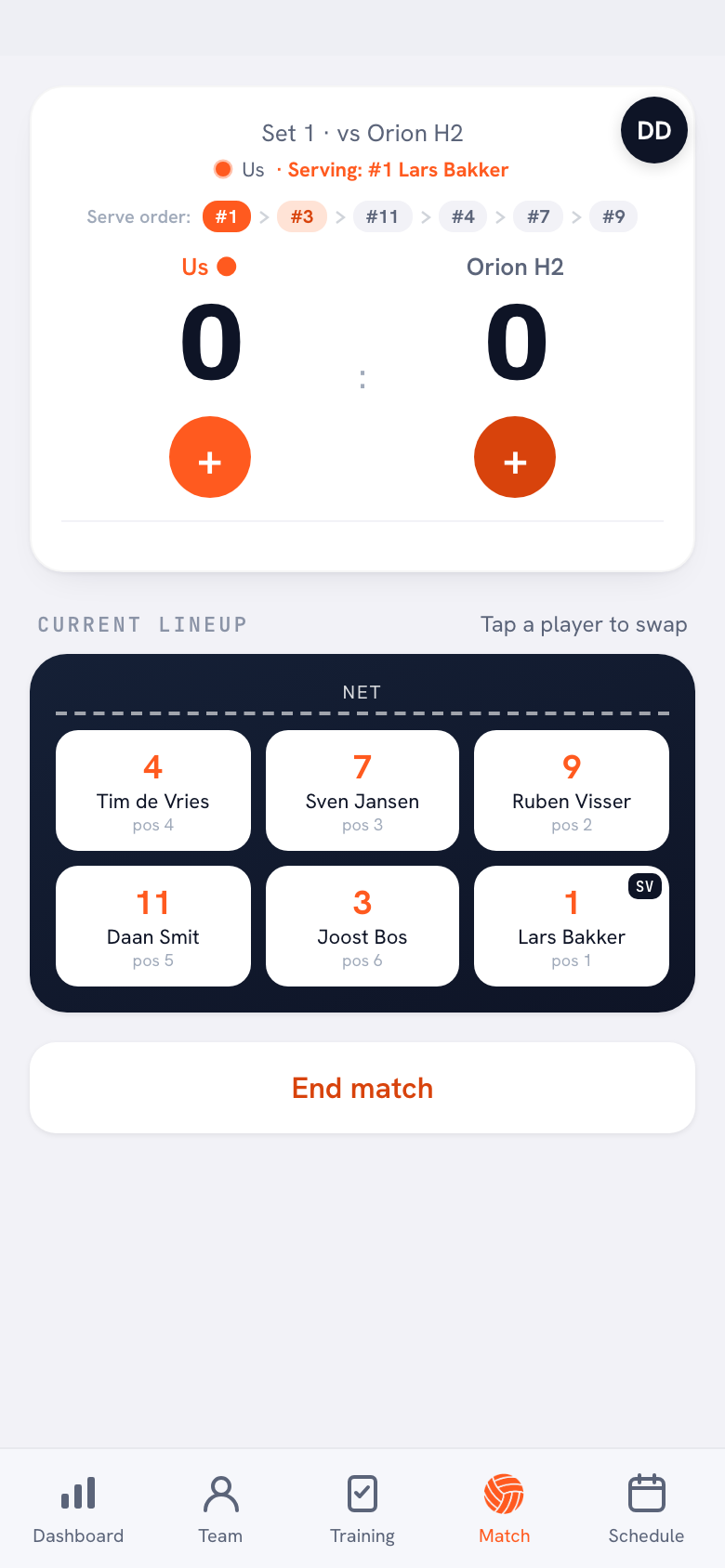
Koach follows the serving order per rotation while you score live, so you can see at a glance whose turn it is.
How it goes wrong in practice
- After a time-out or a substitution. A substitute comes on, everybody mentally shifts a place, and the ball ends up with the wrong player.
- After a libero replacement. The libero comes off because the player they replace has to serve — and that player does not realise it. See the libero replacement rules.
- At the start of a set. The team accidentally rotates one place too far after switching courts.
- Facing set point. Under pressure the most experienced player grabs the ball, even though it is not their turn.
How the scorer records it
The scoresheet lists, per set, the starting line-up with the six shirt numbers in the order of positions 1 through 6. That order is the serving order for the whole set and only changes through a substitution: a substitute takes exactly the place of the player who goes off. The scorer ticks off the shirt number at every service turn, and it is that ticking off that makes it possible afterwards to establish from which point the fault was running. A scorer who tracks only the score and not the server makes cancelling points effectively impossible.
Whose job is it to watch for this?
Formally the scorer and the second referee: the scorer compares the server against the line-up sheet, the second referee checks the positions of the receiving team. At regional matches there is often only one referee and a junior player behind the table — and then the chance that a fault goes unnoticed for a while is very real.
As a coach you have your own responsibility here, and one practical tool: the player rotating into position 1 calls their own name. It sounds childish, but it removes the fault almost entirely. The pre-serve rotation check is covered in the rotation check, and following the service turn during the match in tracking the service turn.
Can a fault be corrected too late?
Yes. A rotation fault can only be penalised for as long as it is noticed. If nobody spots it, the match simply carries on and there is nothing to be done afterwards: a result is not corrected because somebody finds an error on the sheet the following week. If you do spot a fault after the rally has been played, you report it through the captain to the referee, who decides and has the scorer establish the moment.
Youth, mini volleyball and recreational leagues
From under-15 upwards the rule applies in full, including the cancellation of points. In mini volleyball, teams work with fixed, heavily simplified rotation schemes and the supervising adult simply corrects it on the spot, with no penalty. In recreational and corporate leagues it is customary to fix the fault as soon as it is seen, without deducting points — but that is a local arrangement, not a rule. The complete rule framework is in all the volleyball rules at a glance.
Frequently asked questions
What is the penalty if the wrong player serves?
The opponent gets a point and the serve, and the team has to restore its rotational order. On top of that, every point the offending team scored after the fault began is cancelled, if that moment can be established.
Do the opponent's points get cancelled too?
No. Only the points of the team that committed the rotation fault are cancelled. The opponent keeps everything, including the penalty point.
What if nobody can establish when the fault began?
Then nothing is cancelled and only the standard penalty applies: one point and the serve to the opponent. That is exactly why a reliably tracked serving order is worth so much.
What is the difference with a positional fault?
In a positional fault, players are standing in the wrong order at the moment of contact on the serve; that costs one point and the serve. In a rotation fault the wrong player serves, and on top of the penalty, points can be wiped out.
Try it yourself in Koach
Less admin, more coaching.
Get started with KoachOr read first what the volleyball coaching app does.