
Rotational Fault in Volleyball: Finding Where the Order Broke
The rally is won and the bench is already half out of their seats. Then the referee blows the whistle, points the point to the other side and circles an index finger a few times. At that moment a rotational fault in volleyball is mostly confusion: nobody on the bench knows what has to happen now, and nobody knows where the serving order went off the rails. This piece works back from that whistle: what you do in the first minute, how to find where it went wrong and which habit prevents it.
Two things are deliberately left out of this piece. What the fault costs and when points already scored are cancelled is in serving out of order: what a rotational fault costs you. And if your team was standing in the wrong place rather than the wrong player serving, you are dealing with the positional fault and the rules per rotation.
Rotational fault in volleyball: the first minute after the whistle
The first reflex of many coaches is to walk over to the referee. Don't. Under FIVB rules only the game captain may speak to the referee, and only when the ball is out of play. What you can do in that minute is make sure the next rally does not go wrong as well.
- Send your game captain with two questions. Is it a rotational fault or a positional fault, and which player should have served? Those are requests for an explanation, not a protest, and you need the answer for everything that follows.
- Find the player whose turn it was yourself. Take your lineup sheet or your own score record. You usually know the answer before the captain is back.
- Put the team in the right order for receiving. The opponent serves now, and your six have to stand in the order on the sheet. A team that has just been given a rotational fault and is still talking easily commits a positional fault on the next serve.
- Leave the points for what they are. Whether anything comes off the scoreboard is decided by the referee with the scoresheet. An argument about it gets you nothing in this minute and costs attention you need for receiving.
- Note the score and the shirt number. One line on your sheet: at what score, which player served and who it should have been. You use that at the break to trace back where it started.
Let only the game captain talk. Three players talking at the referee at once do not get an explanation, at most a warning. Agree before the match that for every whistle nobody understands, only the captain goes over and the rest get into position.
Recognising the referee's signal (and why it looks like the positional fault)
After the whistle the referee first points with an outstretched arm at the team that gets the point. Then comes the signal that says what happened. For a rotational fault it is a circular movement of the index finger. That is exactly the same signal as for a positional fault: the rulebook makes it one signal. The complete overview of the signals is in referee hand signals in volleyball.
Because the signal does not tell them apart, you read the difference from one other thing: who was serving.
- Your team was receiving. Then it cannot be a rotational fault by your team, because you did not serve. The signal against you means someone was out of position relative to their neighbours.
- Your team was serving. Since the FIVB rule change of 2025, the serving team no longer has to be in rotational order at the moment of service and therefore can no longer commit a positional fault. Under those rules, the signal against a serving team is a rotational fault. Do check from when your own federation applies that change; until then it can still be either.
That distinction is not a detail. With a positional fault you are looking for two players who were out of position at the moment of service; with a rotational fault you are looking for the moment the order went off the rails. Those are two different searches, and the rest of this piece is about the second.
Tracing back: three places where this set's serving order is still recorded
The serving order of a set is fixed before the first ball is served. It is recorded in three places, and you need at least one of them to find where it went wrong.
- The lineup sheet. The order in which you fill in the shirt numbers for positions I to VI is the serving order for that set. Every set has its own sheet, and the order can differ per set. How the positions are numbered is in position numbers 1 to 6. Take a photo of each sheet before you hand it in: then you still have it yourself.
- The scoresheet at the table. It records per set who served. That list is decisive when there is any doubt. As a coach you do not look at it yourself, but your game captain can ask the referee for an explanation.
- Your own score record. If someone on the bench tracks who served on every point — on paper or in an app — you can rewind the set. How to follow the serving turn during the rally is in following the serving turn. A digital lineup helps with that, but does not replace the scoresheet; more on that in from a paper to a digital lineup card.
With the sheet and your own list side by side, you find the starting point in four steps:
- Write the six shirt numbers from the sheet one below the other in order, and repeat that column until you have as many lines as your team had serving turns in this set.
- Next to it, write the servers as they actually came up in the set, from the first serving turn onwards.
- Go down both columns at the same time. The first line where they no longer match is where the fault began.
- Look at what happened just before that line: a substitution, a libero replacement, a time-out or the start of the set.
The four moments when the order goes off the rails
How the order rotates is in rotation order in volleyball. This is about something else: the moments when a team loses the thread, and what you check at each of them.
1. After a substitution. The substitute takes the place of the player going off, and with it that player's turn in the serving order. It goes wrong when the substitute stands where they are used to playing, instead of where their predecessor stood. Check: as they come on, the substitute asks "who do I serve after?" and gets one name back.
2. After a libero replacement. Under FIVB rules the libero does not serve, so the libero is not in the serving order either. Anyone who remembers the order by who happens to be on court at that moment counts the libero in or skips the player the libero replaced. Check: the order is about the six names on the sheet, never about who happens to be on court. The rhythm of the libero replacements themselves is in the libero replacement rules.
3. After a time-out. Nothing changes in the order, but the team walks to the bench and back again. Whoever picks up the ball after the time-out is not necessarily the one whose turn it is. Check: before the whistle for service, the bench calls out one name.
4. At the change of set. New set, new sheet, and often a different order. On top of that, not every set starts with your serve. Players who still have the order of the previous set in their heads serve on the turn from back then. Check: read the new sheet out loud at the set break, from I to VI, and have every player repeat their position.
The habit that prevents it: one name out loud before every serving turn
Good intentions do not hold up under pressure. A habit does, provided it happens at one fixed moment, by one fixed person, with one word.
- The moment. Every time the serve comes to your team, before the whistle for service. That is the only moment when a mistake still costs nothing: a rotational fault only occurs at the service contact.
- The person. One fixed substitute, or an assistant. Not the coach, who is watching the rally. If there is nobody on the bench, the setter does it.
- The word. The name of the player who has to serve. The server raises a hand as a sign they have heard it. If the name does not match whoever is holding the ball, there is still time to give the ball to the right player.
A name works better than "you're up" or a pointing finger, because the caller has to look it up. Whoever says a name has checked the order; whoever points has guessed.
The habit only sticks if it also exists in practice. Agree that the same rule applies in every game form: at every side-out someone calls the name, and a serve without a name does not count. It costs a week of irritation. After that it happens automatically, even at 23-24.
What Koach does and doesn't keep track of for you
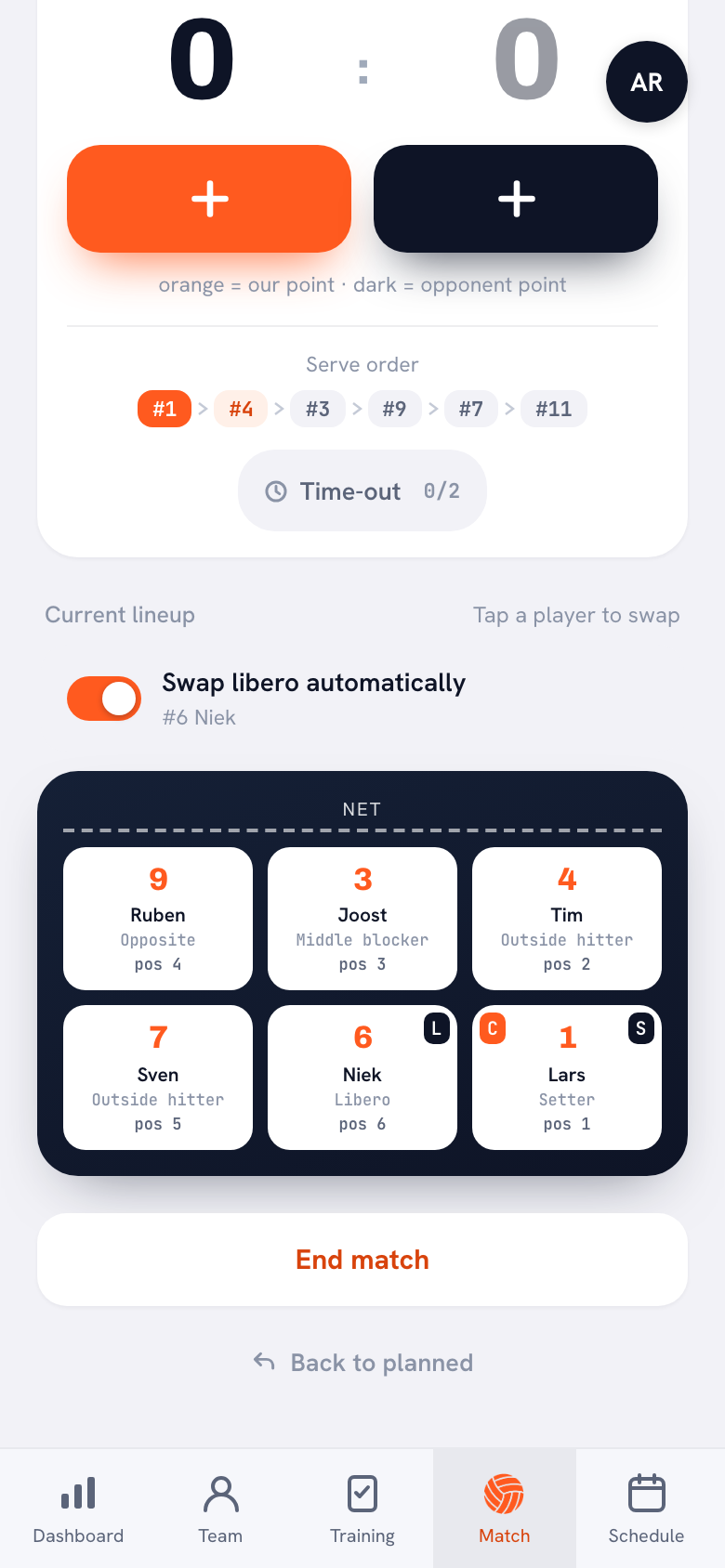
During live scoring the app shows next to the score who is serving and the full serving order as a row of shirt numbers, with the current server highlighted and the next one after them. The libero is not in that row: in their place is the player they replaced. Before the match, the lineup per set and the rotation check show you the six rotations before you lock them in.
It is important to know what that row actually shows. The app does not know who really served in the gym. It shows whose turn it is according to your lineup and the substitutions you entered. That is exactly what makes it useful after a whistle: if the name in the row does not match the player who served the ball, you have found the difference — provided the substitutions were also entered in the app.
What the app does not do:
- It does not detect a rotational fault and does not warn you when the wrong player serves.
- It does not take points back and does not replace the scoresheet. The scorer's sheet remains decisive for the moment the fault began.
- The only automatic lineup warning is about the libero standing in the front row. That is a positional fault, not a rotational fault.
- The rotation check names your best server and your weakest rotation by attacking power. That helps you choose your lineup; it is not a fault check.
If you no longer want to keep the serving order in your head, set your starting lineup for the next match in Koach and keep the row of shirt numbers in view during live scoring: at every side-out you see who is serving now and who comes next. If you only need the six rotations on paper, the free rotation generator prepares them for you without an account. Try Koach free for fourteen days.
Frequently asked questions
What is a rotational fault in volleyball?
A rotational fault is a serve that is not made in the correct serving order: the wrong player serves. The referee signals it with a circular movement of the index finger, the same signal as for a positional fault. What the fault costs and when points are cancelled is in serving out of order.
Where can I find who should have served?
On the lineup sheet for that set: the order of positions I to VI is the serving order. The scoresheet at the table records who actually served and is decisive if there is any doubt. If the bench tracks the server on every point itself, you can put that list next to the sheet and look for the first line where they diverge.
Why does it go wrong precisely after a substitution or a libero replacement?
Because at that moment someone other than the player on the sheet is on court, and players often remember the order by who they see around them. A substitute takes over their predecessor's turn, and under FIVB rules the libero does not serve and is therefore not in the order. Forget that and you count one position too many or too few.
Can an app prevent a rotational fault?
Not on its own. During live scoring Koach shows who is serving according to your lineup and the substitutions you entered, and who comes next, so you do not have to remember the order. The app cannot see who really serves in the gym, so it does not warn you about a wrong server and does not replace the scoresheet. You prevent it with the habit of calling out one name before every serve.
Can I as the coach ask the referee for an explanation?
Under FIVB rules not yourself: the game captain does that, and only when the ball is out of play. The captain may ask how a rule was applied, including whether it was a rotational fault or a positional fault. Agree in advance that only the captain goes over, so the rest of the team can focus on the next rally.

Try it yourself in Koach
Less admin, more coaching.
Get started with KoachOr read first what the volleyball coaching app does.