
Your first practice with a youth team: structure and a sample plan
Next week you will stand in front of a group of ten kids with the energy of a rock concert for the first time. What do you do that first hour? This article gives you a complete, proven structure for your first youth practice — including a sample plan and the mistakes every rookie makes.
Before you step into the gym: three things to arrange
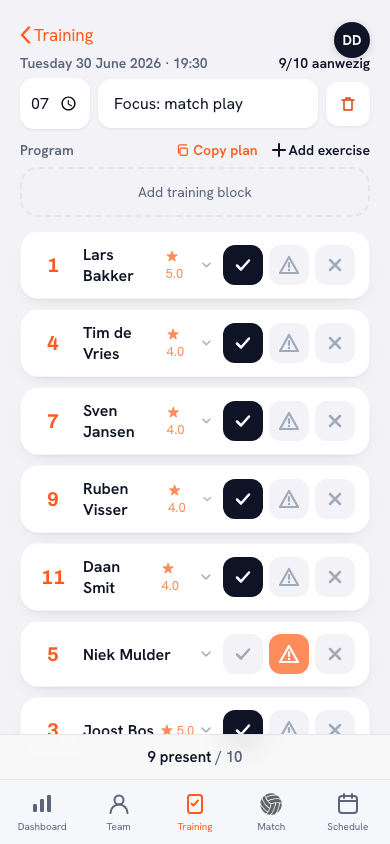
- Know the names. Ask for the member list and learn the first names by heart. "Hey, Sam!" works a hundred times better than "you there". An attendance list you check off every week helps you remember both the names and the turnout.
- Know the level. Ask the previous coach or the club's junior coordinator which age division the team plays — 10U, 12U, 14U and so on — and which simplified game form they are used to. That determines your entire drill material.
- Plan too much. Prepare more drills than you need. Nothing is more awkward than staring at ten kids while you figure out what comes next.
The fixed structure of a youth practice
Every good youth practice follows roughly the same skeleton — the content varies, the structure does not:
- Arrival and start (5 min): a fixed ritual — circle, names, what we are going to do. Keep it short.
- Warm-up as a game (10 min): a tag game or relay with a ball. No running laps; with youth, the warm-up can always be playful.
- Ball skills (15 min): today's technical theme, in pairs or small groups with lots of repetitions.
- Game form with the theme (15 min): the same skill, now in a small game with adapted rules that force the theme.
- Free play (10 min): a scrimmage — what they have been waiting for all week. Never skip this; it is the engine under everything.
- Wrap-up (5 min): circle, one compliment per child or for the group, a look ahead. Putting the balls away together is part of it.
Sample plan: first practice, ages 8-10
A worked-out hour with forearm passing as the theme:
- 0-5 min — circle and name game: toss the ball around; whoever catches it says their name and one thing they enjoy. You memorize names, they get used to you.
- 5-15 min — crossing game with a ball: dribble across the gym without getting tagged. Everyone moves, everyone has a ball.
- 15-30 min — passing in pairs: one tosses an arcing ball, the other passes it back with the forearms; switch after ten balls. Extension for those who can handle it: slap the floor first, then pass — that forces the ready position.
- 30-45 min — game form 3-on-3: small courts, a point counts double if the rally includes a forearm pass. That way the game rewards your theme all by itself.
- 45-55 min — king of the court: the winning team stays on, challengers come in. High tempo, lots of turnover.
- 55-60 min — circle and wrap-up: one question ("what went better today than at the start?"), tidy up together, high fives at the door.
Keeping order without yelling
Ten kids and a gym full of balls: without agreements it turns into a playground. Three things that work from practice one: a fixed silence signal (whistle or hand up — hold your ball, eyes on you), balls still on the hip the moment you speak, and explanations in three sentences at most. Being consistent in week one saves you arguments in week ten. And do not raise your voice: speak more softly and you get kids who listen better.
Afterwards: two minutes for yourself
Right after practice, take a moment to jot down three things: which drill ran well, which one fell flat, and which child needs extra attention. Those notes are gold for your next practice — and after a few weeks you spot patterns you miss in the moment. A coach who saves their practices and observations builds a personal reference library in a single season that lasts for years. Also ask the kids themselves now and then which drill they liked best: youth players are surprisingly honest, and their answer reveals exactly where the learning and the fun were.
The five pitfalls of beginning youth coaches
- Explaining too long. After thirty seconds of talking, nobody is listening anymore. Demonstrate, start, adjust as you go.
- Lines and waiting. One ball and ten waiting kids is chaos in the making. Small groups, many balls.
- Starting too hard. Better a drill that turns out too easy (add a rule, done) than frustration in minute five.
- Only correcting. Name at least one thing per child that went well. Children grow on whatever you give attention to.
- Showing up without a plan. Write out your practice, add the lessons learned, and reuse what works — within a few weeks you have a library of your own.
Realistic expectation: your first practice will be messy, and that is normal. Kids do not remember whether your drill ran perfectly — they remember whether it was fun and whether you knew their name. The rest you learn week by week.
Frequently asked questions
How long should a youth practice last?
For the youngest groups an hour is plenty; from around age twelve, ninety minutes is common. Better one hour full of energy than ninety minutes where the last half hour falls apart.
What do I do with a child who does not want to join in?
Do not force it and do not ignore it: give them a role (feeding balls, keeping score) and pull them back into the group through the game. If the pattern keeps returning, discuss it calmly with the parents.
Do I need a certification to coach youth volleyball?
It depends where you coach. In the US, USA Volleyball requires its IMPACT course as the minimum coaching qualification for junior club coaches, alongside SafeSport training and a background screening — so for club volleyball it is not optional. Recreational and school settings vary, and other federations set their own requirements. Either way, an entry-level coaching course is full of practical tools and well worth it.
How many drills should I prepare?
Count on four to six drills per hour, plus two in reserve. Does a drill that is running well take longer? Fine — cutting off a drill that works just to stick to your schedule is a waste.


Try it yourself in Koach
Less admin, more coaching.
Get started with KoachOr read first what the volleyball coaching app does.