
Growing youth players: development over results
Every youth team has two scoreboards: Saturday's result and the question of whether these kids will still be playing volleyball in three years — and be better at it. Only that second scoreboard is the youth coach's assignment.
Development over results — what that really means
It does not mean winning is irrelevant: kids want to win, and that healthy fire should be nurtured. It means you steer your decisions by development: everyone serves (including the kid who still misses), the setter learns to set in real matches, and the match is never won by letting the three best players do everything. You accept losing points on Saturday as an investment in June.
Measuring youth: the same data, a different lens
- Compare only with themselves: the growth chart per child is sacred; rankings within the team are poison at this age.
- Celebrate courage statistics: with youth, feel free to weigh the attempt ("dared five jump serves!") more heavily than the result. The error column of a youth player who tries a lot is a growth column.
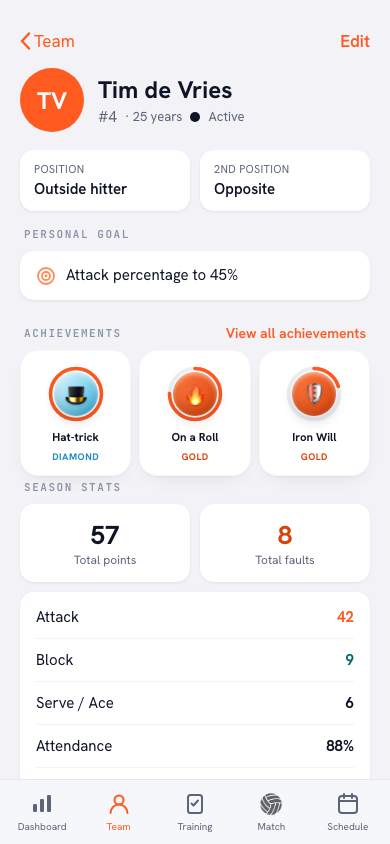
- Use achievements generously: milestones work double with youth — first ace, first 10-point match, ten practices in a row.
Playing time: the fairest development tool
Nothing stunts youth development like a permanent bench. Use a visible, simple rule — everyone plays at least one full set every match — and use your records to check yourself: the playing time distribution over a season does not lie. Parents and kids who know the rule also accept the Saturday when it costs a set.
And the parents?
Data is your ally along the sideline: the conversation "why isn't my kid playing more?" changes completely when you can show a growth chart and an attendance overview. Development becomes debatable instead of a matter of feelings — and the coach who can show that every child is growing has calm parents.
The winter-break question: halfway through the season, ask yourself one question per child — "are they playing volleyball with more joy and more skill than in September?" Two yeses is a successful half season, whatever the table says.
Frequently asked questions
Should I even keep statistics for youth players?
Yes, but through the growth lens: numbers to show each child their own progress, never to rank children against each other. The recording is the same; the communication makes the difference.
How do I handle the talent who can already do everything?
Give them growth goals outside their comfort zone (a new position, harder tasks) instead of letting them carry the team. The biggest risk for a standout is learning nothing new for three years.
What do I say to parents who only look at the score?
Show the development: their child's growth chart, the new skills, the playing time distribution. And state your policy explicitly at the start of the season — managing expectations upfront saves arguments afterwards.


Try it yourself in Koach
Less admin, more coaching — starting at your next practice.
Get started with KoachOr read first what the volleyball coaching app does.