
Should young players see their own stats and errors?
The short answer
Should young players see their stats? Seeing their errors helps players who know what to do with them; a young or insecure player often learns more from what went well. So it depends on the player, not only on age. In Koach you choose with the Players see own errors switch, per team and per player. Coaches always see the errors.
Whether young players should see their stats, errors included, is a choice many coaches would rather not make. A twelve-year-old sees a red 7 next to their name and does not think about their serve, but about themselves. Still, players want to know how they are doing. This article helps you choose and shows how to set it per player.
Why do coaches hesitate to show young players their errors?
An error count is bare. "Four errors" does not say that three of them were serves the player deliberately hit harder, because you asked for that last week. An adult player often puts that number in context themselves. A child of ten or twelve is more likely to see that there are four, and that the teammate next to them had only one.
The risk is that a player starts playing it safe: serving softer, letting the hard ball go, not risking an attack. The error column gets shorter, but the player does not grow. The article on error load per player calls that the difference between investment errors and loss errors: one kind of error is part of daring, the other only costs points. A counter does not make that distinction.
At the same time, hiding is not a cure-all. A player who does not know that they shank five passes every match cannot work on it in a targeted way either. So the question is not whether a player should know their errors, but how they get to see them.
What does research say about feedback after good and bad attempts?
We do not know of any research on error counters in a volleyball app. There is research on the question of after which attempts feedback helps most. In a study by Chiviacowsky and Wulf (2007), adults threw beanbags at a target with their non-dominant hand. One group heard after each block how their three best throws had been, the other group how their three worst had been. During practice the groups performed the same, but on a test without feedback the group that got feedback after good throws did better (summary of the study).
With children the picture is mixed. Saemi, Wulf and colleagues (2011) repeated the setup with 28 primary school children of around ten years old. There too, the children who got feedback after their best throws learned more, and they felt more competent (the article). A study by Chiviacowsky and colleagues with 40 children, on the other hand, found no difference between the groups (summary).
So do not draw a hard rule from this: these are small groups and a throwing task, not volleyball and not a stat on a phone. What you can take from it: feedback also works through motivation, and with a young player you can make success at least as visible as errors.
When does it help to show young players their errors?
The choice depends more on the player than on their year of birth. This is our own judgement, not a rule from any federation:
| Situation | What we would choose |
|---|---|
| Young players, just starting with matches | Hide errors; show points and rallies played |
| A player who shuts down after an error | Hide them for that player, even in an older team |
| Older youth players with a goal of their own | Show them, and discuss one type of error at a time |
| A player who asks where they give away points | Show them, and look at the numbers together |
Visible errors work best when they belong to a goal ("fewer serve errors than last month") and when the player sees their points next to them. How to choose and follow that goal is in tracking player development in volleyball. For the wider story about growing as a youth player: growing youth players. Which stats you track at each age in the first place is in stats in youth volleyball.
How to set it in Koach: per team and per player
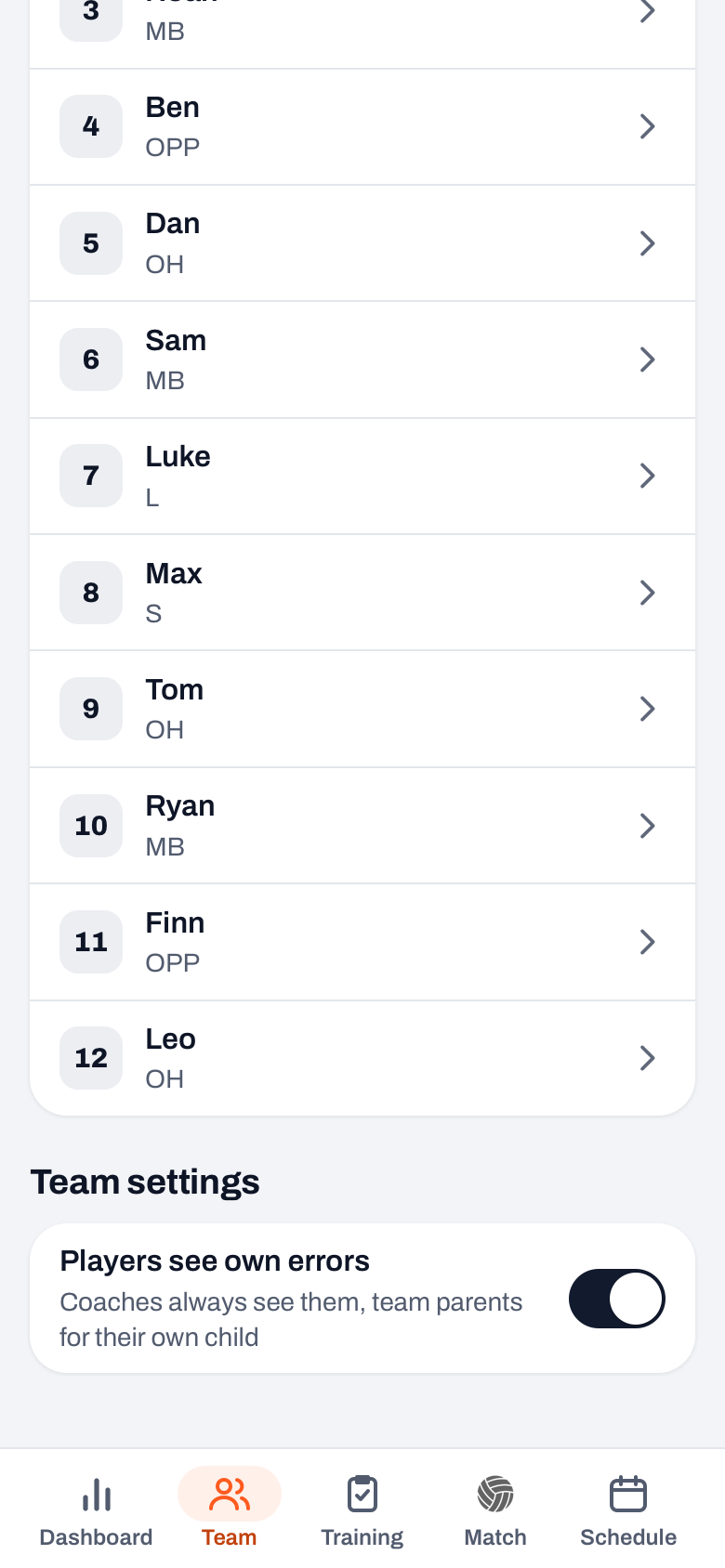
- For the whole team. Open Team and scroll below the player list to Team settings. There you find the Players see own errors switch, with Coaches always see them, team parents for their own child below it. The switch is on by default. If you turn it off, no player sees their own error counts anymore, except those you set to Visible individually.
- For one player. Tap the player, then the pencil at the top right (Edit player). Under In the team you find Sees own errors with three choices: Team setting (the player follows the team), Visible or Hidden. Tap Save.
- Back to one rule. If players differ from the team, the team setting says so, for example 2 players differ, with the button Everyone follows the team.
Only coaches can set this. A player cannot change their own setting.
14 days free, no credit card. Add your youth team, choose per player what they see and check after a month how they respond to their own numbers.
Try Koach with your teamWhat does a player see when their errors are hidden?
Hiding is about what the player sees on their own screen. Nothing is deleted: errors are still recorded, and if you turn the switch back on, everything is there again.
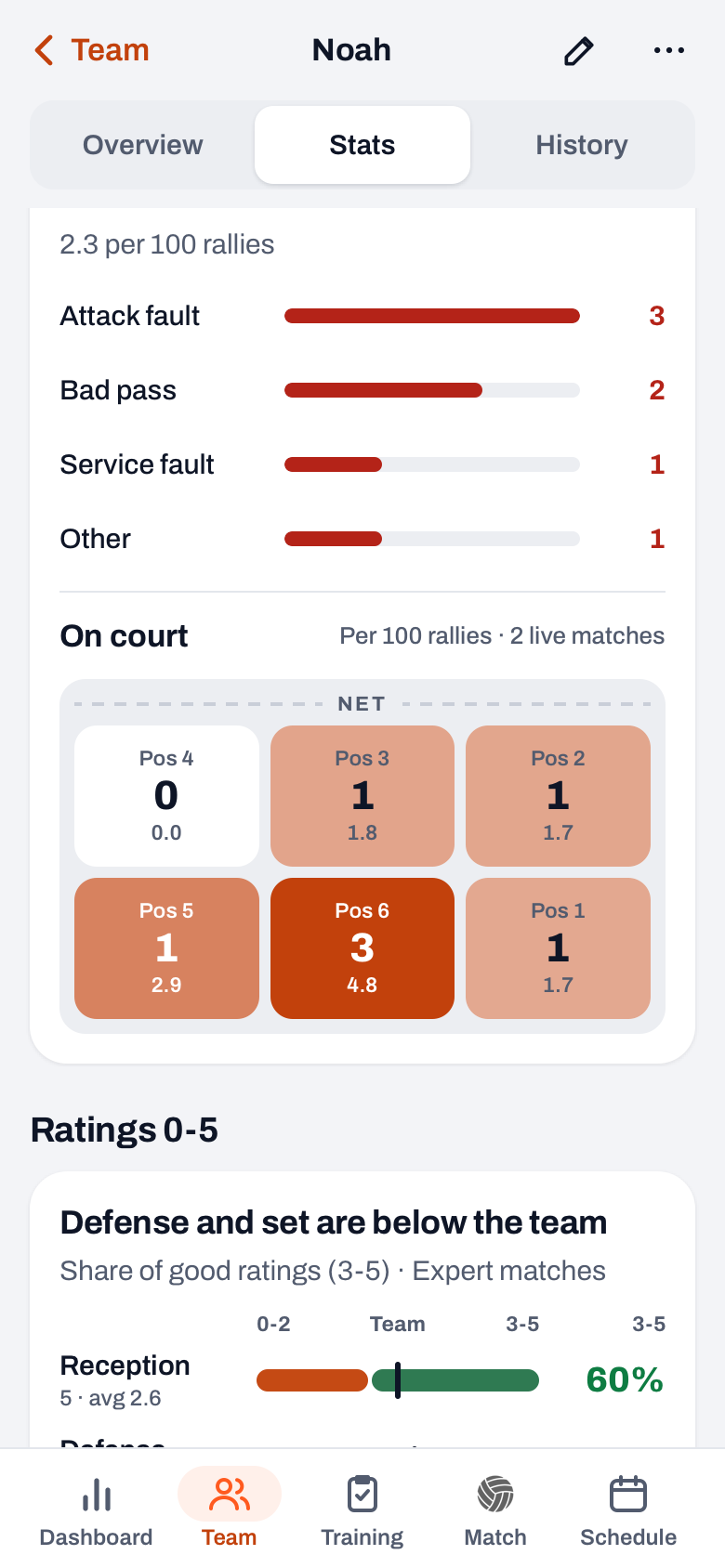
- In their profile the Errors block with the small On court diagram disappears, and so do the insight line about errors, the Errors option under Per match and the error counts under Rotations and positions and in the match list under History.
- For a played match they see no Errors tile and no error column in their rotation table. On the tournament screen they see their points without an error count.
- What stays: in an Expert match every ball contact gets a rating from 0 to 5. The player does see those ratings, zeros included, and the attack block in their profile shows the share of attacks that went wrong. So hiding removes the counters, not every trace of an error.
Coaches always see the errors. So do parents, as far as they see match stats: a team parent sees their child's errors for a played match, even if they are hidden from the child. A regular parent sees no match stats. How that works is in seeing your child's volleyball stats as a parent.
In Koach a player also only sees their own numbers, no team totals and no teammates' profiles. So there is no ranking on which they can put their errors next to someone else's.
Both plans include this setting; what Koach costs after the trial is on the pricing page.
Say it out loud. If you hide the errors, tell your team why: you want them to take risks, and you discuss errors together at practice. Otherwise a player thinks something is wrong with the app.
Frequently asked questions
Is it bad to let kids see their errors?
Not necessarily. A child who knows where they give away points can work on it in a targeted way. The risk is in a bare number without explanation: then a young player starts playing carefully to keep the counter low. Ideally, show errors next to the points, link them to one goal and discuss them together. For an insecure player you can hide them individually.
Do parents see the errors if I hide them from players?
Parents do not see a player profile. A team parent can open a played match and sees their own child's numbers there, errors included, even if they are hidden from the child. A regular parent sees no match stats in the app. Coaches always see the errors, whatever you set.
Can a player switch the setting back themselves?
No. Only the team's coaches can change the Players see own errors switch or choose Sees own errors for a player. A player does not see the setting and cannot change it. If a player wants to see their errors after all, you set them to Visible in Edit player.
What does Koach cost for a youth team?
You can try Koach free for 14 days, with no credit card and every feature. After that you choose Coach for one team with two coaches, or Club for unlimited teams; the amounts are on the pricing page. The player account is free, so your youth players pay nothing to see their own numbers.
Choose what your youth players see
14 days free, no credit card. Set it per team and per player.
Get started with KoachOr read first what the volleyball coaching app does.