
Error load per player: risk versus return
A team that never makes errors is doing something wrong: it isn't taking risks. The error column is not a pillory but a price list — the question per player is whether the return is worth the price.
Good errors, bad errors
Errors are not equal. Investment errors come with daring: the aggressive serve that misses three times a match but also delivers two aces, the hitter who goes for the line. Loss errors yield nothing: the pass that flies off without any pressure, the serve into the net at 23-24, the third net fault by the same blocker. The column counts them the same — the coach is supposed to tell them apart.
Error load per role
- Opposite/outside hitters: the highest acceptable load — they get the hard balls and the most volume. A points-to-errors ratio of 3:1 or better is healthy.
- Middle blockers: average — their errors are often net faults and missed first tempos; watch the trend above all.
- Setter and libero: the lowest load. Their errors are almost always loss errors and deserve attention sooner.
The conversation about errors
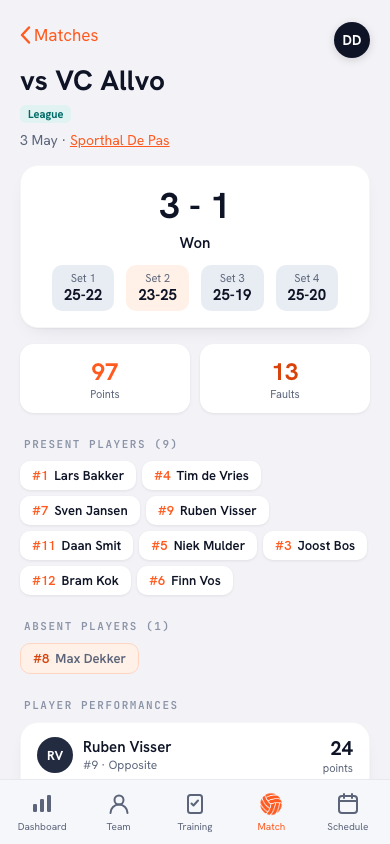
Discuss errors in proportion and in context, never as a bare count. "Four errors" is a reproach; "four errors against eighteen points — fine balance" is an analysis. And look at the moment: errors in the build-up phase of a set are tuition; the same errors after point 20 are a pressure signal that calls for pressure training rather than a lecture. The one-on-one conversation is the place; the group chat never is.
Watch the player without errors. Zero errors across three matches from a hitter is rarely perfection — usually risk avoidance. The question 'what have you stopped trying?' often produces a more important conversation than any error column.
Frequently asked questions
Which errors does the app count per player?
The errors you assign to a player during tracking — service errors, attack errors, net faults. They appear as a separate counter next to the points in the match report.
What is an acceptable points-to-errors ratio?
For attacking players, 3:1 is a healthy rule of thumb (three points per error); for setters and liberos the error counter should stay structurally low. But each player's trend says more than any benchmark.
How do I stop players from fearing the error column?
Consistently name the difference between daring errors and sloppiness errors, and visibly celebrate the investments ('we accept that service error — it comes with your weapon'). Fear comes from counting without context.

Try it yourself in Koach
Less admin, more coaching — starting at your next practice.
Get started with KoachOr read first what the volleyball coaching app does.