
Types of errors in volleyball: see where you give away points
The short answer
The main types of errors in volleyball are serve errors, attack errors (blocked attacks included), bad passes, net and technical faults and rotation faults. For every lost rally, track which error it was and who made it. In Koach you pick the type and the player in the Why did they score? drawer after the point.
Which types of errors in volleyball cost your team the most points? The answer is rarely where your gut puts it. Here are the types of errors side by side, the difference between forced and unforced, a worked example from one set and how to track errors without missing a rally.
What types of errors are there in volleyball?
Every rally ends with a point. If that point goes to the opponent, there are two possibilities: they made a good play, or your team made an error. Those errors fall into a handful of types. Sorting them by the moment in the rally works best, because then you see right away what to train.
- Serve error. The serve goes into the net or out, or the server steps on the end line. The only point you give away without the opponent touching the ball.
- Bad pass. The reception or the dig shanks away and the ball can no longer be played. An ace against belongs here too if your passer touched the ball.
- Attack error. The attack goes out, into the net, or is blocked down on your side. In most stats, hitting percentage included, a blocked attack counts as an attack error.
- Net and line faults. A player touches the net during their action, or a foot crosses completely over the centre line.
- Technical faults. Double contact, a carried ball and four hits. The rules and the borderline cases are in double contact, carried ball and other technical faults.
- Position and rotation faults. Players are not in the right order at the serve, or the wrong player serves. How to prevent that is in preventing positional faults.
- Late. Not a rule violation but a playing error: the ball drops between two players, or nobody gets to a tip or a ball on the line in time.
Forced or unforced error: what is the difference?
You make an unforced error without the opponent putting you under pressure: a serve error, an easy ball hit into the net, a net touch on a ball that was already over. A forced error is one the opponent provokes: a pass that shanks off a hard serve, an attack that runs into a good block, a defender who is just too late for a hard spike. The difference is not a rule but a coach's judgement, which is why it isn't on any scoresheet.
The distinction matters because you tackle the two differently. Unforced errors are about focus, routine and decisions; you reduce them in practice with repetition and clear agreements. Forced errors show where the opponent is stronger. There you train technique under pressure, or you accept them as the price of playing a strong opponent.
And then there is a third kind of point against: their winner. A hard attack nobody could dig or an ace on the line is not an error by your team. Book it as an error anyway and your error list gets longer than it really is, and you end up training the wrong thing.
Worked example: a 21-25 set taken apart
You lose a set 21-25. Afterwards you go through the opponent's 25 points:
| Type | Points against | Forced or unforced |
|---|---|---|
| Serve error | 6 | Unforced |
| Attack error, net or out | 3 | Unforced |
| Attack error, blocked | 2 | Forced |
| Bad pass | 3 | Forced |
| Net or touch | 1 | Unforced |
| Late | 1 | Forced |
| Their winner | 9 | Not an error by your team |
| Total | 25 |
Sixteen of the 25 points were your own errors (6 + 3 + 2 + 3 + 1 + 1). Ten of those were unforced (6 + 3 + 1): ten points the opponent got without doing anything for them. Their winners numbered nine, so fewer than your unforced errors. And the six serve errors alone are more than half of those ten. So the lesson of this set is not that the opponent was too strong, but that the serve cost you the set.
How to track errors without missing a rally
Tracking only works if it is quick. For each lost rally, two things are enough: which type of error it was, and who made it. On paper that is a column per type and a jersey number in the box; in an app it is two taps. Agree on three things beforehand, so every match is counted the same way:
- A blocked attack is an attack error by the attacker, just as in hitting percentage.
- An ace against is a bad pass by whoever touched the ball. If nobody touched it because it landed unplayable on the line, it is their winner.
- When in doubt, don't book an error. A point without a cause is better than a wrong cause; otherwise your biggest leak is no longer right.
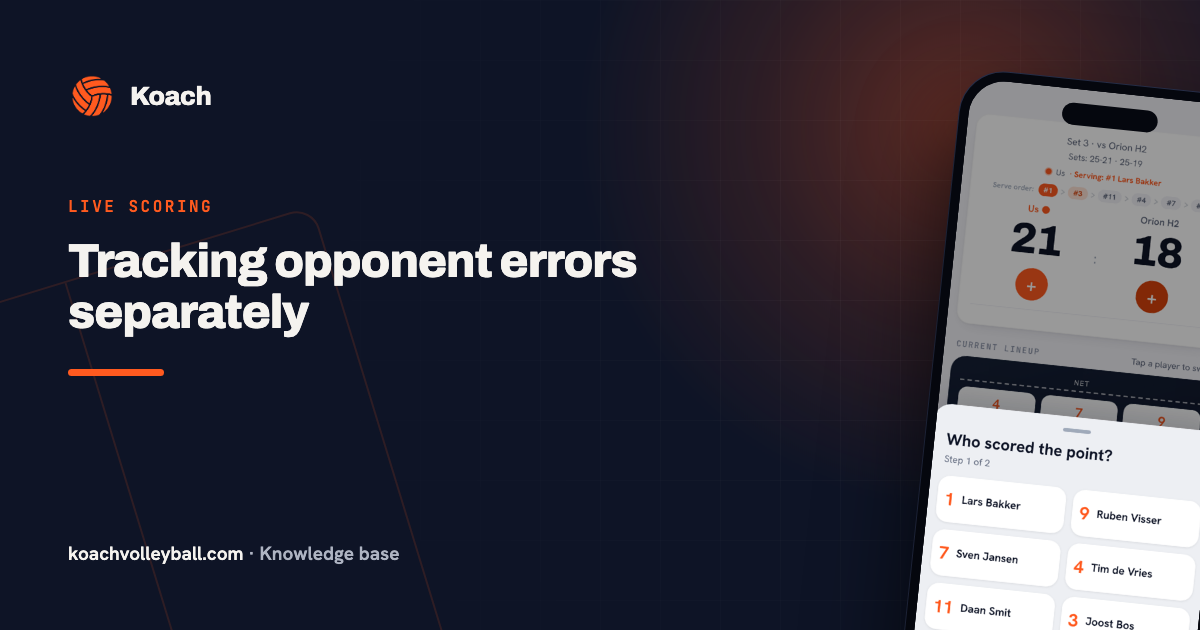
Track the opponent's errors separately: they belong with your points, not with your leaks. How and why is in tracking opponent errors separately.
Tracking errors in Koach: the Why did they score? drawer
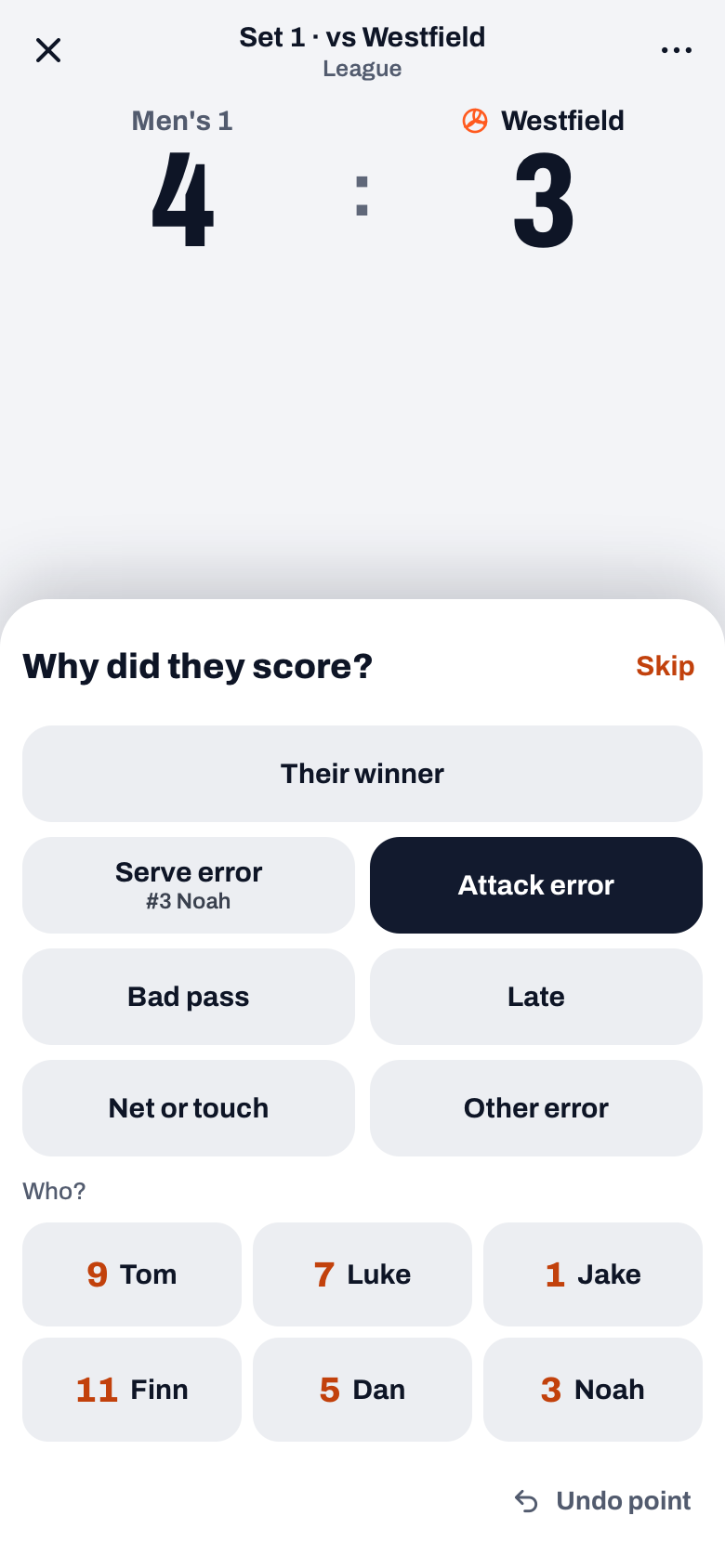
In Koach you record a point for the opponent with one tap on the big button with their name. The point is on the board right away; then the Why did they score? drawer slides up. In Simple mode it contains:
- Their winner: the point counts, without an error by your team.
- Serve error, with your server's name on the button. It only works when your team was serving, and it books straight away.
- Attack error, Bad pass, Late, Net or touch and Other error. Choose the type and tap the player under Who?. Attack error is preselected, so for an attack error tapping the player is enough.
- Skip: the point stays, without an error type. Use it when you didn't see what happened.
If a second coach scores the match in Expert mode, three more types are added: Double touch, Four hits and Rotation fault. In Expert you rate every ball contact from 0 to 5, and a 0 books the error by itself: at the serve a serve error, at the reception a bad pass, at the set a double touch and at the attack an attack error. A 0 at block or dig gives the opponent the point without an error by your team. How that mode works is in scouting your own team.
14 days free, no credit card. Track the errors on Saturday and see in one sentence after the match where your team gave away the most points.
Try Koach with your teamWhat you see after the match: your biggest leak
When you finish the match, the match screen shows one sentence under Summary with your biggest leak: the type of error that occurred most often, and how many of all your errors that was. Below it are the tiles Points, Errors and Top scorer. Under Stats you find the Errors block: a bar per type with the count, and at the top which type cost the most points. With the chips Set 1, Set 2 and so on you see the errors per set, and under Players each player shows how many errors they made.
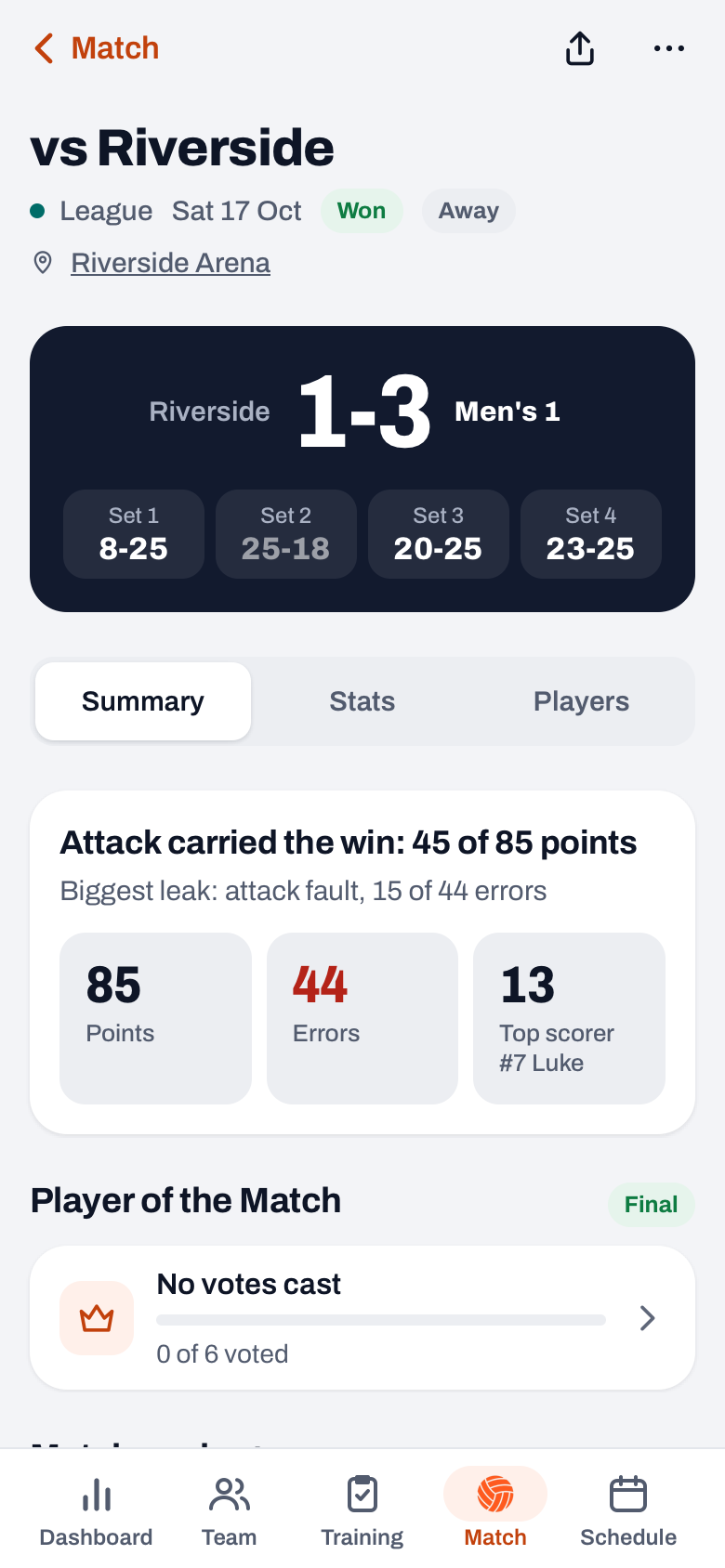
Watch the names. In the drawer the buttons read Serve error, Attack error, Late, Net or touch and Other error; in the stats after the match the same types are called Service fault, Attack fault, Too late, Net fault and Other. And an error without a player does count towards its type, but towards no player at all; the app notes that under the block.
You have it during the match as well. The time-out screen shows Most errors with the type and the count, and at the set break you see the set's errors per type. If one type gave away more points than your best point type earned, the first line says so straight away, for example "Serve error gave away 6 points". Want to know whether a leak persists? On the Match tab, under Played, choose Compare and put a few matches side by side: you see the errors per type per match, and at the top which type is the biggest leak across those matches together.
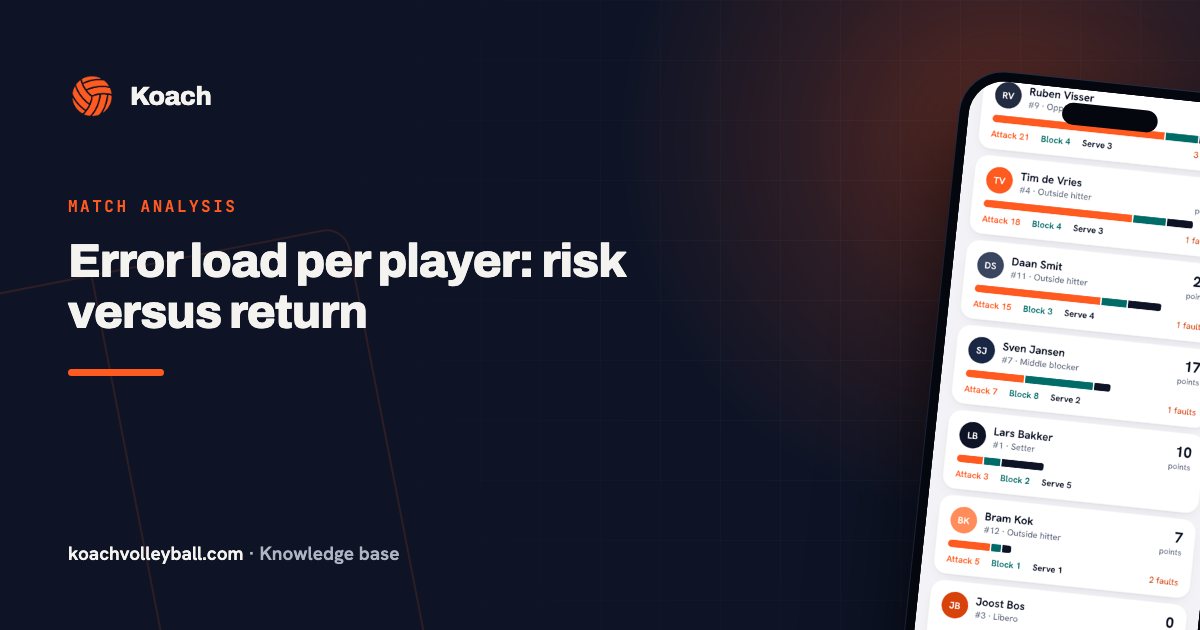
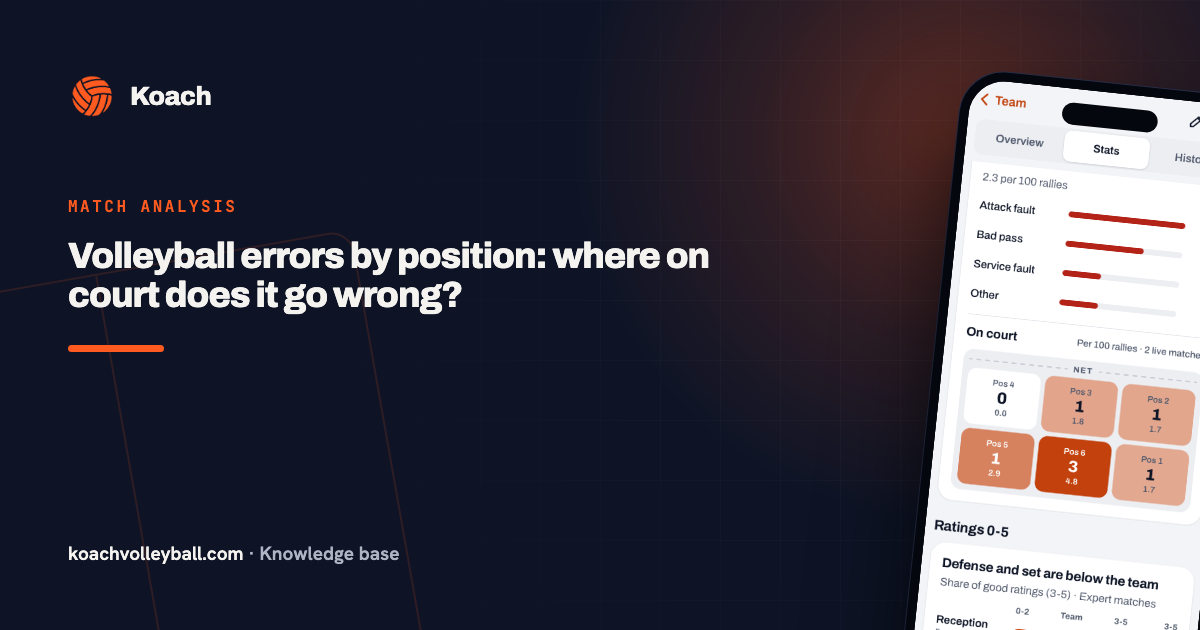
Where on the court and in which rotation those errors happen is in volleyball errors by position. What they mean per player, and when an error is an investment, is in error load per player.
Which error do you tackle first?
Start with the type that comes back most often and is unforced, because that is where you win back points fastest. Six serve errors per set are easier to fix than six points against a strong attacker. Only then look at who: a leak that sits with one player calls for a conversation and a targeted drill; a leak spread across the whole team calls for an agreement for everyone. Don't draw conclusions from one night. How to read numbers like these without being misled by a single match is in understanding volleyball statistics.
Tracking errors costs no extra work in Koach: it is the second tap after every point against. You can try the app free for 14 days with every feature; what it costs after that is on the pricing page.
Agree on the count with your whole staff. Put the three agreements (blocked is an attack error, an ace against is a bad pass, when in doubt no error) on one line in your staff chat. If two coaches count differently, you are measuring their habits and not your team.
Frequently asked questions
What is an unforced error in volleyball?
You make an unforced error without the opponent putting you under pressure, such as a serve error, a net fault or an easy ball hit into the net. A forced error is provoked by the opponent, for example a pass that shanks off a hard serve or an attack that runs into a good block. The distinction is a coach's judgement and is not on any scoresheet, but it helps you choose what to train first.
How do you make a sheet to track errors?
Make a column for each type of error (serve error, attack error, bad pass, net, technical, late) and a column for the opponent's winners. For every lost rally, write the jersey number of whoever made the error in the right column, and start a new line for each set. Afterwards you add up each column. Agree beforehand how you count a blocked attack and an ace against, or your matches won't be comparable.
Is an ace against an error by the passer?
That is an agreement you make as a staff. A workable rule: if your passer touched the ball, it is a bad pass; if the ball landed unplayable on the line without anyone able to reach it, it is the opponent's winner. Keep the same rule in every match, or you won't be able to compare matches with each other.
What does it cost to track errors in Koach?
You can try Koach free for 14 days, with no credit card and with every feature, so including the Why did they score? drawer and the Errors block after the match. After that you choose the Coach or Club plan; the prices are on the pricing page. Tracking errors needs no extra plan: it is part of normal live scoring.
See on Saturday where you give away points
14 days free, no credit card. After one match you'll know your biggest leak.
Get started with KoachOr read first what the volleyball coaching app does.