
Double contact, carried ball and more technical faults explained
No whistle draws as many groans as the one for a 'double contact' or 'carried ball'. Partly justified: they are partly judgment calls, where the referee interprets. But the rules behind them are clearer than the stands often think — including a few exceptions that actually make the game possible.
Double contact: the same player twice in a row
A player may not touch the ball twice in a row. If, on an overhead touch, the ball hits first one hand and then the other, that is formally a double contact — which is why referees whistle on a 'spinning' set: the ball betrays that both hands did not touch it at the same time. But there are two important exceptions:
- The first team contact. On the team's first ball — the serve receive or a defensive dig — the ball may touch several body parts in succession in one action. A hard serve that ricochets off your forearms against your shoulder is therefore not a fault.
- After a block. A block touch does not count as a team contact. The blocker may play the ball again right after, and the team still has three full contacts afterward.
For setters the double contact is the occupational fault: on the overhead set both hands must touch the ball at the same time. How strictly that is judged varies per level — internationally the line has become more lenient in recent years, while in the Dutch game it is generally whistled more strictly.
Carried ball: catching and throwing
The ball must be struck or rebounded, not caught or thrown. As soon as the ball comes to rest in the hands — even for a fraction of a second — the referee whistles for a carried ball (also called 'held', 'lift' or 'held ball'). Typical examples: a low ball 'scooped' up with the palm, an overhead ball that sinks too deep into the fingers, or a one-handed save where the ball is visibly guided. The line is interpretation, but the criterion is fixed: did the ball have one moment of contact, or was it guided?
Four touches
A team has a maximum of three contacts to bring the ball back over the net. If a fourth teammate touches the ball, the referee whistles 'four touches'. Remember the block exception here: the block does not count. Block, defense, set, attack — those are four touches but three team contacts, and completely legal. If two teammates touch the ball at the same time, that counts as two contacts (except on the block), and each of them may then simply play the next ball.
The other technical faults in brief
- Assisted hit: leaning on a teammate or object to reach the ball is a fault.
- Ball under the net: the ball must cross the net between the antennas; under it or outside it is a fault — see also the net-fault rules.
- Attack and block faults by back-row players and the libero: covered in the three-meter-line rules and the libero rules.
- Serving faults: foot fault on the end line, not serving within 8 seconds, or letting the ball drop after the toss without striking it.
How to handle it as a coach
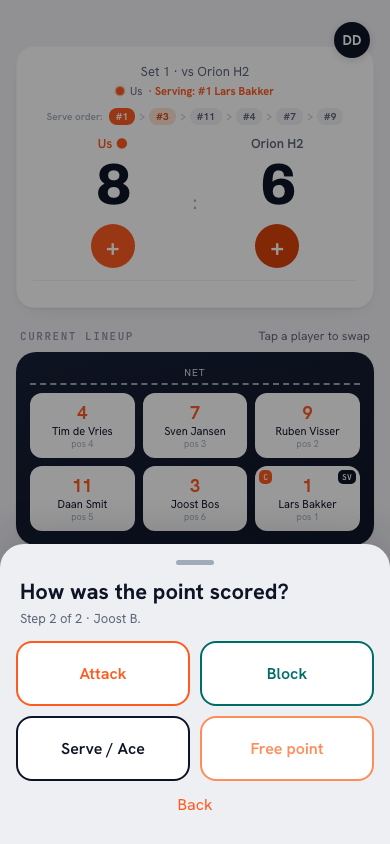
Technical faults are partly level-dependent: for the youngest players the whistle is deliberately lenient to keep the game going, while in the top division every spinning ball stops play. Three practical pieces of advice: teach your players that the first ball allows freedom (one action, several contacts allowed), train the overhead touch until the double contact is gone instead of avoiding the overhead game, and never argue over a carried ball — it is a judgment call no referee reverses. If you tally the fault types during the match, you quickly see whether technically faulty play is structurally costing points — see point types in volleyball.
Did you know: on the first team contact the ball may touch two body parts in succession, but may not be caught. 'Double' on the first ball is therefore almost never a fault — 'carried' always is. Whoever knows that difference understands nine out of ten whistles on the serve receive.
One reassurance to close: at every level the referee whistles to the spirit of that level. What is a double contact in the top division is often simply play-on in the third class. So do not expect an identical line from week to week, but do expect consistency within a single match — and as captain you may politely inquire about that. All the fault categories together are in the overview all volleyball rules in one place.
Frequently asked questions
When is a ball 'carried'?
As soon as the ball is not struck but caught and/or thrown: it visibly comes to rest or is guided instead of rebounded. It is a judgment call by the first referee.
May the ball touch two body parts on the dig?
On the first team contact yes, provided it happens in one action: a serve that ricochets off your arms against your chest is not a fault. On the second and third team contact that does not apply and any double contact is a fault.
Does a block count as one of the three contacts?
No. A block touch does not count as a team contact, and the blocker may play the ball again right after their block. After a block touch the team therefore still has three full contacts.
May you play the ball with your foot?
Yes, the ball may be played with any body part, including foot and leg. The rules on double contact and carrying apply then too; only on the serve must the ball be struck with one hand or arm.


Try it yourself in Koach
Less admin, more coaching.
Get started with KoachOr read first what the volleyball coaching app does.