
Beach volleyball rules: the official 2v2 game explained
The short answer
The key beach volleyball rules: two players per team with no substitutes, sets to 21 and a third set to 15, a court switch every 7 points (every 5 in the third set), a block that counts as a contact, no open-hand tip with loose fingers and a fixed service order. Positions and positional faults do not exist.
Beach volleyball rules look like the indoor ones, until you get whistled for the first time on a set that would have been fine in the gym. These are the official FIVB rules for the 2v2 game, from scoring and court switches to the serve, the net and ball handling, with the rule numbers.
Beach volleyball in short: two against two
A team consists of exactly two players (rule 4.1.1), and there are no substitutions (rule 15.2.2): whoever starts finishes the match. One of the two is the captain and the only one allowed to speak to the referee while the ball is out of play (rule 5.1). In FIVB World and Official Competitions, players may not receive coaching from outside during the match, with exceptions for age group competitions. At a summer tournament the organiser decides.
The game uses the rally point system: every rally wins a point, and the receiving team that wins the rally also gets the serve. You play barefoot unless the referee allows socks or shoes (rules 4.3 and 4.4). The big differences from indoor volleyball are listed in indoor volleyball vs beach volleyball; this article walks through the beach rules themselves. All the indoor rules are in volleyball rules at a glance.
Court, net and ball
The court measures 16 by 8 metres with a free zone of at least 3 metres all around (rule 1.1). The lines are bands 5 centimetres wide and are part of the court: a ball on the line is in. There is no centre line and no attack line (rules 1.3 and 1.4). The service zone is the full width behind the end line. How to lay out such a court and what the sand should be like is in the beach volleyball court and its dimensions.
The net is as high as indoors, and the FIVB gives lower heights for young players (rule 2.1):
| Age | Women | Men |
|---|---|---|
| Seniors | 2.24 m | 2.43 m |
| 16 and under | 2.24 m | 2.24 m |
| 14 and under | 2.12 m | 2.12 m |
| 12 and under | 2.00 m | 2.00 m |
The ball is slightly bigger than an indoor ball and inflated much softer: 66 to 68 centimetres in circumference, 260 to 280 grams and a pressure of 0.175 to 0.225 kg/cm² (rule 3.1).
Scoring, court switches and time-outs
- Sets to 21. You win a set with 21 points and a two-point lead, with no cap: 22-20, 23-21 and so on (rule 6.2).
- Best of three sets. At 1-1 a third set to 15 follows, also with a two-point lead (rule 6.3).
- Toss and warm-up. Before the match the winner of the toss chooses either to serve or receive, or a side of the court, and the loser gets the other choice; in the second set the loser of the toss chooses, and before the third set there is a new toss (rule 7.1). After that you get three minutes of warm-up at the net, or five if you had no other court available beforehand (rule 7.2).
- Court switch. In sets one and two the teams switch sides after every 7 points played, in the third set after every 5, and that happens straight away, without a break (rule 18.2). If a court switch is forgotten, you switch as soon as someone notices and the score stays as it is.
- Time-outs. Each team has one time-out of 30 seconds per set (rules 15.1 and 15.4). In FIVB competitions sets one and two also have a technical time-out when the teams have 21 points between them; the third set does not.
- Pace. There is one minute between sets (rule 18.1). Between the end of a rally and the whistle for the serve there should normally be no more than twelve seconds (rule 16.1).
At summer tournaments with lots of matches this format is often shortened, to a single set or a match played on time. That is up to the organiser; the variations you come across are in the rules for 4v4 beach volleyball.
Serve and service order
On the sand there are no positions and no positional faults (rules 7.4 and 7.5). You can stand wherever you like in your own court, including at the moment of the serve. What is fixed is the service order: the captain hands it in straight after the toss, and it applies for the whole set (rule 7.6). When your team wins back the serve, the player who did not serve last time serves (rule 12.2). If the wrong player serves, the opponent gets the point and the serve.
- Five seconds. You have five seconds after the whistle, not eight as indoors (rule 12.4).
- One toss. If you let the tossed ball drop without hitting it, that counts as your serve. There is no second attempt (rule 12.4).
- The end line. At the moment of the hit or the take-off you do not touch the court, and your foot may not go under the line band. If the band moves because of sand you push away, that is not a fault (rule 12.4).
- No screen. Your partner may not block the view of the server and the path of the ball by waving, jumping or moving sideways, and does not raise their hands above their head during the serve (rule 12.5).
- No blocking or attacking the serve. Blocking a serve is a fault (rule 14.5), and so is attacking a serve while the ball is entirely above the top of the net (rule 13.2.4).
Which serves work on the sand and why is in serving in beach volleyball.
Ball contact: what is different on the sand
- The block counts. A block touch is a team contact, so after it you have two left (rule 14.4.1). The player who blocked may play the next ball.
- The first contact. On your team's first ball, the ball may touch several body parts one after the other, as long as it happens in one action. If you play that first ball overhand with your fingers, that is not allowed: then the contact has to be clean (rule 9.2.2.2).
- A hard driven attack. When you defend a hard driven ball, the contact may last a moment longer, even overhand with your fingers (rule 9.2.2.4).
- Setting over the net. If you set the ball over the net, it has to go straight forward or straight backward relative to the line of your shoulders. Only when you were trying to set it to your partner does that not apply (rule 13.2.5).
- No open-hand tip with loose fingers. An attack with an open hand and loose fingers is a fault (rule 13.2.3). You may place the ball with your knuckles or with straight, closed fingertips, or hit it short and clean with your hand without directing it with your fingers.
- Any part of the body. The ball may touch any part of your body, including your foot (rule 9.2.1), as long as it is not caught or thrown.
Play the first two rallies strictly on purpose. When in doubt, bump set the ball, place the last ball with your knuckles or the heel of your hand, and only set over the net straight forward. That way you find out right away how the referee is calling it that day, without it costing you a point.
At and under the net
Touching the net between the antennae is a fault if it happens while you play the ball, and that includes the take-off and a safe landing (rule 11.3). Touching the net outside the antennae is not a fault. Because there is no centre line, you may go under the net into the opponent's court, as long as you do not interfere with them (rule 11.2). When blocking, your hands may reach over the net, but you only touch the ball there after the opponent's attack hit.
A rule many players do not know: a ball that goes outside the antenna into the opponent's free zone after your team's first contact may still be played back, provided it also comes back outside the antenna on the same side. After the second or third contact that is no longer possible: the ball is out as soon as it crosses the vertical plane of the net (rule 10.1.2).
Players may talk to each other during the match (rule 19.2). The best known form is the blocker's signals behind the back; what they mean is in hand signals in beach volleyball. If a player gets injured, they get a maximum of five minutes of recovery time. If they cannot continue after that, their team is incomplete and loses the match (rules 17.1 and 6.4).
The full text is in the FIVB Official Beach Volleyball Rules 2025-2028. National federations and tournaments can have their own rules for young players and for recreational tournaments.
Tracking beach practice with your indoor team
Koach is built for indoor volleyball: in the live screen a set goes to 25 or 15, so you cannot track an official beach match to 21 with it. If your indoor team heads to the sand in summer, you can use a practice game instead. Put two players in Team A and two in Team B and leave Rotation on: then the server changes at every side-out, just like on the sand. A practice game has no set target; at 21 you start a New round, and the score is saved.
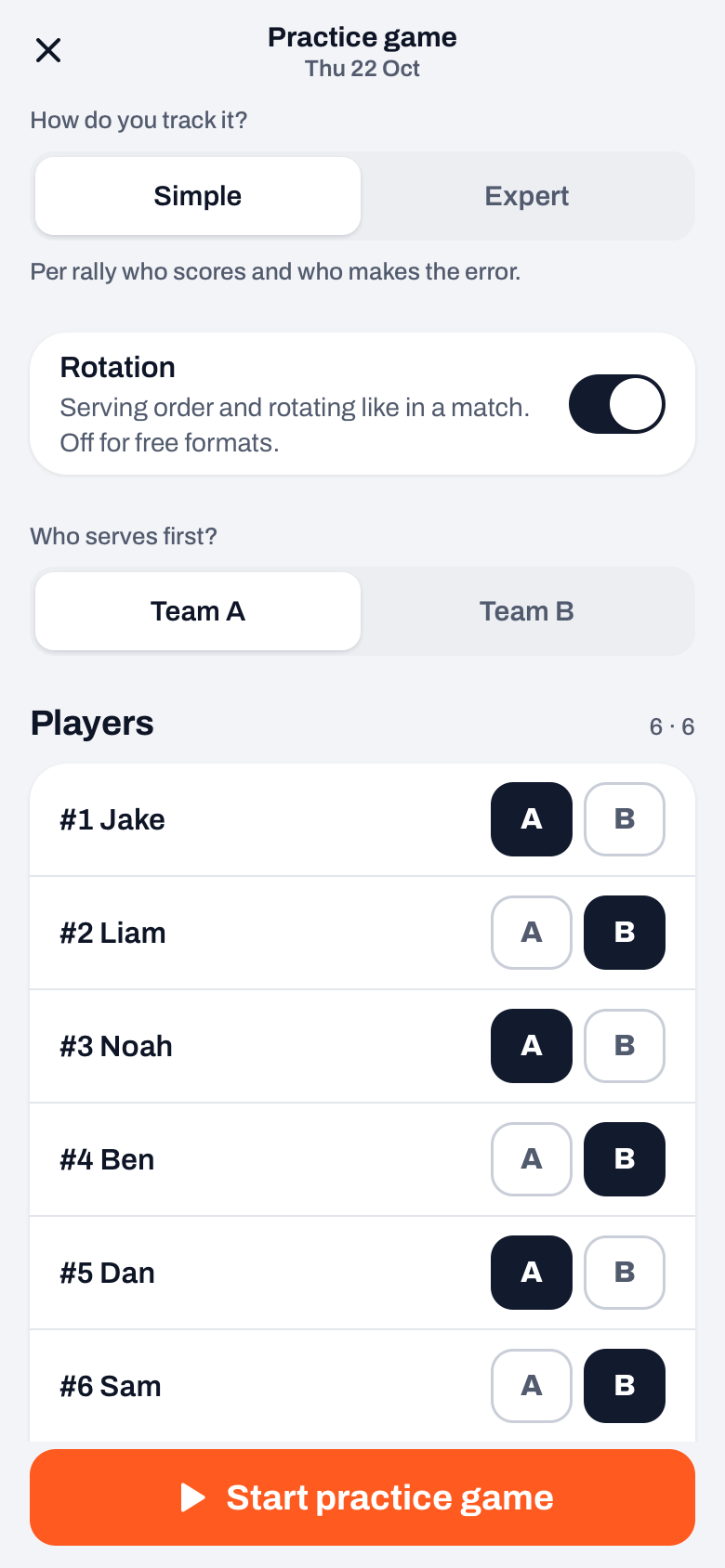
With Finish and save you keep the scores of all rounds and the points and errors for each player; if you track it in Expert, also the average rating per skill. What Koach costs after the 14 free days is on the pricing page.
14 days free, no credit card. Put your next beach practice in your plan as a practice game and see who scores on the sand.
Try Koach at your practiceFrequently asked questions
Can you set the ball in beach volleyball?
Yes, setting is allowed, but the contact has to be clean: no double contact and no ball that comes to rest in your hands. If you set the ball over the net, it has to go straight forward or straight backward relative to your shoulders, unless you were trying to set it to your partner. Only when defending a hard driven attack may the contact last a moment longer.
Can a coach give instructions in beach volleyball?
In FIVB World and Official Competitions, players may not receive coaching from outside during the match, with exceptions for certain age group competitions. At recreational tournaments the organiser decides what is allowed. Talking between the two players is always allowed, including hand signals behind the back.
Can you play beach volleyball in shoes?
Under the rules you play barefoot, unless the first referee allows socks or shoes, for example on hot or cold sand. At recreational tournaments you often see sand socks in the heat. At a tournament, ask the referee or the organisers beforehand.
What happens if you forget to switch sides?
Then you switch as soon as someone notices. The score simply stands: no points are taken off and nothing is replayed. In sets one and two you switch after every 7 points played, in the third set after every 5.

Bring your beach practice into your plan
14 days free, no credit card. After one summer you see who improved on the sand.
Get started with KoachOr read first what the volleyball coaching app does.