
Beach volleyball hand signals: the signs behind the back
The short answer
Beach volleyball hand signals are given by the player at the net behind his back, just before his own team serves. The left hand is for the hitter on the left, the right hand for the one on the right. Common: one finger blocks the line, two fingers the angle; what a fist or open hand means differs per pair.
Beach volleyball hand signals are something you see on almost every serve: the player at the net puts his hands behind his back and holds up fingers. It is an agreement between two players about block and defence that the opponents are not supposed to see. This is how to read the signs, and how to agree on them with your partner.
Who gives the signals, and when?
The signals come from the player at the net while his partner serves, usually the pair's regular blocker. He gives them just before the serve: after that the opponents receive and attack, and by then block and defence must already know what they are doing. When your team is receiving, both players are back to pass, and then there are usually no signals.
Each hand is for one hitter. The left hand is for the player who attacks on the left as seen from the blocker, the right hand for the one on the right. Because you do not know beforehand who gets the serve and who attacks, you always give a signal for both. The hands stay low on the back: that way the opponents do not see them, and the rules forbid players of the serving team from holding their hands above their head while the serve has not yet crossed the net (rule 12.5 of the Official Beach Volleyball Rules 2025-2028).
Talking and giving signals between the two players is simply allowed (rule 19.2.2). A coach on the side, on the other hand, may not pass anything on in FIVB competitions: there, players get no instructions from outside during the match (rule 4.1), with exceptions for age-group competitions. So the signals are the pair's own language. If the blocker serves himself, you go over the plan before he walks back.
What do the hand signals mean?
No rulebook defines the signals; what follows are the common meanings. Two terms first. The line is the ball straight down the sideline, the angle is the cross-court ball. What the block takes away, the defender does not need to dig, and the other way round.
| Signal | Blocker | Defender |
|---|---|---|
| One finger | Blocks the line | Defends the angle |
| Two fingers | Blocks the angle | Defends the line |
| Fist | Agreed per pair: no block, or block the ball | Follows the agreement |
| Open hand | Agreed per pair: block the ball, or no block | Follows the agreement |
| Hand opening and closing | Often: serve at the player on that side | Knows where the serve is going |
Most pairs agree on one and two fingers. On the fist and the open hand, the agreements differ. For one pair the fist means no block: the blocker drops back from the net and you defend together, each taking half of the court. For another pair the fist means block the ball: the blocker jumps right in front of the hitter's hitting arm and the defender reads what comes past the block. Which meaning you pick does not matter, as long as you both use the same one. The serve signal also varies. A common form: opening and closing the hand a few times on the side of the player the server should aim at.
Advanced pairs sometimes add a signal for a fake: the blocker first shows one side and takes away the other at the last moment. Which signal that is, for example three or four fingers, differs per pair. Only start on that once the basics run blind.
Adjusting during the rally: calling instead of signals
A signal sets the plan for the first attack after the serve. After that there is no time to put your hands behind your back, and you talk. After the set both players see where the hitter is approaching and how far the ball is from the net. If the set is far off the net, blocking makes little sense and the blocker calls that he is dropping back. Some pairs let the defender still adjust out loud with "line" or "angle" during the approach, because he sees the hitter better from behind. Agree beforehand who has the final word, or you will go two different ways in the same rally.
Indoors, "signals" mainly means a different system: the setter's attack codes, which tell the hitters which set is coming. On the sand the signals are about block and defence. How block, defence and serve fit together in two against two is in beach volleyball tactics; the rules themselves are in the beach volleyball rules.
How to agree on the signals with your partner
- Start with three signals. One finger, two fingers and the fist. Agree out loud what the fist means for you.
- Choose who gives the signals. If your pair has a regular blocker, it is him. If you alternate the block, the player at the net gives the signals.
- Confirm. The defender says a short "yes" or repeats the signal. No confirmation means: show it again.
- Choose based on the opponents. Watch in the first rallies where each hitter goes. If he mainly hits the angle, take that away and leave your defender on the line.
- Review at the side switch. Every side switch is a short moment to adjust one thing, such as "left hits everything line".
Always give both hands. Even if you think you know for sure who gets the serve, give a signal for both hitters. The serve goes slightly differently than planned, the other player passes, and then your defender has no plan.
Practising hand signals at training
- Signal and ball. The coach stands on a box on the other side of the net and hits line or angle. Before every ball the blocker gives a signal; the defender has to be where the block is not. One point for every dug ball in the right zone, ten balls, then switch.
- Serve on the signal. The player at the net shows with the opening and closing hand who the serve should go to. Count how many serves land on the right side. It also trains the server to look.
- Two against two with double points. Before every serve the serving pair gives a signal for both hitters. A point that starts with a dug ball in the agreed zone counts double.
More sand drills for an indoor team are in beach volleyball drills, and the thinking about choices in block and defence starts with the basics of volleyball tactics.
Block signals in your practice plan
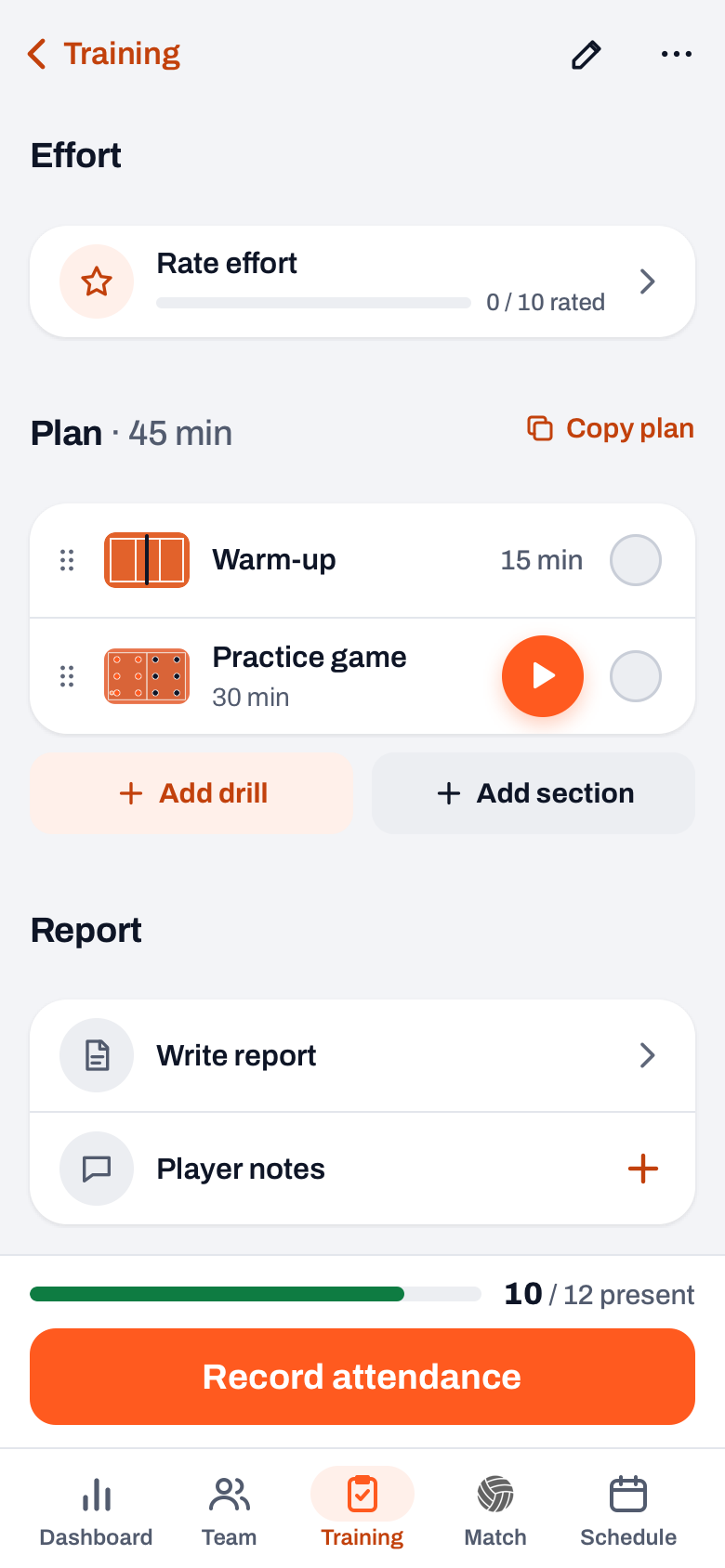
Koach is built for indoor volleyball; you cannot track an official beach match to 21 with it. If your team goes onto the sand in summer, you can still simply put the drills above in that practice's plan. With + Add section you make your own block, for example "Block signals", with a duration and a description in which you write down the signals and your agreement about the fist. If it worked, you bring the plan back for the next sand practice with Copy plan.
What Koach costs after the 14 free days is on the pricing page.
14 days free, no credit card. Put your first sand practice with block signals in your plan and copy it to next week.
Plan your practice in KoachFrequently asked questions
Why do beach volleyball players put their hands behind their back?
To show their partner what they are going to do, without the opponents seeing it. Just before his own team serves, the player at the net gives a signal with each hand: the left hand for the hitter on the left, the right hand for the one on the right. That way blocker and defender know before the attack who takes which ball.
What does a fist mean in beach volleyball?
That differs per pair. For one pair the fist means no block: the blocker drops back from the net and the two players defend together. For another pair the fist means block the ball: the blocker jumps right in front of the hitter's hitting arm. So agree with your partner beforehand what the fist means for you.
Which hand is for which hitter?
The left hand is for the hitter who attacks on the left as seen from the blocker, the right hand for the hitter on the right. Because the blocker stands with his back to his partner, the defender sees left and right exactly as the blocker means them. Always give a signal for both hitters.
Do indoor volleyball players use hand signals too?
Yes, but usually a different kind. Indoors it is mainly the setter who gives signals to his hitters, about which set is coming after a good pass. On the sand the signals are about block and defence and come from the player at the net. In both cases a signal only works if everyone knows the same system.
Put your sand practice in your plan
14 days free, no credit card. Next week you copy it with one tap.
Get started with KoachOr read first what the volleyball coaching app does.