
Beach volleyball strategy for beginners: who blocks, who defends
The short answer
Beach volleyball strategy comes down to three agreements in your pair: who blocks and who defends, who takes the ball in the middle, and which side the block closes so the defender takes the other. With your serve you also pick the attacker, because on sand the passer nearly always attacks.
Beach volleyball strategy starts with a question that never comes up indoors: which of you two goes to the net? This article gives beginner pairs and their coaches the basic agreements for splitting the roles, the side-out, the block with the defense behind it, the serve and the wind.
What makes beach volleyball strategy different from indoor
Indoors you take a weak passer out of serve receive and set your best hitter more often. On sand you can't. With two players on a half court of eight by eight meters, everyone passes, sets and attacks, and whoever receives the serve is nearly always the attacker of that rally. That is the core of all strategy on sand: the server chooses who attacks, and the receiving pair needs an answer to that.
The building blocks are the same as in indoor volleyball tactics: serve, reception, attack and defense. Two things are added. Wind and sun decide what works on each side. And in official FIVB competitions players get no coaching from outside during the match, so the pair makes every agreement itself, before the match and between rallies. What the rules allow is covered in the beach volleyball rules.
Who blocks and who defends? Splitting the roles in your pair
The first agreement in every pair is who does what when the opponent attacks. There are three ways to split it, and the right one depends on the height and the jump of the two of you.
| System | How it works | Suits |
|---|---|---|
| Fixed roles | One player blocks every rally, the other defends the court behind | A pair with one clearly taller player or better jumper |
| Split block | Whoever is on the attacker's side blocks; the other defends | Two players of about the same height |
| No block | Both stay back and each defends one half | Players who can't get their hands above the net, or a hitter who attacks far from the net |
For beginners, playing without a block is often the best start. A block that is just too low doesn't stop the ball, but it does leave half the court empty. Only once one of you can really get the hands over the net is it worth trying fixed roles. At the top level of beach volleyball, nearly every pair plays with a fixed blocker and a fixed defender.
Fixed roles come at one price. When the blocker serves, he has to reach the net in a few steps after his serve, which is why many blockers serve a little softer. When the defender serves, the blocker is already at the net. His hands stay below his head during the serve, and waving, jumping or stepping sideways to block the view is a screen and therefore a fault.
The side-out: pass, set and attack with two
Receive side by side, each in your own half. A good starting point is two to three meters in front of the end line: in sand it is easier to run forward for a short serve than backward for a deep one.
- Agree who takes the ball in the middle. A serve between you is the cheapest point for the server. Pick one rule, for example that the better passer takes everything in the middle, and call it early.
- Pass high to the middle, not to the net. Aim for the middle of your half, a few meters off the net and higher than indoors. A tight pass to the net blows over or becomes a gift for the block; a high pass in the middle always gives your partner a set.
- Whoever passes, attacks. Your partner sets, and after your pass you first move outside and only then approach. That keeps room for your approach, which on sand usually has two steps instead of three.
- Set high and a meter off the net. Bump setting is normal and safe on sand; hand setting is called more strictly than indoors.
- The setter calls the open spot. After the set your partner looks at the defender across the net and calls one word: "line", "angle", or "nobody" when there is no block. Agree on the words beforehand, and call what is open, not where the defender stands.
For the attack itself you have more options than a hard swing. With a block up, there are three soft shots: the cut shot, a sharp, short angle just behind the net; the high line shot over the block into the deep corner; and the ball pushed over the block with the knuckles, the pokey. A tip with an open hand or loose fingers is a fault on sand; with stiff, closed fingertips, the cobra, it is allowed (beach rule 13.2.3). Beginners score more with a placed ball into an open spot than with power straight at the defender.
Block and defense: one side closed, the other side open
The main rule: the block takes one side, the defender the other. If the blocker blocks the line, the defender plays angle. If he blocks the angle, the defender stays on the line. Before the serve the blocker shows behind his back what he plans, with one signal per hand for each of the two attackers. What those signals mean is in beach volleyball hand signals.
The weak spot is always the ball over or around the block. If your partner blocks the line, you as the defender have to cover the angle plus the high line shot and the cut shot. That only works if you read instead of guess:
- Be still at the moment the attacker contacts the ball, low and with your weight forward.
- Watch the shoulder and the arm speed. A slow arm or an open hand means a soft shot: go right away.
- If the attacker's shoulders turn toward you, the hard ball is coming to you: hold your ground and dig it high.
When the set is poor and far off the net, blocking makes little sense. The blocker leaves the net, drops back a few meters and defends too; in beach volleyball that is called the pull. Agree who then takes which half, so you don't both dive for the same ball.
Serving with a plan: you choose the attacker
Because the passer usually attacks as well, your serve decides who attacks against you. Four targets that work:
- The player you would rather face on attack. That is not always the weaker passer. A good passer with a predictable attack is a fine target.
- The blocker. If the other pair plays fixed roles, serve the blocker. He has to pass, approach, attack and then still get to the net for his block. After a few rallies in that order, his block gets slower.
- Short, or between the two. A short serve pulls the passer forward and cramps his approach; a ball down the middle creates doubt.
- The player who just played the long rally. Whoever just had to attack three times gets the next serve as well. That way fatigue works for you.
Which serve to use for this, the float, the jump float or the skyball, and how to use the wind in your serve, is covered in serving in beach volleyball.
Wind and sun: a different plan on each side
On sand you play part of the set with the wind and part against it. In sets one and two you switch sides after every seven points played, in the third set after every five (beach rule 18.2). So make a plan for each side:
- Wind at your back. Serves and attacks carry further, so the risk of going out is bigger. Serve flatter, aim well inside the lines and attack more often with a placed ball.
- Wind in your face. The ball hangs and drops sooner, so here you can serve and hit harder. Pass and set lower and a bit closer to the net, because the wind pushes a high ball away from the net.
- Crosswind. Set the ball on the side the wind comes from, so it drifts toward your attacker instead of away from them.
- Sun. If you receive with the sun in your eyes, agree who calls the high ball. Serve a high ball yourself at a player who is looking into the sun.
If you win the toss, the rules let you choose either serve or receive, or the side of the court. In strong wind or with a low sun, the side can be the smarter choice: you then start the set on the side that suits your game.
Agree on three things before the first serve. Who blocks (or whether you both defend), who takes the ball in the middle, and which words the setter calls. Under pressure you won't remember more agreements than that, and these three prevent most of the free points that beginner pairs give away.
Training beach strategy with your indoor team
Many indoor coaches take their team to the sand in summer. Drills for footwork, passing and the two-step approach are in beach volleyball drills for your indoor team. You add the strategy from this article by playing one agreement per block in the two-on-two: first the split without a block, then the line block with the defender on the angle, and only then the serve at a fixed target.
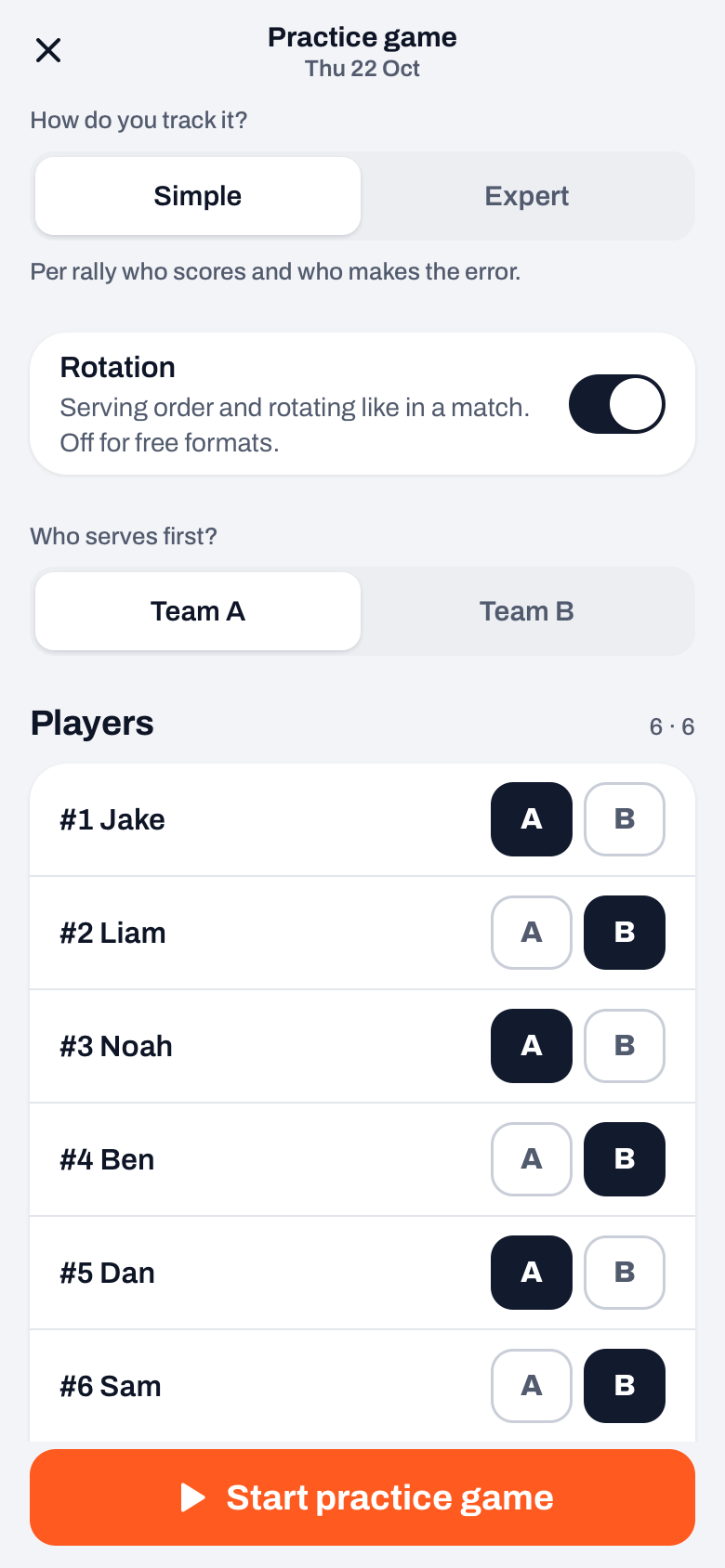
Koach is made for indoor volleyball, but you can track a two-on-two in it as a practice game. Put two players in team A and two in team B, leave Rotation on for a fixed serving order and choose Expert with Serve and Reception as the focus. You then rate every serve and every pass from 0 to 5, and after Finish and save you see the average per player. That shows you in black and white which passer in each pair can't handle the serve, and so who the others should serve at.
What Koach costs after the 14 free days is on the pricing page.
14 days free, no credit card. Put your next sand session in your plan and track the two-on-two as a practice game.
Try Koach at your practiceFrequently asked questions
Who should block in beach volleyball?
Usually the taller player or the better jumper in the pair. With fixed roles they block every rally and their partner defends the court behind. If you are about the same height, whoever is on the attacker's side blocks. If neither of you gets the hands above the net, play without a block and both defend one half.
What is a cut shot in beach volleyball?
A cut shot is a soft, sharp angle attack that lands just behind the net near the sideline. The attacker turns the hand over the ball and plays it past the block, into the space the defender deep in the court can't reach. Along with the high line shot and the knuckle pokey, it is one of the most used soft shots on sand.
What does your partner call on a beach attack?
After the set, the setter looks at the defense across the net and calls where the open spot is, for example "line" or "angle", or "nobody" when there is no block. The attacker keeps their eyes on the ball and trusts that call. Agree beforehand on the words you use, and that you call the open spot, not the spot where the defender stands.
Does beach strategy help indoors too?
Yes, especially reading the attacker and picking a target for your serve. On sand every player has to pass, set and attack, and so make their own decisions. Indoor players who spend a summer playing two-on-two look at the defense more often before they swing. The rotations and the fast tempo of indoor volleyball are not something you train this way.

Track your next two-on-two
14 days free, no credit card. After one practice you know who to serve at.
Get started with KoachOr read first what the volleyball coaching app does.