
Beach volleyball serve: float, jump float and skyball
The short answer
For the beach volleyball serve most players hit a standing float or a jump float; a topspin jump serve and the high skyball are less common. Sand gives you less push-off and wind and sun play a part, so you adjust your toss, approach and target. You have five seconds and one toss.
The beach volleyball serve looks like the indoor serve, until the wind pushes your float sideways. On the sand you play two against two, you jump less high and you play outdoors, and that changes which serve you choose and how you hit it. Here you read which serves work, how to adjust them to sand, wind and sun, and what the rules say.
Which serve do you hit in beach volleyball?
The serves are the same as indoors. What each serve is technically and what the ball does is in types of volleyball serves; how the serve relates to the other fundamentals is in learning volleyball technique. On the sand it is mainly the choice that shifts:
| Serve | On the sand | When |
|---|---|---|
| Standing float | Floats and reacts strongly to wind, costs little strength | At every level, the basis |
| Jump float | Contacted higher and flatter, also floats, needs an approach through the sand | Advanced players who have mastered the standing float |
| Topspin jump serve | Hard and dipping, but the push-off in sand costs a lot and the high toss blows away | Strong jumpers, with little wind |
| Skyball | Hit underhand or sidearm very high, drops almost vertically | In sun or wind, as a surprise |
Two things make the float a logical choice on the sand. Wind makes a ball without spin move even more erratically. And every jump costs more in soft sand, while right after your serve you are one of the two defenders. On a tournament day with several matches you feel that in your legs. The jump float sits in between: more pressure than a standing float, without the full jump of a topspin serve. How to build it up is in the jump float serve.
What sand changes about your technique
- Standing float: a firm base. Set your feet slightly wider than indoors and press them a few centimeters into the sand. Take a small step forward, so you do not sink away as you hit. Toss low and straight in front of your hitting shoulder; the lower the toss, the less grip the wind has on it.
- Jump float: a shorter approach. One or two steps is enough. In sand a long approach gives you little speed and mostly costs strength. The push-off is deeper and slower than on a floor. Toss the ball slightly further forward and no higher than necessary.
- Topspin jump serve: only with little wind. The high toss is the weak point. If it is windy, choose a float, even if indoors you always jump serve with topspin.
- The end line. Your foot must not go under the boundary line. If the line shifts because you push sand away, that is not a fault.
- After the contact. You are immediately a defender or blocker. Agree with your partner who blocks after the serve, and move straight to your spot. A serve that leaves you off balance in the sand costs you the next ball.
Serving in the wind
- Into the wind. You serve against the wind. The wind slows the ball and makes a float move more, so you can hit harder without it going out. Aim deep.
- With the wind. The wind is at your back. The ball carries further and floats less. Hit softer and aim shorter, for example at the front half of the court.
- Crosswind. The ball drifts. Aim towards the side the wind is coming from, so it blows into the court, or let it drift towards a passer's sideline on purpose.
In the warm-up, look at flags or trees and serve a few balls from both sides. You switch sides every 7 points in sets one and two and every 5 in the third set (Rule 18.2), so the wind changes often. Adjust your target on the first serve after every side switch, not only after the first error.
Say out loud what you adjust. In practice, have players call out one word on every serve: deeper, shorter, left, right. Players who put into words what the wind does to the ball adapt faster in a match than players who serve on feel.
Serving into the sun: the skyball
For the skyball you stand sideways or with your chest to the court, and contact the ball underhand or sidearm, low and behind its center, so it goes very high. It drops almost vertically and with speed, and the passer has to look up the whole time. It works best when the receiver looks into the sun while tracking it, or when the wind makes the ball drift as it falls. Without sun or wind it is an easy ball to pass, and in strong wind it blows out. So use it as a surprise, not as your regular serve.
If you are the one receiving in the sun: the rules allow a cap or headwear (Rule 4.3), and glasses or sunglasses at your own risk (Rule 4.5).
Where do you aim your serve?
In two against two the ball usually falls so that whoever passes also attacks afterwards. So when you choose whom you serve, you also choose who has to attack. Four targets you can always use:
- The player you want to make attack, for example the weaker attacker or whoever just played a long rally.
- The seam between the two players, so they have to decide who takes it.
- Short, so the passer has to come forward and then has less room for the approach.
- Deep in the corner or down the line, so the pass comes from far away.
Agree the target with your partner, so the blocker knows which attack is likely to come. How the pair then blocks and defends is in beach volleyball strategy. And hold on to one rule: a service error gives the opponents a point without them having to do anything.
Serving rules on the sand
A few serving rules differ from indoor volleyball. According to the FIVB Official Beach Volleyball Rules 2025-2028:
- Five seconds and one toss. You hit within five seconds of the whistle. If you let the tossed ball drop without touching it, that counts as your serve (Rule 12.4).
- The service zone is 8 meters wide behind the end line. You may move within it, but at the moment of the hit or the take-off you do not touch the court or the ground outside the zone (Rules 1.4 and 12.4).
- Serving order. If your team wins the rally on its own serve, the same player serves again. If you win the rally on the opponents' serve, you get the serve and the player who did not serve last time serves (Rule 12.2).
- No screening. Your partner may not wave arms, jump or move sideways to hide the server and the flight path of the ball, and does not raise their hands above their head until the ball has crossed the net (Rule 12.5).
- The net. A serve may touch the net (Rule 10.2). The opponents may not block your serve (Rule 14.5) and may not attack it while it is completely higher than the top of the net (Rule 13.2.4).
All the other rules, from scoring to the poke shot, are in the beach volleyball rules, and the full text is at the FIVB.
Three drills for your beach serve
- Zones with wind. Place four targets on the court: two deep corners, the line and short in the middle. Serve ten balls per side at a fixed target and then switch sides, just like a side switch in a match. Count how many balls land in the zone, for each side separately.
- Serve and defend. Serve, move straight to your defensive spot and play the ball your partner hits at you from the other side. Eight reps, then switch. That trains the moment after the serve, which is missing from a standalone serving drill.
- Points on serve. Serve in series of five. A serve in the zone is one point, a serve in the court outside the zone zero, an error minus two. Do it at the end of practice, when you are tired.
A full sand session for an indoor team, in which this block fits, is in beach volleyball drills for your indoor team.
Measuring your beach serve in Koach
Koach is made for indoor volleyball, and you cannot track an official beach match to 21 with it. You can track a beach session with your team as a practice game. Put two players in team A and two in team B and leave Rotation on: then the server changes at every side-out, as on the sand. Choose Expert mode and Serve as the focus. Then you rate every serve, from 0 Error via Easy, Fair, Tough and Free ball to 5 Ace, for both teams. For the rest of the rally you just pick who wins.
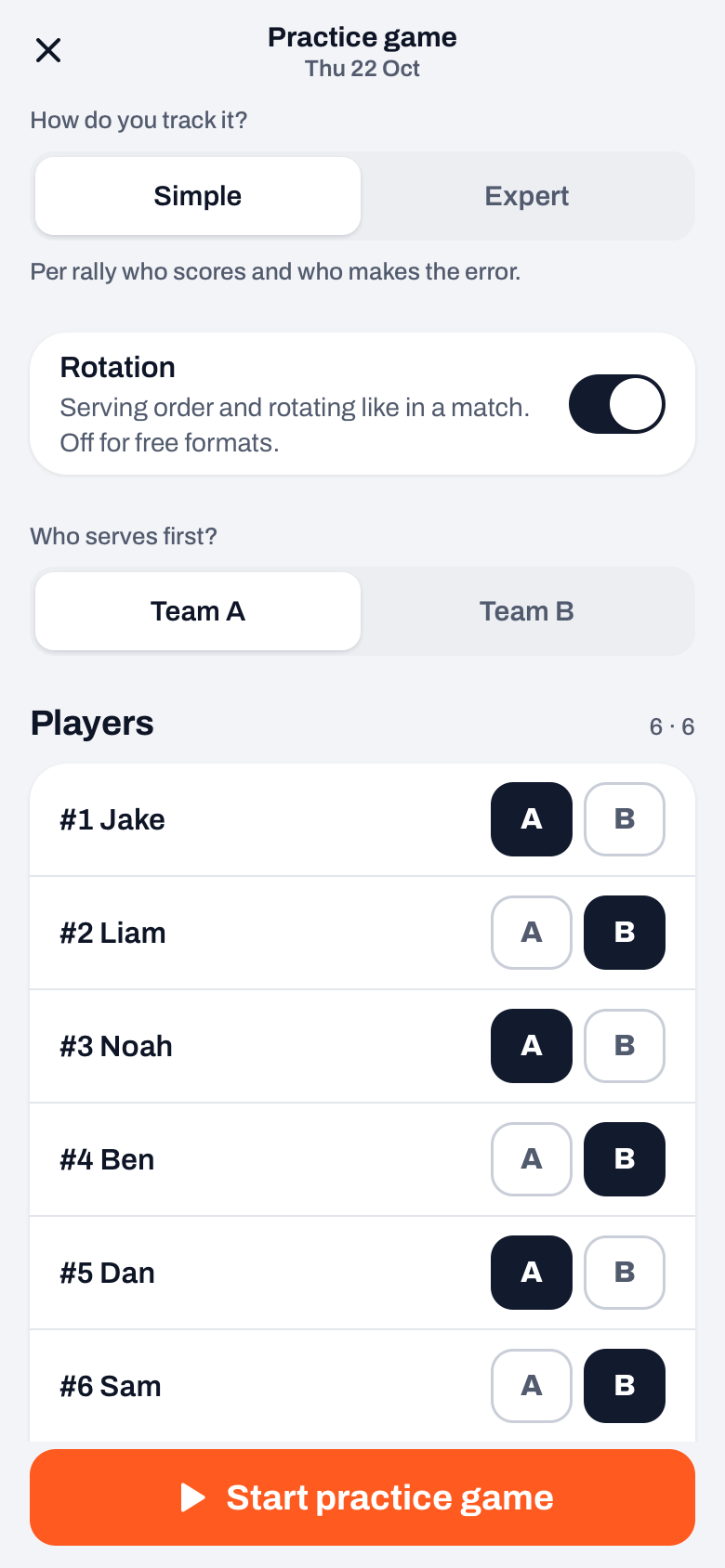
After a few sessions you see per player whether their serve puts on pressure or mostly gives away easy balls. The ratings are saved separately and do not count as a match. What Koach costs after the 14 free days is on the pricing page.
14 days free, no credit card. Put your next beach session in your plan as a practice game and rate every serve.
Try Koach at your practiceFrequently asked questions
Which serve is used most in beach volleyball?
The standing float and the jump float. A ball without spin moves even more erratically in the wind than indoors, and a float costs little strength, which matters when you have to defend right after your serve. The topspin jump serve is less common, because the push-off in sand is heavy and the high toss can blow away. The skyball is a surprise for sun or wind.
How many seconds do you have to serve in beach volleyball?
Five seconds after the first referee's whistle, according to the FIVB Official Beach Volleyball Rules. Indoors it is eight seconds. You may toss the ball once; if you let it drop without touching it, that counts as your serve and the point goes to the opponents.
Can you serve underhand in beach volleyball?
Yes. The rules do not prescribe a type of serve: you hit the ball with one hand or any part of the arm after tossing or releasing it. Serving underhand or sidearm is therefore allowed, and the skyball is an example of it. At a higher level, though, a plain underhand serve is easy to pass.
How do you serve in the wind in beach volleyball?
Into the wind you hit harder and aim deep, because the wind slows the ball and makes a float move more. With the wind you hit softer and aim shorter, because the ball carries further. In a crosswind you aim towards the side the wind is coming from. Toss low in the wind and adjust your target after every side switch.

Rate every beach serve
14 days free, no credit card. After a few sessions you see whose serve puts on pressure.
Get started with KoachOr read first what the volleyball coaching app does.