
Types of volleyball serves: every serve side by side
The short answer
The types of volleyball serves are the underhand serve, the standing float and the standing topspin serve, plus two jump serves: the jump float and the topspin jump serve. They differ in what the ball does in the air, how much power and timing they need and how many errors they cost.
There are more types of volleyball serves than underhand and overhand. A float and a standing topspin serve fly completely differently, and there is a big gap in risk between the jump float and the topspin jump serve. Below they sit side by side: what the ball does, who the serve suits and what it costs you.
What types of serves are there in volleyball?
You can group serves in two ways. By how you hit: underhand, overhand from a standing position, or after a jump. And by what the ball does: float without spin or dive with topspin. Combine the two and you are left with five serves that you see at every level. The serve is the only skill in which you have the ball completely in your own hands; how it fits with the other fundamentals is in learning volleyball technique.
| Serve | What the ball does | For whom | Biggest risk |
|---|---|---|---|
| Underhand | High, slow arc | Beginners and the youngest players | Easy to pass |
| Standing float | Floats without spin, drops or swerves late | Every level from the first overhand serve | Does not float if the contact is not clean |
| Standing topspin | Dives forward on a steady path | Players with a good wrist snap | Too short into the net or too long out |
| Jump float | Floats, but flatter and hit from higher | Advanced youth and adult players | Timing of toss and jump |
| Topspin jump serve | Hard and diving | Strong attackers at a high level | Many errors |
Every serve starts with the toss, and it is different for each type: low and still for a float, high and well into the court for a jump serve. The heights and the spot for each serve are in the serve toss.
The underhand serve
The ball rests at hip height in your non-hitting hand, the hitting arm swings forward straight like a pendulum and contacts the ball with the heel of the hand or a fist, below the centre. It takes little power and beginners get it in far more often than an overhand attempt, so rallies get going. The downside is the high, slow arc: as soon as the opponent can pass a little, this serve hands them the attack.
One rule point that often gets missed: under the rules you hit the ball after it has been tossed or released (rule 12.4.1 of the FIVB). So let go of it a fraction before contact. Youth competitions can have their own arrangements. The technique step by step is in the underhand serve.
Overhand from a standing position: float or topspin
The float and the topspin start the same way: feet staggered, the ball in front of your hitting shoulder, weight shifting from back to front. The difference lies entirely in the contact.
The float serve
You hit the ball with an open, firm hand right in the middle and stop the movement almost straight after contact, without a wrist snap. The ball gets no spin, and a ball without spin flies unsteadily: the air breaks away on different sides in turn, so it drops late or swerves sideways. The passer has to adjust until the last moment. That is why the float is the standard serve at many levels: it takes little power and still puts on pressure. Why it floats and how you train the quiet contact is in the float serve.
The standing topspin serve
Here you hit the ball slightly below and behind the centre and snap your wrist over the top. The ball gets forward spin and so dives down faster than a ball without spin. That means you can hit it harder and still have it land in the court. The downside: the path is predictable, and a good passer reads it early. The toss goes higher and slightly in front of your hitting shoulder, so you can contact the ball with a full arm swing from behind and below.
Jump serves: jump float and topspin jump serve
The jump float
After an approach of one or two steps you jump and hit a float at your highest point. The contact is the same as for the standing float; what the jump adds is height. That makes the path flatter and gives the passer less time. The toss does not go higher but further forward, and the timing of toss, approach and jump is the hardest part. For many players this is the step after the standing float, because it needs no extra power. The progression and the reasoning behind the choice are in the jump float serve.
The topspin jump serve
This is a full attack on your own toss: a high toss with topspin, a metre or more into the court, an approach of three or four steps, take-off behind the end line and contact at your highest point with a full arm swing and wrist action. It is the fastest serve and usually produces the most aces, but also the most errors. It loads the shoulder, knees and ankles like an extra spike, so you build up the volume gradually. The pathway is in learning the jump serve.
The hybrid serve
At a high level you also see a hard jump serve with little spin, hit flat over the net, that can drop at the end like a float. It is sometimes called the hybrid serve. It is not a serve to start with: players who hit it have mastered both other jump serves first.
Less common serves
- Skyball. An underhand or sidearm serve that goes extremely high and falls down on a steep line. You see it on the sand, where sun and wind help. Indoors there is usually no room for it.
- Sidearm serve. The arm swings sideways to the ball at shoulder height. Some coaches use it with young players as a step between underhand and overhand.
- Roundhouse or hook serve. The arm rotates in an arc over the head, with a float contact. Seen more often in the past, rare now.
Which serve suits which player?
The order in which players learn them is fairly fixed:
- Underhand, until eight out of ten serves go in.
- Standing float, as soon as a player hits the ball overhand with power and control. For young players that is usually somewhere between ten and thirteen, depending on strength and technique.
- Jump float, once the standing float is reliable from the end line.
- Topspin jump serve, for players with a full attacking movement who are still fresh enough to hit it in the last set.
The standing topspin sits slightly apart: some players hit it as a hard option without a jump, others never hit it. The same rule of thumb applies at every level: a player has one reliable serve for the tight points and at most one serve that puts on pressure. Which one is right is not something you decide on feel but on what it produces: how many aces and forced free balls against how many errors.
What the rules say about each type of serve
The rules do not prescribe a type of serve: underhand, overhand and jump serves are all allowed, and the same rules apply to all of them (rule 12.4 of the Official Volleyball Rules 2025-2028). You have eight seconds after the whistle and one toss, and at the moment of the service hit or the take-off for a jump serve you do not touch the court (the end line included) or the floor outside the service zone. Everything about serving, from the service order to screening, is in the volleyball serving rules.
Test a new serve in scrimmages first, not in league play. Have a player hit only the new serve in every scrimmage for a week and count aces, free balls and errors. Only when it earns net points there does it come along on Saturday.
Measuring which serve works
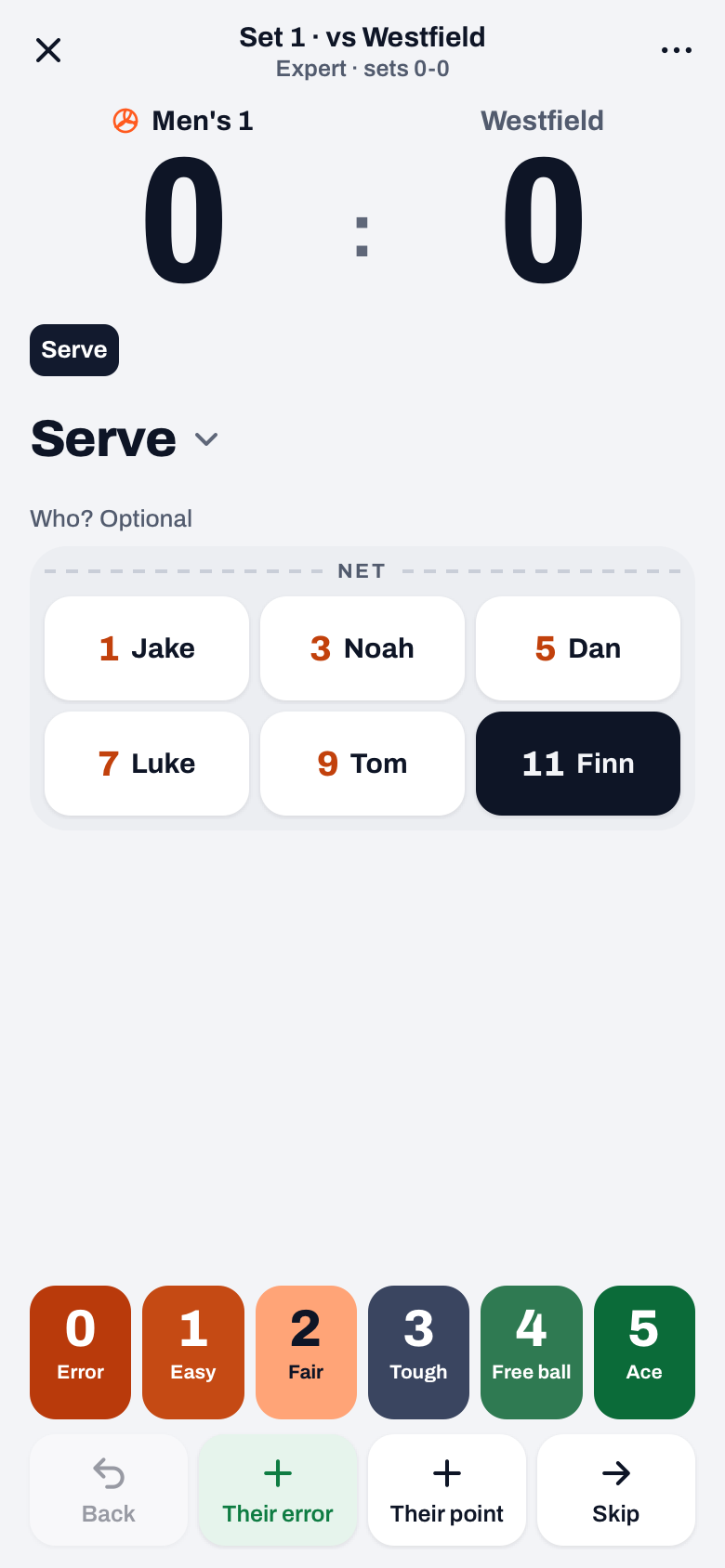
In Koach you track what each serve produced. In Simple mode you tap Ace after an ace, with the server already attached, and Serve error after an error. In Expert mode you give every serve a rating: 0 Error, 1 Easy, 2 Fair, 3 Tough, 4 Free ball and 5 Ace. That way you see not only the aces and errors, but also how often a serve takes the opponent out of their attack.
After a few matches the serve numbers for each player are in their profile, next to those of the team. If you move a player from the standing float to the jump float, you can see across matches whether their numbers go up or down. What Koach costs after the trial is on the pricing page.
14 days free, no credit card. Score your next match in Expert and see for each player which serve wins points.
Measure your serves in KoachFrequently asked questions
Which serve is the hardest to pass?
That depends on the passer, but for many players a well hit float is harder than a hard topspin serve. A float moves late and unpredictably, while a topspin serve has a steady path you can read early. The topspin jump serve is the fastest, but also the serve with the most errors, so over a whole set it does not always produce the most.
What is the difference between a float and a topspin serve?
The difference is in the contact. With a float you hit the ball with a firm, open hand in the middle and stop straight away, so it does not spin and floats unsteadily. With a topspin serve your wrist snaps over the ball, so it spins forward and drops faster. The float is unpredictable, the topspin is faster but easier to read.
Are you allowed to serve underhand in a competitive match?
Yes. The rules do not prescribe a type of serve: underhand, overhand and jump serves are all allowed, as long as you hit the ball with one hand or arm after tossing or releasing it, within eight seconds after the whistle. At higher levels underhand is rarely a smart choice, because the ball is easy to pass.
Which serve should a beginner learn?
A beginner learns the underhand serve first, until eight out of ten serves go in. Next comes the standing float, as soon as they hit the ball overhand with power and control. Jump serves only come once the standing float is reliable from the end line too.


See which serve really wins points
14 days free, no credit card. After three matches you know who should hit which serve.
Get started with KoachOr read first what the volleyball coaching app does.