
Learning volleyball technique: all the fundamentals at a glance
Volleyball is one of the most technical team sports there is: you cannot catch the ball, cannot hold it and usually touch it only once. Whoever masters the fundamentals wins the rallies others give away. This overview lines up every core skill — with the essence of each technique and a link to the full explanation.
Why technique carries so much weight in volleyball
In many sports you can compensate for mediocre technique with strength or stamina. Not in volleyball: every ball contact lasts a fraction of a second and has to be right the first time. A crooked pass is not "almost good" — it makes your entire team's attack impossible. That is why the same law applies at every level: the team with the fewest technical errors wins. Research on amateur-level matches shows time and again that most points are not scored but given away.
The good news: technique can be learned, at any age. The key is the right order and a great many repetitions under gradually increasing pressure.
The six fundamental skills
1. Serving. The only moment the ball is entirely in your own hands. Beginners start with the underhand serve, then move on to the overhand serve, and at higher levels choose between the float serve and the jump serve.
2. Passing (forearms). The forearm pass is the most used technique in the game: every rally for your team starts with it. Platform, posture and footwork decide whether your setter can do anything with the ball.
3. Setting (overhead). With the overhead set you stage the attack. Officially anyone may do it; in practice it is the setter's core job.
4. Attacking. The spike is the best-known weapon. The technique consists of two parts you learn separately: the spike approach with the three-step rhythm and the arm swing itself — see learning to spike in 5 steps. Smart attackers also carry the poke, tip and roll shot in their arsenal.
5. Blocking. The first line of defense at the net. Blocking is about footwork, timing and hand position — height helps, but wins nothing without those three.
6. Defense. Everything behind the block: posture, positioning and, when needed, a dive. See defense in volleyball.
In what order do you learn the skills?
For beginners — youth players and starting adults alike — this progression works best:
- Forearm passing: the technique you need in every rally.
- Underhand serving: so a game can start right away.
- Overhead setting: first from a standstill, then after moving to the ball.
- Spike approach and spike: first the rhythm without a ball, then with one.
- Overhand serving: once the spiking arm swing is in place — it is largely the same movement.
- Blocking and diving: last, because they demand timing and falling technique that must rest on a foundation.
Do not skip steps. A player who wants to spike before the approach is right will hit balls into the net for a whole season — and grooves a rhythm that is hard to correct later.
How to structure a technique practice
Every technical drill ideally moves through three phases: isolated (the movement without time pressure, lots of repetitions), linked (the skill in a chain: pass–set–attack) and game-like (with a net, an opponent and a score). Many coaches linger too long in phase one: neat pepper drills in pairs are comfortable, but the match demands technique under pressure. Rule of thumb: at least a third of your technique time in game forms with a consequence — points, tasks, winners. How to build such a session is covered in structuring a volleyball practice.
Common mistakes when teaching technique
- Too hard, too soon. Putting a skill under pressure before it is stable grooves errors instead of abilities.
- Correcting everything at once. One cue per turn. Nobody remembers "sit lower, extend your arms, feet to the ball and step through".
- Coaching only on results. A pass that happens to land well from a bad position is not a good pass. Judge the movement, not just where the ball ends up.
- Too few repetitions. Technique only becomes automatic after thousands of contacts. Choose drill forms where everyone touches lots of balls instead of standing in line.
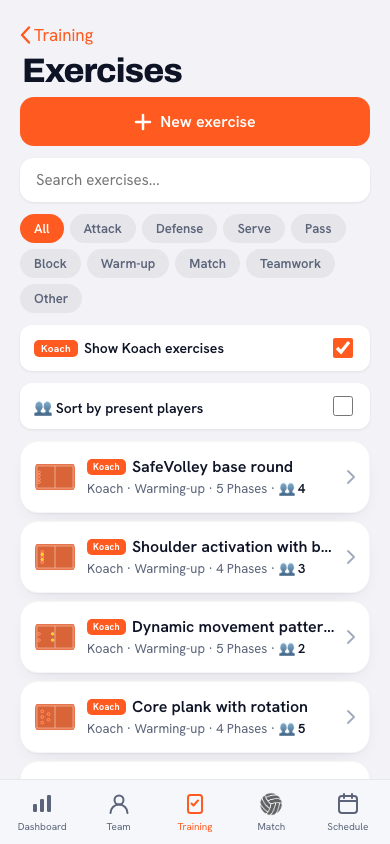
Tip: track one technique point per player at a time and hold on to what you agreed. In an app like Koach you store such a focus point as a note in the player profile, so you can pick it up again next practice.
Technique is never finished
Even at the top professional level, players train passing and serving every week. The difference with beginners is not different techniques but the details: a quieter hand on the float, a half-second earlier takeoff on the block. So treat technique not as a chapter you close, but as a thread running through every season — from the first practice in August to the last match in April.
Frequently asked questions
Which volleyball skill should you learn first?
The forearm pass. It is the most used technique in the game and every rally for your team starts with it. Right after that comes the underhand serve, so you can train in game forms.
How long does it take to master the fundamentals?
Count on one to two seasons for a stable base in passing, serving and setting, provided you train weekly. Making it automatic under match pressure takes longer — technique remains maintenance work even at high levels.
Can you train volleyball technique on your own?
Partly. Serving against a wall or at targets, controlling the ball overhead and on the forearms, and the spike approach without a ball are all fine solo work. For passing, blocking and defense you need teammates.
What is the hardest skill in volleyball?
For most players the spike, because the timing of approach, jump and arm swing has to coincide with a moving ball. For setters, overhead setting at match level is at least as demanding.


Work on technique with purpose, every practice
Plan drills per skill and track where everyone stands — Koach keeps the record while you coach.
Get started with KoachOr read first what the volleyball coaching app does.