
Volleyball serving rules: every rule for the serve on one page
The short answer
The volleyball serving rules are in rule 12 of the FIVB rules. The right back player serves from the service zone, within 8 seconds after the whistle, with one toss and with one hand or arm. The ball may touch the net, but must cross between the antennae and land in the court.
Volleyball serving rules look simple, until an argument starts about a toss you let drop, a foot on the line or a middle blocker raising their hands. Here are all the rules for the serve on one page, according to the FIVB rules 2025-2028, with a link to the details for each topic.
Who serves, and in what order?
The rules below come from the FIVB Official Volleyball Rules 2025-2028, mainly from rule 12. The first serve of set 1 and of a deciding fifth set goes to the team that gets the serve through the toss; the other sets are started by the team that did not serve first in the previous set (rule 12.1).
After that, the rotation decides who serves (rule 12.2). If the serving team wins the rally, the same player serves again. If the receiving team wins, that team rotates one position clockwise and the player who moves from right front to right back serves. If the wrong player serves, that is a rotation fault: point and serve to the opponent, and sometimes points already scored come off the board. Exactly how that works is in serving out of order. Under the FIVB rules the libero never serves (rule 19.3.1).
Where do you stand for the serve?
The service zone is 9 metres wide and lies behind the end line. At the sides it is marked by two short lines of 15 centimetres, 20 centimetres behind the end line in line with the sidelines; to the back it runs to the end of the free zone (rule 1.4.2). At the moment you hit the ball, or for a jump serve at the moment of take-off, you may not touch the court, the end line included, nor the floor outside the service zone (rule 12.4.3). After that you may step or land in the court. The pitfalls, such as the angled approach of a jump server, are in foot faults on the serve.
How must you serve?
- Only after the whistle. The first referee authorises the serve once both teams are ready and the server has the ball (rule 12.3). A serve before the whistle is cancelled and repeated (rule 12.4.5).
- Within 8 seconds. From the whistle you have 8 seconds to hit the ball (rule 12.4.4). More on that in the 8-second rule.
- With one hand or arm. You hit the ball with one hand or any part of one arm, after tossing or releasing it (rule 12.4.1). Underhand, overhand or in a jump makes no difference; hitting with two hands is a fault, including on a jump serve.
- One toss. You may toss or release the ball only once; bouncing it and turning it in your hands beforehand is allowed (rule 12.4.2). So the FIVB rules do not have a second toss after a failed first one. Some competitions do allow one re-serve per term of service, for example US high school volleyball (NFHS); check the rules of your own competition.
When is a serve a fault?
The rules distinguish between faults in the hit itself and faults after it (rule 12.6). During the hit, the serve is a fault if the wrong player serves or if the execution is wrong: a foot on the line, too late, two hands. After a correct hit, the serve is a fault if the ball:
- touches a player of the serving team;
- does not cross the net completely through the crossing space: above the net, between the antennae and their imaginary extension;
- goes out;
- passes over a screen by the serving team (see below).
Touching the net is allowed: the ball may touch the net while crossing it (rule 10.2). A serve that clips the net tape and falls on the other side simply counts; more in a serve that hits the net. With every service fault the opponent gets the point and the serve.
The serving rules in one table
| Situation | Allowed? | Rule |
|---|---|---|
| Hitting with your foot on the end line | No | 12.4.3 |
| Landing in the court after a jump serve | Yes | 12.4.3 |
| Bouncing the ball before you toss | Yes | 12.4.2 |
| Tossing twice | No | 12.4.2 |
| Hitting with two hands | No | 12.4.1 |
| More than 8 seconds after the whistle | No | 12.4.4 |
| Serving before the whistle | Repeated | 12.4.5 |
| Ball touches the net and goes over | Yes | 10.2 |
| Ball crosses the net outside the antenna | No | 12.6.2 |
| Ball touches a teammate of the server | No | 12.6.2 |
| Teammates with hands above their heads during the serve | No | 12.5.3 |
| Blocking the serve | No | 14.5 |
| Attacking the serve from the front zone above the top of the net | No | 13.2.4 |
| The libero serves | No | 19.3.1 |
Count service errors separately by type. A serve into the net, a serve out and a foot fault each call for something different: toss and power, direction, or where your approach starts. In practice, have a substitute tally which of the three it is. After two weeks you know what to work on.
What does the receiving team need to know?
At the moment of the service hit the receiving team must be in the correct rotational order; since the 2025-2028 edition the serving team may take any position (rule 7.4). If the receiving team is out of position, that is a positional fault. If the server makes a fault in the hit at the same moment, the service fault counts; if the serve only goes wrong afterwards, for example out, the positional fault counts (rule 12.7).
Blocking the serve is always a fault (rule 14.5). Attacking it is allowed, except when you hit the ball in the front zone while it is entirely above the top of the net (rule 13.2.4). And the serving team may not prevent the receivers from seeing the server and the flight path of the ball: no screen of players, and no hands above the head until the ball has crossed the net (rule 12.5). When a referee calls a screen is in screening on the serve. The ban on hands above the head is new in the 2025-2028 edition; it is listed with the other changes in the new volleyball rules.
Different serving rules for youth and recreational play
Everything above is the FIVB rules. National federations and competitions adapt them, especially for young players. Examples you come across: a maximum number of serves in a row for the same server, after which the team rotates; a service line closer to the net for the youngest children; a re-serve after a failed toss; or a libero who is allowed to serve. Which rule applies to you is in the rules of your own federation or competition. The full overview of the rules of the game is in all the volleyball rules at a glance.
Tracking serve order and service errors in Koach
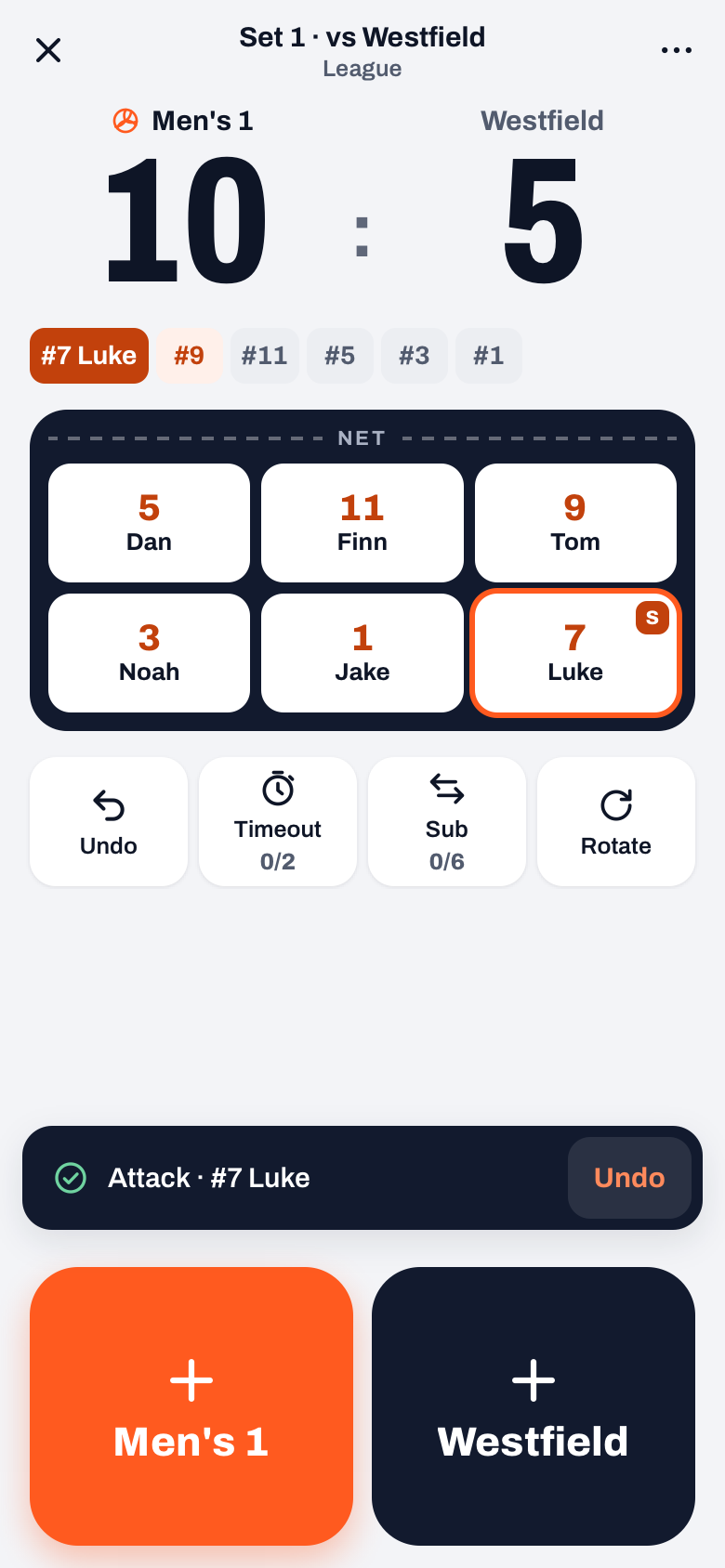
When you score live in Koach, you see the Serve order at the top: the server first and then who follows, and on the court an S next to the player who is serving. When you win back the serve, the court rotates along, so you always see whether the right player is behind the line. The libero is not in that row: in their place is the player they are replacing. If your own server misses, you tap the point for the opponent and then Serve error in the drawer, and the error goes on your server's name; in the player profile the errors later appear by type.
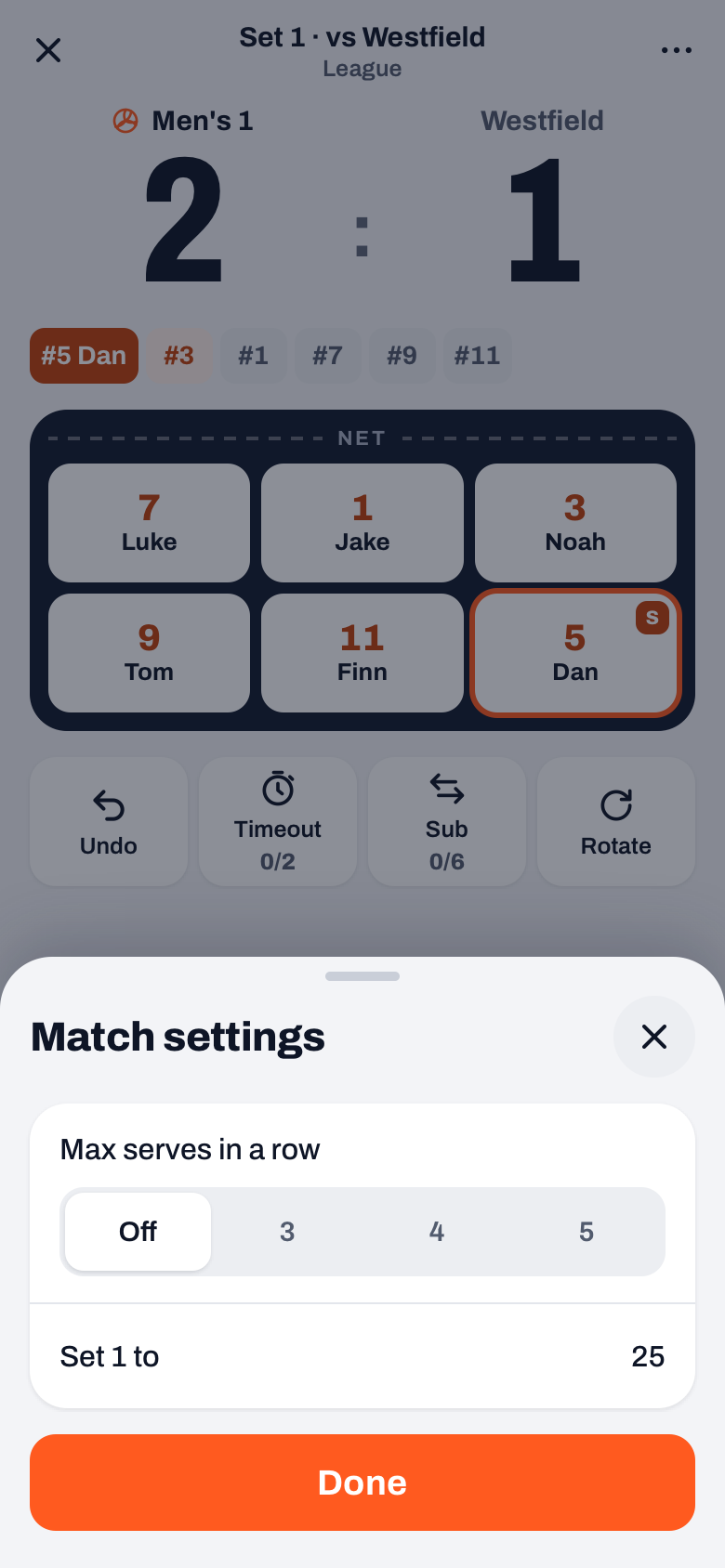
If your team plays with a youth rule, you choose 3, 4 or 5 under Max serves in a row. After that many points in a row by the same server, the team rotates automatically in the app.
14 days free, no credit card. Score your next match live and see the service errors for each player afterwards.
Score your next match in KoachWhat Koach costs after the trial is on the pricing page.
Frequently asked questions
Can you re-toss the ball on a volleyball serve?
Not under the FIVB rules: you may toss or release the ball only once (rule 12.4.2). Bouncing the ball and turning it in your hands before the toss is allowed. Some national and youth competitions, such as US high school volleyball, allow one re-serve per term of service, so check the rules of your own competition.
Can a serve touch the net?
Yes. The ball may touch the net while crossing it (rule 10.2). It must still cross the net between the antennae and land in the opponent's court. If the ball stays on your own side, or crosses outside the antenna, it is a service fault and the opponent gets the point and the serve.
How many times in a row can you serve?
Under the FIVB rules, as long as your team keeps winning rallies: the same player keeps serving until the opponent scores a point (rule 12.2). Some youth competitions have a maximum, for example three serves in a row, after which the team rotates. That differs by federation and age group, so check the rules of your competition.
Can you serve underhand in volleyball?
Yes. The rules only say that you hit the ball with one hand or any part of one arm after tossing or releasing it. Underhand, overhand, a float or a jump serve are all allowed. Hitting with two hands is not, not even on a jump serve.
Where do you have to stand to serve?
In the service zone: behind the end line and between the extensions of the sidelines, up to the end of the free zone. At the moment you hit the ball, or take off for a jump serve, you may not touch the end line or the floor outside that zone. After that you may step or land in the court.


Score your next match live
14 days free, no credit card. The serve order rotates along by itself.
Get started with KoachOr read first what the volleyball coaching app does.