
Screening in volleyball: what is allowed at the serve
The short answer
Screening in volleyball is a fault: players of the serving team may not keep the opponents from seeing the server hit the ball and the flight of the ball, alone or as a group. Since 2025 no player of that team may have their hands above their head until the ball is over the net either. A screen costs the point and the serve.
Screening in volleyball has been forbidden at the serve for years, but since the FIVB rules 2025-2028 the rule is stricter: hands above the head are enough for a fault. Here you read what a screen is exactly, how the referee calls it and how to line up your team when you serve.
What is screening at the serve?
A screen is any action by the serving team that keeps the receivers from seeing the server or the ball properly. The rule is in the FIVB Official Volleyball Rules 2025-2028, rule 12.5. The core is 12.5.1: the players of the serving team must not prevent their opponents from seeing the service hit and the flight path of the ball, neither individually nor as a group.
Rule 12.5.2 describes when that happens. A player or a group of players makes a screen by waving their arms, jumping or moving sideways during the service, or by standing grouped, so that both the service hit and the flight path of the ball stay hidden until the ball reaches the vertical plane of the net. The word both matters: if the receiving team can see the hit or the flight of the ball, it is not a screen under that rule.
Since the 2025-2028 edition there is a third paragraph, rule 12.5.3: no player of the serving team may raise their hands above their head during the service, until the ball has crossed the net. For the five players next to the server that means: hands down until the ball is over. The rule is listed with the other changes in the new volleyball rules, and all the other rules for the serve are in the serving rules.
Individual and collective screen: the difference
The rulebook knows two forms. In an individual screen one player does it: a middle who bounces up and down during the serve, a player who waves their arms, or someone who steps sideways at the moment of the hit, right into the path of the ball. In a collective screen two or more players stand so close together that they form a wall and the serve goes over it. The rulebook draws this in diagram 6.
What is not a screen: standing still in your spot, even if you are tall and close to the net, as long as the receivers can follow the hit or the ball and your hands are not above your head. A receiver may also take a step sideways to look past a front-row player, but for the receiving team the rotation order applies as usual at the moment of the hit (rule 7.4).
| Situation at the serve | Allowed? | Rule |
|---|---|---|
| Standing still at the net, the receivers can see the server | Yes | 12.5.2 |
| Waving the arms | No | 12.5.2 |
| Jumping or stepping sideways into the path of the ball | No | 12.5.2 |
| Three players standing together, the serve goes over them | No | 12.5.2 |
| Hands above the head until the ball is over the net | No | 12.5.3 |
| Hands protecting the face, in front of the head, not above it | Yes | Guidelines 2025 |
| Serving team players outside the rotation order | Yes | 7.4 |
| The serve goes over a screen | Serving fault | 12.6.2.3 |
The hands rule: what the referee calls now
Before 2025 the referee had to judge whether the receivers really could not see the ball. That stayed a judgment call, and teams stretched the rule in the name of tactics. Rule 12.5.3 makes it checkable: hands above the head are enough. The FIVB Casebook 2025 gives an example (case 3.31.2): the three front-row players of the serving team stand grouped at the net, one of them raises a hand high, and the first referee whistles a screen. Correctly, the casebook rules, and where that player stands relative to the path of the ball does not matter.
The Refereeing Guidelines and Instructions 2025 describe how referees handle it. If a team clearly stands grouped with the intention to screen, or players keep their hands above their heads, the referee can whistle before the serve and ask the players to spread out. If they do not, the referee calls the screen right after the service hit, without waiting for the ball to pass over the group. Players may protect their head with their hands, as long as the hands do not go above the head. In addition, the referee may warn a team through the game captain if they suspect deliberate screening (rule 12.5.3). According to the casebook a warning beforehand is sensible, but not required. So do not count on one.
What does a screen cost, and who calls it?
- The first referee decides. Faults of the server and of the positions of the serving team, the screen included, are the first referee's job (rule 23.3.2.3a).
- The signal. Both arms raised vertically, palms forward. It is the same signal as for a blocking fault; all signals are in the referee hand signals.
- The consequence. A serve that goes over a screen is a serving fault (rule 12.6.2.3). The opponent gets the point and the serve.
- A positional fault by the receivers at the same time? Then the receiving team's positional fault counts. The screen only makes the serve a fault after a correct service hit, and the positional fault already existed at the moment of the hit (rule 12.7.2).
- Asking is allowed, arguing is not. When the ball is out of play, only the game captain may ask the referee for an explanation (rule 5.1.2.1). If you think the opponent is screening, have your captain ask at such a moment.
How do you line up when your team serves?
Since 2025 the serving team may take any position at the moment of the service hit (rule 7.4); only the receiving team still has to stand in rotation order. That is an opportunity, because your blockers can already start at their blocking spots. But it is also exactly the situation in which a screen happens: three tall players standing together at the net, ready to block. Five agreements prevent it.
- Hands at shoulder height or lower. The rule says above the head; shoulder height gives you a margin. Front-row players stand in the high ready position with their hands in front of their chest and only raise them once the ball is over the net.
- Spread your front-row players. Leave visible space between your net players and do not put all three of them in the line between the server and the middle of the other court.
- Stand still during the serve. No little hops, no sidestep into the path of the ball and no arm movements. You make your first move when the ball passes you.
- Watch where your server stands. If someone serves from the corner of the service zone, the path runs diagonally across the court and a different net player is in the line than with a serve from the middle. Agree per server who moves aside.
- One call. Have one player call "over" when the ball crosses the net. Then everyone knows when the hands may go up and nobody has to guess.
Practice the fault on purpose once. In a serving drill, have a net player raise their hands or stand next to a teammate on purpose for three serves, and whistle it. Then five minutes with the agreements in place. Players mostly do it out of habit, and you only notice a habit when someone points it out.
As the receiving team: what do you do against a screen?
If you cannot see the server, take half a step sideways within your position so you look past the net players. If the opponent keeps standing grouped, have your captain ask for an explanation when the ball is out of play. You can practice it in training: in serve receive drills, now and then put a few players still at the net so passers learn to pick up a ball late. That is not a screen as long as they stand still and keep their hands low, and it makes your passers calmer when it does happen in a match.
Youth, recreational and beach volleyball
Everything above is the FIVB rulebook for indoor volleyball. National federations base their rules on it, but can have their own provisions for youth or lower divisions; so check the rules of your own league. On the sand only the individual screen exists, because there is just one partner next to the server. The hands rule applies there too, in rule 12.5 of the beach rules; the rest of the two-on-two game is in the beach volleyball rules. If you want the big overview first, start with all volleyball rules at a glance.
Preparing your serving formation and tracking screens in Koach
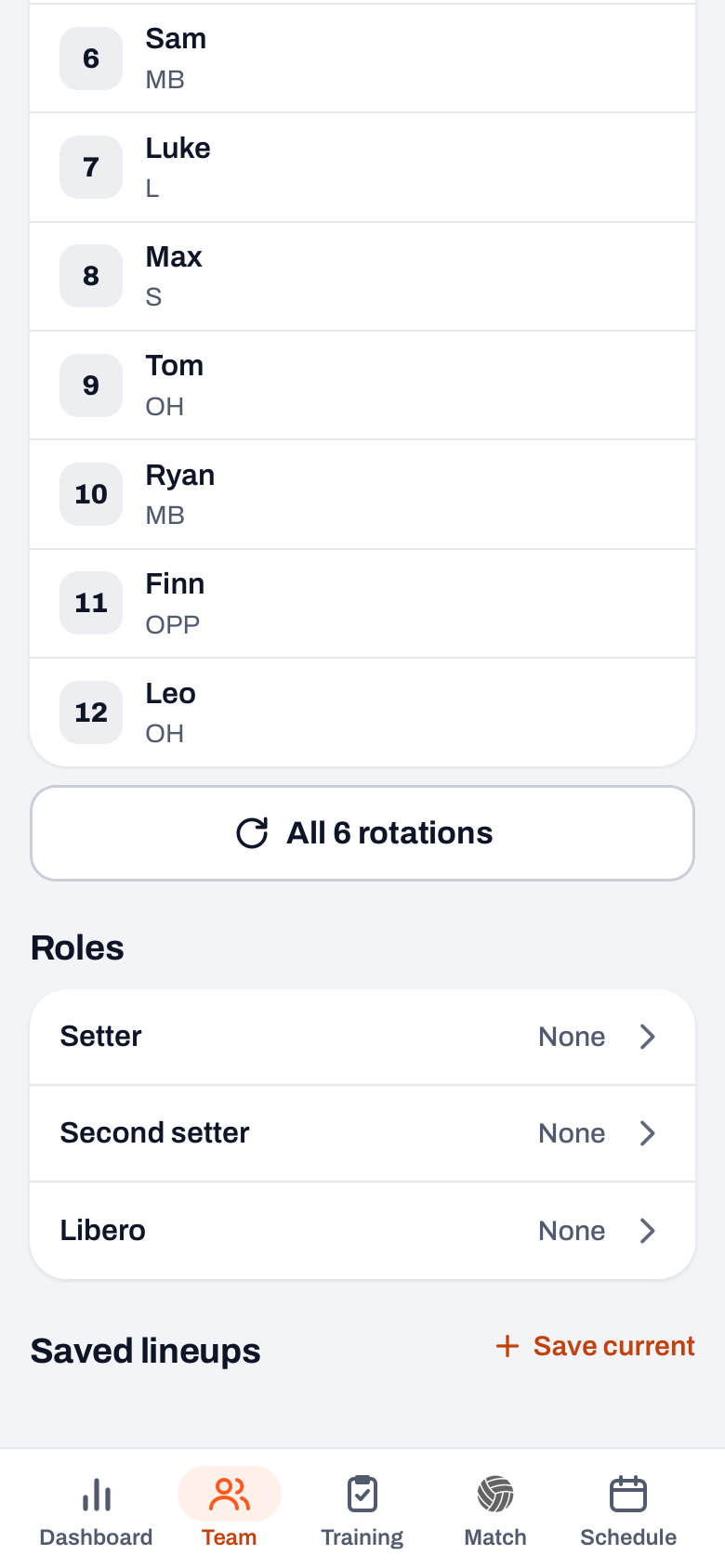
In Koach you set up your lineup under Team. All 6 rotations opens six small courts showing who stands where in each rotation. That way you see for each serving turn which three players are in the front row and therefore need to know the agreements about hands and spacing. If you also want to draw the serving formation, create a board under Training and share it with your team using Share as image.
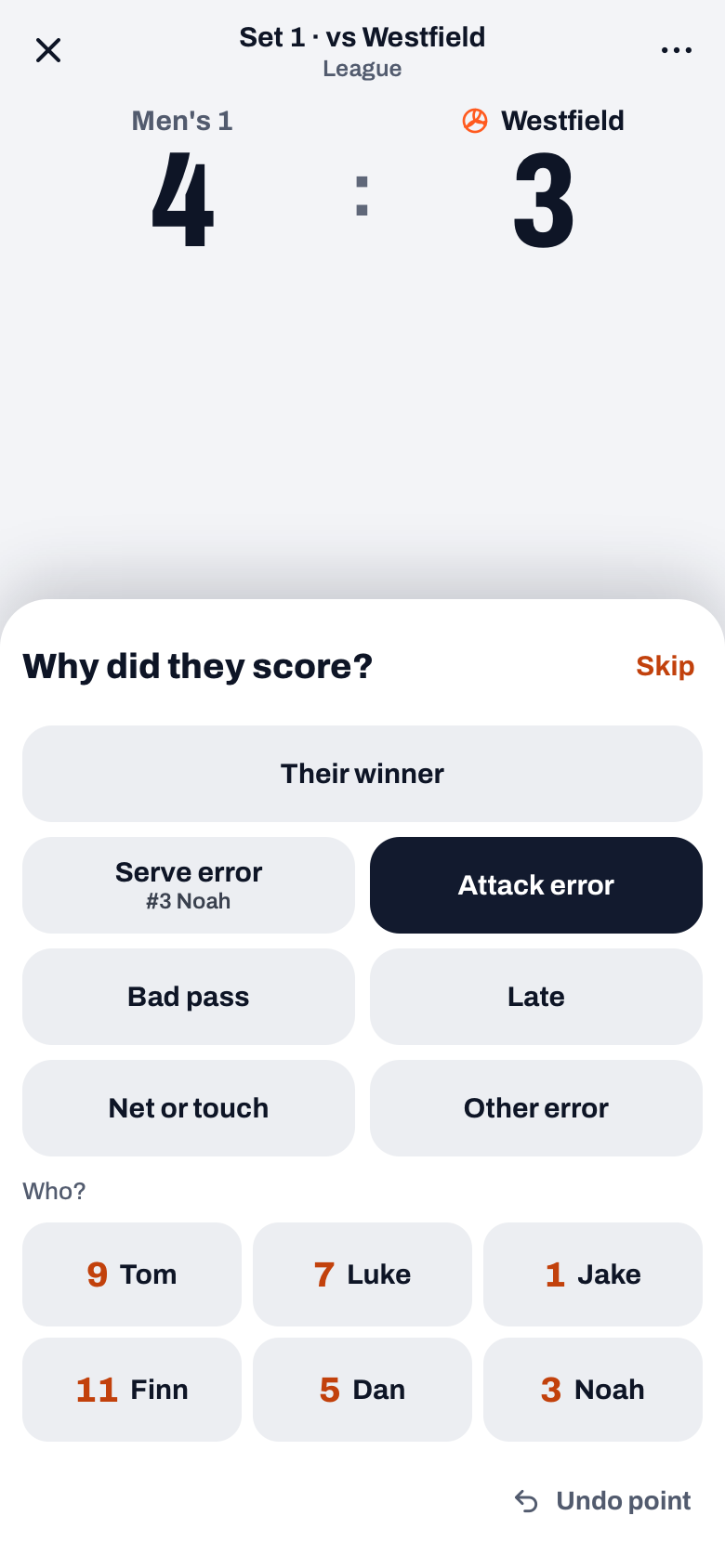
If a screen is called on your own serve, the opponent gets the point. In the live screen, tap the opponent's button, choose Other error in the Why did they score? drawer and then tap the player who raised their hands or stood in the path. The rulebook calls it a serving fault, but your server did nothing wrong. Koach has no separate error type for a screen; with Other error under a player's name you do see afterward where it went wrong.
14 days free, no credit card. Look at your six rotations tonight and agree for each serving turn who stands in the front row and where.
Set up your lineup in KoachWhat Koach costs after the trial is on the pricing page.
Frequently asked questions
Can you raise your hands when your own team is serving?
No. Since the FIVB rules 2025-2028, no player of the serving team may raise their hands above their head during the service until the ball has crossed the net (rule 12.5.3). Protecting your head with your hands is allowed, as long as they do not go above the head. Agree on shoulder height with your team, then you have a margin.
Is it a screen if the receiver can still see the ball?
Not for the screen in rule 12.5.2: that only exists when both the service hit and the flight of the ball stay hidden until the ball reaches the net. The hands rule 12.5.3 stands apart from that. If a player raises their hands above their head, the referee can call a screen, even if that player is not in the path of the ball.
What is the difference between an individual and a collective screen?
In an individual screen one player blocks the view, by waving, jumping or stepping sideways during the serve. In a collective screen two or more players stand grouped and the serve goes over that group. Both are forbidden and result in a serving fault: point and serve to the opponent.
Do you get a warning first for screening?
You might, but it is not required. Rule 12.5.3 allows the referee to warn a team through the game captain if they suspect deliberate screening, and under the 2025 refereeing guidelines the referee can whistle before the serve to make players spread out. The 2025 casebook calls a warning sensible, but also says the referee is not obliged to give one.
Does the screening rule also apply in youth leagues?
The FIVB rules apply where a national federation adopts them. For youth and lower divisions, federations and leagues can have their own provisions, for example because young children do not block yet. So check the rules of your own league to see whether the hands rule already applies there.

Set up your serving formation tonight
14 days free, no credit card. By Saturday everyone knows where to stand.
Get started with KoachOr read first what the volleyball coaching app does.