
Volleyball ready position: three heights and how to teach them
The short answer
The volleyball ready position is the stance from which you get to the ball fastest: feet slightly wider than the shoulders, weight on the balls of the feet, knees bent, trunk leaning slightly forward and arms loose in front of the body. You stand high at the net, medium in serve receive and low on defense.
The volleyball ready position looks like the most boring part of practice, until you see how many balls beginners miss because they stand upright on their heels. Here you read what the stance looks like, why there are three heights, which mistakes you see most and how to teach it in four steps.
What is the ready position in volleyball?
The ready position, also called the athletic stance or ready stance, is the position in which you wait for the ball to come your way. It has one goal: to move off as quickly as possible, in any direction. A player who stands upright first has to drop before they can push off, and you lose those tenths of a second on every ball. That is why the ready position is the start of almost every skill: the pass, defense, the block and the set all begin with it. Where it fits among the other skills is covered in learning volleyball technique.
The key points, from the ground up:
- Feet: slightly wider than the shoulders, toes pointing forward. One foot may be half a foot length ahead of the other.
- Weight: on the balls of the feet, with hardly any weight on the heels. A player on their heels takes their first step backward instead of toward the ball.
- Knees: bent, in line with the toes and not caving inward. They stay springy; they are not locked.
- Hips and trunk: hips back, trunk leaning slightly forward, back straight. The shoulders end up roughly above or slightly in front of the knees.
- Arms: loose in front of the body, elbows slightly bent, hands apart. You do not know yet whether the ball will come high or low, so you do not form a platform yet.
- Head: up, eyes on the ball and on the player who is about to hit it.
High, medium or low: which ready position when?
There is not one ready position. How low you stand depends on how much time you have and how high the ball arrives. Coaches usually distinguish three heights:
| Height | When | What to watch |
|---|---|---|
| High | At the net for a block or an attack, the setter on the way to the net, players far from the ball | Knees slightly bent, weight forward; at the net the hands in front of the chest or at shoulder height |
| Medium | Serve receive, a free ball, a ball that comes in on an arc | Knees clearly bent, hips back, arms loose in front of the body |
| Low | Defense against a hard attack or a tip | Wider, center of gravity low and forward, arms low in front of the knees |
A player changes height several times within one rally. An outside hitter stands medium in serve receive, high when they start their approach, and low when they are on defense afterward. So do not just teach players the stance, but also the moment of switching. The low stance with positioning and diving is worked out in defense in volleyball, the medium stance as the start of the pass in the forearm pass.
One rule comes with the high stance. When your own team serves, net players keep their hands below head height until the ball is over the net: since the FIVB rules 2025-2028 that is a fault. The explanation is in screening at the serve.
Five mistakes you see in every group of beginners
- Standing on the heels. The player seems to stand low, but their weight is back. Have them rock gently back and forth on the balls of their feet until they feel where their weight belongs; the heels may touch the floor, but carry nothing.
- Bending at the back instead of the knees. The head goes down, the legs stay straight. Use an image: "sitting on a high stool", hips back and chest forward.
- Forming the platform too early. Hands together while the ball is still on the other side. A player who waits like that struggles with a ball above the waist and moves stiffly. Only when the ball comes and you know it will be a forearm pass do the hands go together.
- Standing too narrow or too wide. Too narrow and you have no balance, too wide and you cannot take a step without first bringing your feet in. Rule of thumb: wide enough that you can take one step left or right without adjusting first.
- Standing still like a statue. A frozen stance is slow. Keep the feet light and do a small hop, the split step, at the moment the opponent hits the ball. How that works is covered in volleyball footwork.
Watch the feet, not the ball. During a scrimmage, stand next to the court for a minute and only watch your players' feet at the moment the opponent hits the ball. Whoever is standing still with straight legs at that moment is the player you follow for the next few weeks.
How to teach the ready position in four steps
Explanation alone works poorly. Players learn the stance by taking it hundreds of times, preferably with a reason to move afterward. Spend a few minutes on it in the warm-up of every practice and then bring the stance back in your drills.
Step 1: finding the stance
Pairs. A takes the medium stance, B checks four points: feet, weight, knees and arms. Then B gently pushes A's shoulder, from the front, from the side and from behind. If A stands well, they hardly wobble and do not come up. After three pushes the roles switch.
Step 2: high, medium and low on command
The group spreads out over the court. The coach calls a color: green is high, orange is medium, red is low. After a few rounds, use only a colored cone or a hand signal, so players learn to look instead of listen. Progression: on a clap, a quick step to the left or right and straight back into the same stance.
Step 3: moving and catching
Pairs, four meters apart. A stands in the medium stance, B throws the ball one to two meters to the side of A at hip height. A moves with shuffle steps and catches the ball low in front of the body, without standing up. Ten balls, then switch. Progression: first B only throws when A is ready, then at unexpected moments, and finally A plays the ball back with a forearm pass instead of catching it.
Step 4: the stance in the game
Play a small-sided game, for example three-on-three on a small court. On a whistle everyone freezes. Anyone standing upright at that moment while the ball is in play costs their team a point. After a few whistles players stand lower on their own, also when the ball is on the other side. That is exactly the point: the stance is only learned when players take it without you asking for it.
For children up to about ten, an image works better than four coaching points: "sit on an invisible stool" or "ready to jump away like a goalkeeper". If you teach a whole class at once, see volleyball in PE class.
Tracking each player's ready position in Koach
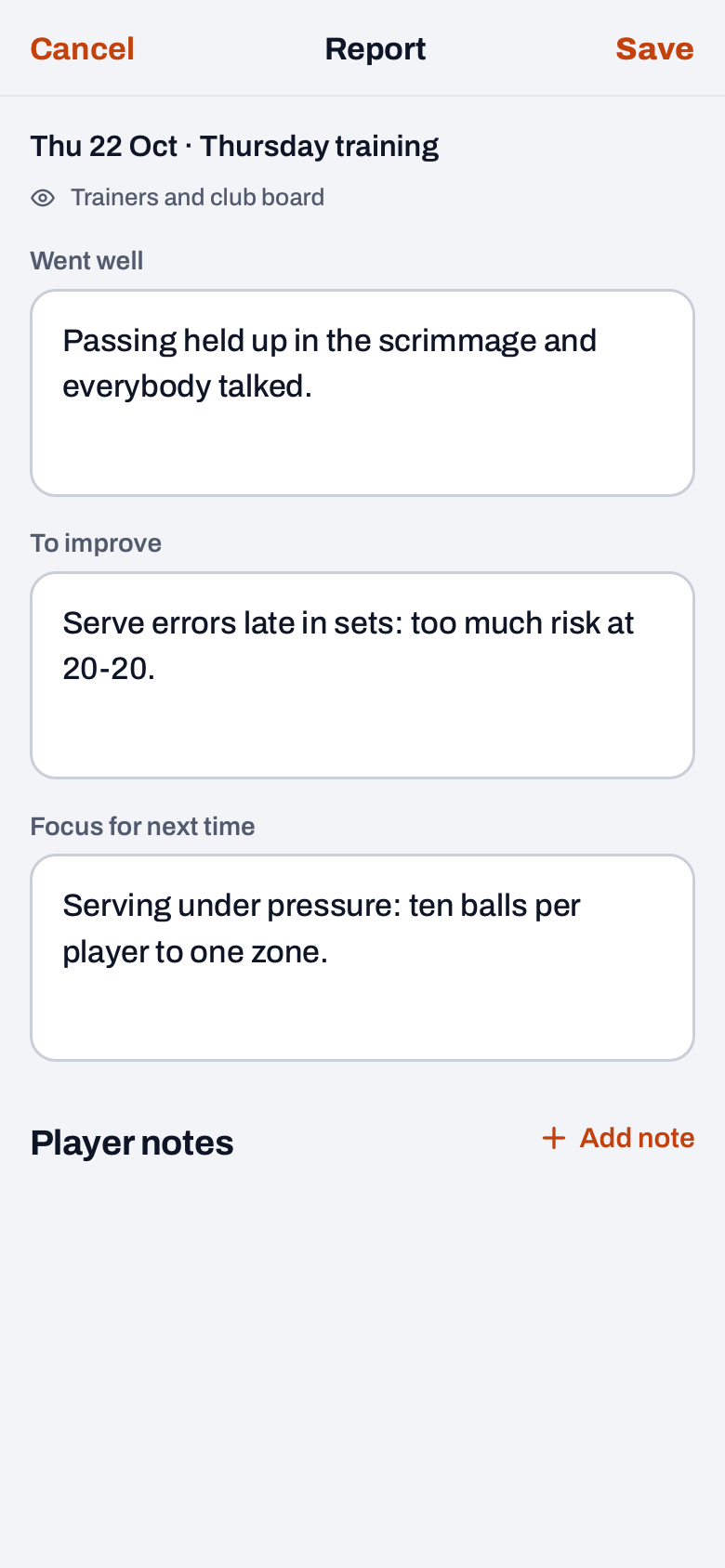
A stance does not change in one practice, and with a group of twelve you forget after two weeks who was still on their heels. In Koach you write it down with the practice itself. In the practice report, under Player notes, tap Add note, choose the player and switch on Follow up if you want to come back to it later. The note belongs to the player and to that practice, so three weeks from now you can read back what you saw then. You add the stance block itself as a section in the practice plan, with its duration.
14 days free, no credit card. After your next practice, write one note about their stance for three players and read it back three weeks from now.
Try Koach at your practiceWhat Koach costs after the trial is on the pricing page.
Frequently asked questions
What is the difference between the ready position and the split step?
The ready position is the stance in which you wait. The split step is the small hop you make from that stance, landing at the moment the opponent hits the ball. The hop loads your legs, so you move off faster. Without a good ready position the split step does little, and without a split step a good stance stays slow.
How low should you be in the ready position?
That depends on the situation. At the net you stand high, in serve receive medium with clearly bent knees, and on defense against a hard attack low and wide. A good test: can you take a step to the left or right straight from your stance without coming up first? Then you are low enough, and not too low.
Why do beginners keep standing upright?
Staying low is tiring when your legs are not used to it, and beginners focus on the ball instead of their body. So they only drop when the ball is already on its way. Repeat the stance briefly and often, reward it in games, and do not expect a group to hold it for a whole scrimmage after one practice.
Should one foot be forward in the ready position?
It may, and some coaches have passers put one foot half a foot length forward. More important is that both feet carry weight and that you can move off equally fast to both sides. Choose one way within your team and stick to it, so players do not learn something different from every coach.


Track your players' stance in Koach
14 days free, no credit card. Three weeks from now you see who stands lower.
Get started with KoachOr read first what the volleyball coaching app does.