
Volleyball drills for middle school PE: a class on one court
The short answer
Good volleyball drills for middle school PE keep thirty students playing at once instead of waiting: small courts side by side, three against three, a light ball and simple rules such as catching allowed. Start with throwing and catching over the net and build over four lessons to setting, passing and a small tournament.
Volleyball drills for middle school PE are something different from a club practice: thirty students, half of whom never played a ball over a net, one court and fifty minutes including changing. This lesson plan is built around exactly that, with the layout of the gym, rules that work and a unit of four lessons.
What makes a PE class different from a practice
At the club you train twelve players who chose volleyball. In a PE class you have thirty students of roughly 10 to 15 years old: a few club players, a large group who have never done it and a few who would rather dodge the ball. The lesson lasts 45 or 50 minutes, but after changing and tidying up there are often 35 to 40 minutes left. There is one volleyball court, sometimes a second net, and sometimes no net at all.
That leads to three rules for every lesson. Everyone plays at the same time, because nobody learns anything in a queue. The ball has to go over the net often, so the game is small and the rules are flexible. And anyone who is scared of the ball gets a ball that does not hurt. How to build volleyball up by age is in coaching youth volleyball by age; this article is about the lesson at school.
One court for thirty students: how to lay out the gym
- Split the volleyball court lengthwise. Put a row of cones or a tape along the middle of the court, from end line to end line. That gives you two narrow courts of 4.5 metres wide under the same net, each for three against three.
- Courts with an elastic rope. In the rest of the gym, stretch an elastic rope between two posts, wall bars and a post, or two high jump stands. A height of about 2 metres works well in practice for students of 12 to 14, and for younger students you hang it lower; there is no official school height. The lines of a badminton court, about 13 by 6 metres, make a ready-made court. Use elastic and not rope: elastic gives when someone runs into it.
- Without a net. Two lines 2 metres apart form a no-man's land. The ball has to go over it in an arc, higher than the hands of the students on the other side. It works less well than an elastic rope, but the game stays the same.
A worked example: with four courts, eight teams of three play at once, which is 24 students. The two remaining teams of three are at a station by the wall, setting or passing against the wall, and swap after every round with the losers of the lowest court. More layouts for large groups are in drills for a large group.
The lesson plan: fifty minutes for a whole class
| Minute | Part | What the students do |
|---|---|---|
| 0 to 5 | Arrival | Teams of three are already on the board; each team grabs a ball and goes to its court |
| 5 to 12 | Warm-up with the ball | A tag game where you are safe holding the ball; passing it on with an overhead throw |
| 12 to 22 | Technique in threes | Throwing and catching above the forehead, then tossing to yourself and setting it back |
| 22 to 42 | Three against three | Five-minute rounds; winners move up a court, losers move down a court |
| 42 to 47 | Wrap-up | One question to the group, one team of three shows what went well |
| 47 to 50 | Tidying up | Each team of three has a fixed job: posts, elastic or balls |
The technique block is short, and that is on purpose. Students learn most in the game, as long as the game is small enough that they touch the ball often. Three against three gives every student many more ball contacts than six against six on a big court. If you see something going wrong in the game, for example nobody playing the ball high, stop for one minute, show it and play on. If you only have 40 minutes after changing, cut the warm-up to two minutes and the technique block to five, and keep the game.
Rules that work in PE
Start with catch volleyball: three against three, the ball goes over the net in three contacts, and every contact may be caught and thrown again. The serve is an underhand throw or hit from a few metres behind the end line. When a team wins the serve back, it rotates, so everyone serves. Every rally is a point; a round lasts five minutes or up to 11 points.
Then you adjust the dials:
- Easier: catching allowed on every contact, the ball may bounce once, a light or soft ball, serving with a throw or from closer in, the elastic lower.
- Harder: catching only on the first ball, three contacts compulsory, the last ball is played and not thrown, serving from behind the end line, a bigger court.
Even better: give each court its own rules. On the top court it is real volleyball, on the bottom court everything may be caught. Because of the moving up and down, after a few rounds every student ends up on a court that suits them, without you having to group them by level. The step-by-step path from throwing and catching to real play is worked out in lead-up games for volleyball.
Put the teams of three together before the lesson. Write them on the board or on a list by the door, mixed in level. Whoever comes in grabs a ball and goes to their court. That saves you the first five minutes, which would otherwise go on picking and waiting.
Scared of the ball, or already a club player
Every class has both. For students who are scared of the ball: give them a soft or light ball, always let them catch and put them in a team with classmates who play calmly. A hard ball on the forearms in the first lesson can be enough to make them avoid the ball from then on. More on that approach is in a child who is scared of the ball.
Club players get bored quickly in catch volleyball. Give them their own task within the same game: they may never catch, they always set the second ball to a teammate, or they serve from behind the end line. That keeps them in their team of three and has them lift the game instead of just winning it.
A unit of four lessons
- Lesson 1: catch volleyball. Throwing and catching over the net, three contacts, everything may be caught. Goal: understanding what the game is about. Over the net in three, and the ball does not land on your side.
- Lesson 2: setting. Technique: catch above the forehead and push the ball straight back, holding it shorter and shorter. Game: the second contact is set, the others may be caught.
- Lesson 3: passing and the serve. Technique: forearm passing after a toss from a classmate, and an underhand serve from a few metres behind the court. Game: the serve is hit, the first ball may still be caught.
- Lesson 4: tournament. Three against three or four against four with the move-up system and each court with its own rules. Students keep score themselves.
If you want to extend a unit like this, or you also teach a group of beginners outside school, read teaching volleyball to beginners.
Saving your lessons in Koach
Koach is an app for teams and clubs, not for schools: there are no class lists or grades for students. If you are also a youth coach at a club besides teaching, you build a lesson or practice the same way as above. In a practice you use + Add section to make your own block with a name and duration, such as "Catch volleyball 3v3, 20 minutes", and + Add drill to pick a drill from the library. A plan that worked, you bring back later with Copy plan.
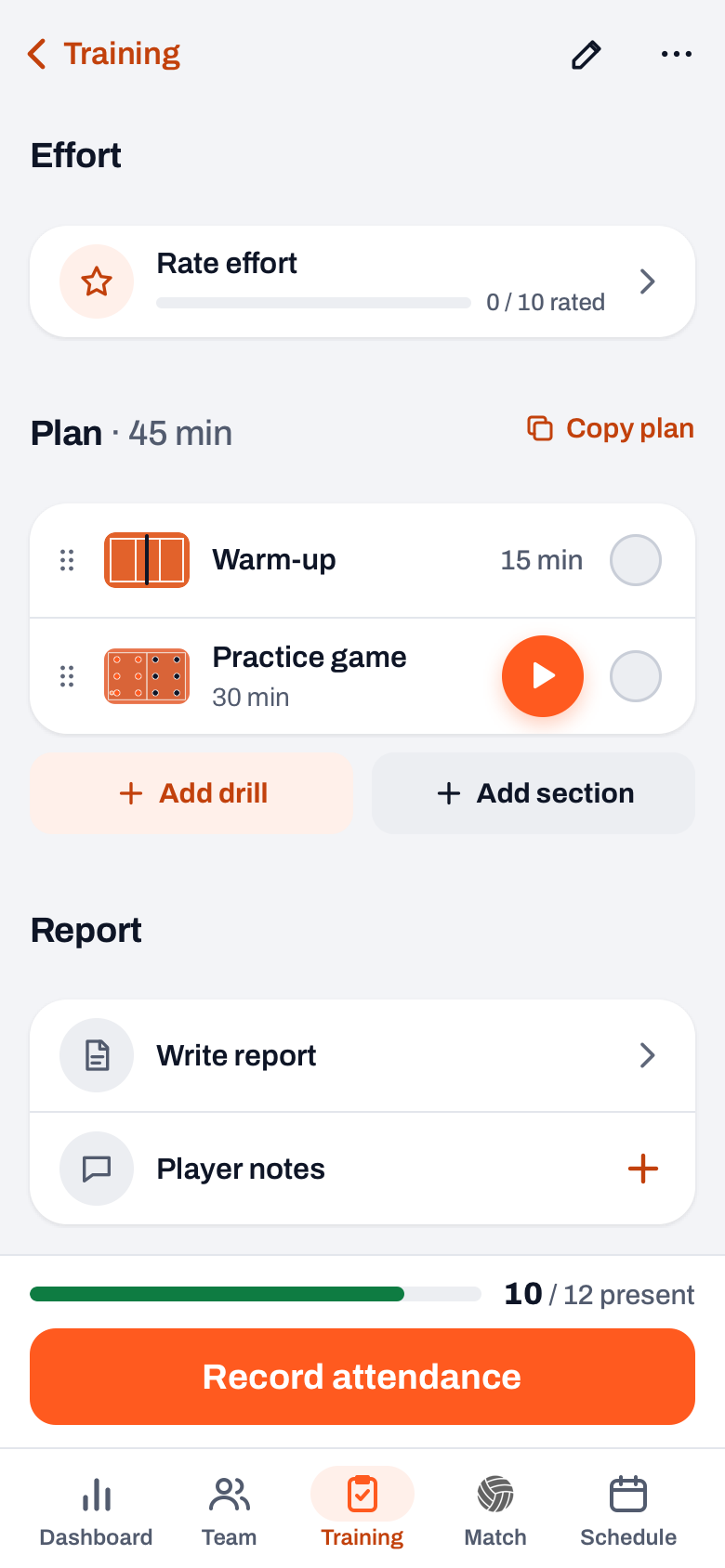
The drills from that library, each with an animation per phase, can also be viewed without an account in the volleyball drills on our site. What Koach costs after the 14 free days is on the pricing page.
14 days free, no credit card. Set up your next youth practice as a plan and see whether it saves you preparation.
Try Koach with your teamFrequently asked questions
How do you teach volleyball without a net?
Stretch an elastic rope between two posts, wall bars and a post, or two high jump stands. In practice about 2 metres works well for students of 12 to 14, and lower for younger ones. If you do not have that, make a no-man's land with two lines 2 metres apart, which the ball has to cross in an arc, higher than the hands of the students on the other side.
How many students do you put on one court?
Three against three works well: every student touches the ball often, and the court can stay small. Four against four works on a slightly bigger court. Six against six on a full court gives beginners too few ball contacts, and the ball then mostly drops between students who are looking at each other.
Which ball do you use in PE class?
A light or soft ball, especially for beginners and students who are scared of the ball. A match ball is too heavy and too hard for most students: it hurts the forearms and produces few rallies. If you have club players in the class, they can play with a heavier ball on the top court.
What do you do with big differences in level in the class?
Give each court its own rules and have winners move up a court and losers move down. On the top court it is real volleyball, on the bottom court everything may be caught. Club players get their own task within their team of three, such as never catching or always setting the second ball.

Save your best lesson as a plan
14 days free, no credit card. Next time you copy it with one tap.
Get started with KoachOr read first what the volleyball coaching app does.