
How to teach volleyball to beginners: building a lesson
The short answer
How to teach volleyball to beginners: split the lesson into four parts, a warm-up with the ball, one skill to learn, a small-sided game to apply it and a closing game. Demonstrate instead of explaining at length, give one cue at a time and use one ball per two players, so nobody stands in a line.
If you want to know how to teach volleyball to beginners, forget for a moment how you coach a team that already knows the game. You are teaching people movements they have never made, and yet you want them to have played a rally after an hour. This is how to build a lesson, how to teach a skill, and a complete lesson you can use as it is.
How to teach volleyball: start and finish with playing
Beginners come to play. The lesson that goes wrong most often is forty-five minutes of technique in lines and five minutes of scrimmage at the end. Turn it around: play, learn, play. Start with a simple game in which the group notices for itself what is missing, for example that the ball is on the floor after one contact. Then teach the one skill that game needs, and play again afterwards, with a rule that rewards that skill. How such a whole-game approach compares with separate technique drills is covered in isolated, combined and game-like drills.
This article is about the lesson itself: for a new group of teenagers or adults, a clinic or a camp. If you are teaching a whole school class, read volleyball in PE class; for the first practice with a youth team there is your first practice with a youth team.
Building a lesson in four parts
Every lesson has one learning goal, written as something you can see: "after this lesson every pair sets the ball back and forth five times without catching". You build the four parts around it.
| Part | What's in it | Minutes |
|---|---|---|
| Opening and warm-up | The learning goal in one sentence, warming up with the ball | 10 |
| Teaching | One skill, in pairs, with one cue at a time | 15 |
| Applying | The same skill in a small-sided game with a task | 20 |
| Playing and closing | A game that rewards the theme, a short look back | 15 |
In a 90-minute lesson you mainly stretch the applying and the playing; the teaching doesn't get better with a longer block. How to run a regular practice from preparation to evaluation is covered in running a volleyball practice.
How to teach a skill in five steps
- Pick one learning goal. Not "setting", but "contact the ball above the forehead and play it back high".
- Demonstrate it. Two or three times, once at full speed and once slowly, from the side where the group needs to see it: from the side for the forearm pass, from the front for setting.
- Give one cue, focused on the effect. "Send the ball to the ceiling above your partner" often works better with beginners than "extend your arms and legs". In a review of fifteen years of research on attentional focus (Wulf, 2013), people in most studies learned a movement better with a cue about the effect than with one about their body parts.
- Let everyone start at the same time. Within half a minute of your explanation the first ball is played, with one ball per two players.
- Walk around and give short feedback. First what went well, then one point. If half the group shows the same error, stop briefly and give the point to everyone; the rest you solve player by player.
If most players can't do it, make it easier: a shorter distance, a lighter ball, allow catching or let them toss the ball to themselves. If it almost always works, make it harder: further apart, a partner's toss instead of their own, or a step to the side after every contact. In what order to teach the skills is covered in learning volleyball technique.
Sample lesson: setting in 60 minutes
For twelve beginners on one court, with six balls. The net is divided across its width into three small courts of about three meters wide.
- 0 to 10 minutes, throw and move. Pairs move around the gym and throw the ball to each other with two hands from the forehead; they catch above the head, in the "window" of their hands. After five minutes: after catching, bend the knees and push the ball back out in one movement. Finish with two minutes of two against two over the net in which catching isn't allowed: the group notices for itself how quickly the ball hits the floor.
- 10 to 25 minutes, teaching in three steps. First catch and push straight back, extending arms and legs at the same time. Then toss the ball to yourself, set it up once and catch it. Then toss and set to your partner, who catches. The cue: "to the ceiling above your partner".
- 25 to 45 minutes, applying. Groups of three in a triangle: A throws to B, B sets to C, C catches; after five balls everyone moves one role on. Then two against two over the net on the small courts: you catch the first ball and throw it to your teammate, who sets it over the net.
- 45 to 57 minutes, playing. Three against three on two courts. The first ball may still be caught, after that the ball is played. A point counts double if the ball goes over the net with a set.
- 57 to 60 minutes, closing. One question to the group: "When did setting work best?" Then everyone tidies up together.
Write the learning goal on a note in your pocket. Glance at it after each part of the lesson. If you notice halfway that the group already reaches the goal, make the game harder; if you notice that hardly anyone reaches it, take a step back in the applying part instead of pushing on.
Organization: everyone plays, nobody waits
- One ball per two players. If you have fewer, choose drills in threes with one tosser.
- Courts across the net. Three small courts on one net means three balls in play at once instead of one.
- Fixed groups. Keep pairs or threes together for the whole lesson; to change partners, everyone moves one spot along.
- A fixed stop signal. Ball between the feet and eyes on you, the same every time.
- You walk around. A coach who does the tossing sees only one player; let players toss to each other.
From one lesson to a series
Give every lesson one theme and let the warm-up of the next lesson repeat last week's theme. Let the closing game grow with the series: catching allowed at first, then one bounce, then three contacts required. That way the group sees every week that the game is getting better, and that keeps beginners coming back. For adult beginners there is a progression over ten practices in volleyball drills for adult beginners.
Five mistakes when teaching beginners
- Talking too long. From a minute of explanation, a beginner usually remembers one thing. Choose which one yourself.
- Too many cues at once. Feet, arms and timing in one sentence gives you three half corrections.
- Too difficult too soon. An overhand serve from the end line or a spike in the first lesson mostly produces failure.
- Lines. Every line longer than three players is mostly waiting time.
- Only playing at the end. Or not at all. For a beginner, a lesson without a game feels like a lesson without volleyball.
Preparing and evaluating your lesson in Koach
In Koach you set up the lesson as a plan: each part a section with a name, a duration and a description, or a drill from the library of more than 200 drills with animated phases. After the lesson you write in the report what went well, what to improve and what the focus will be next time. At the next lesson that focus is waiting for you, and with Copy plan you take over the structure and only change the theme.
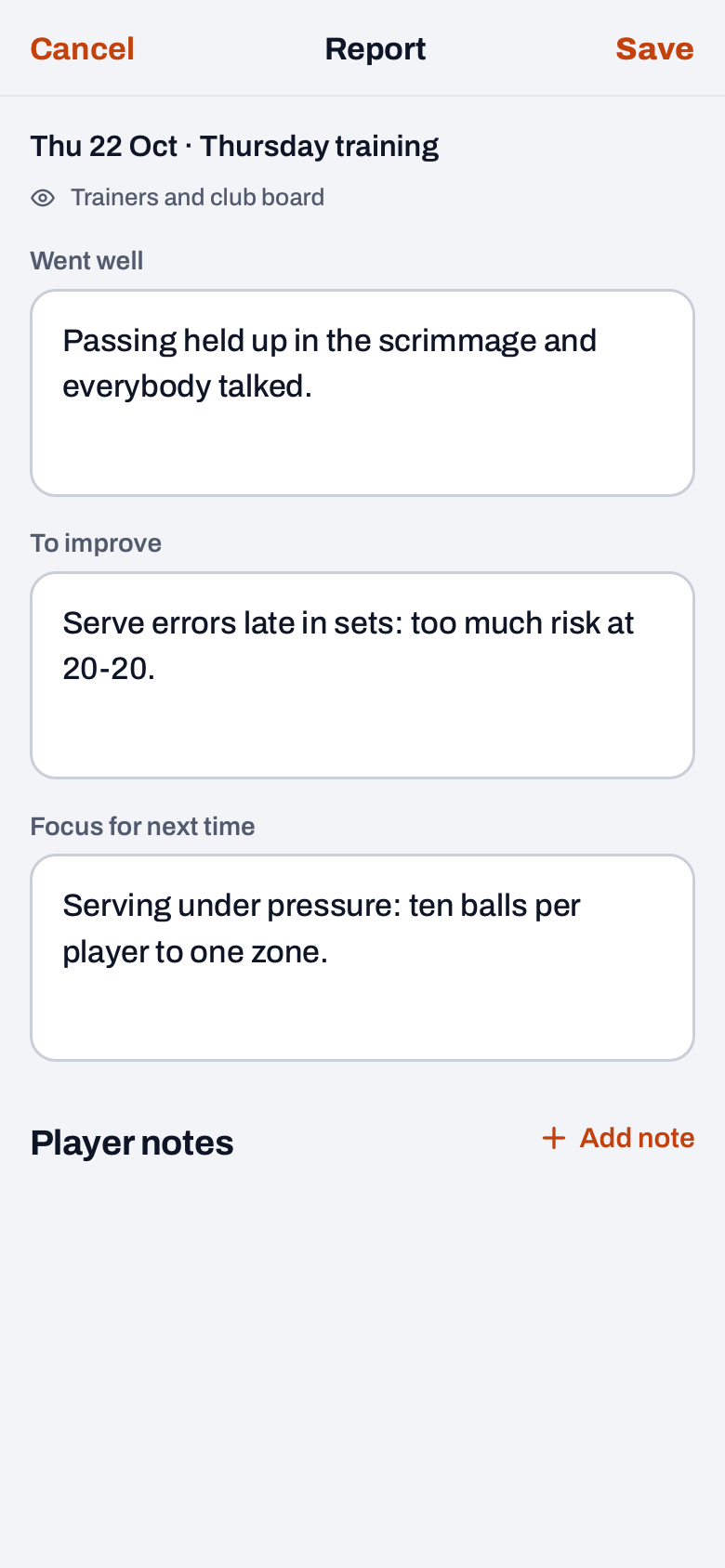
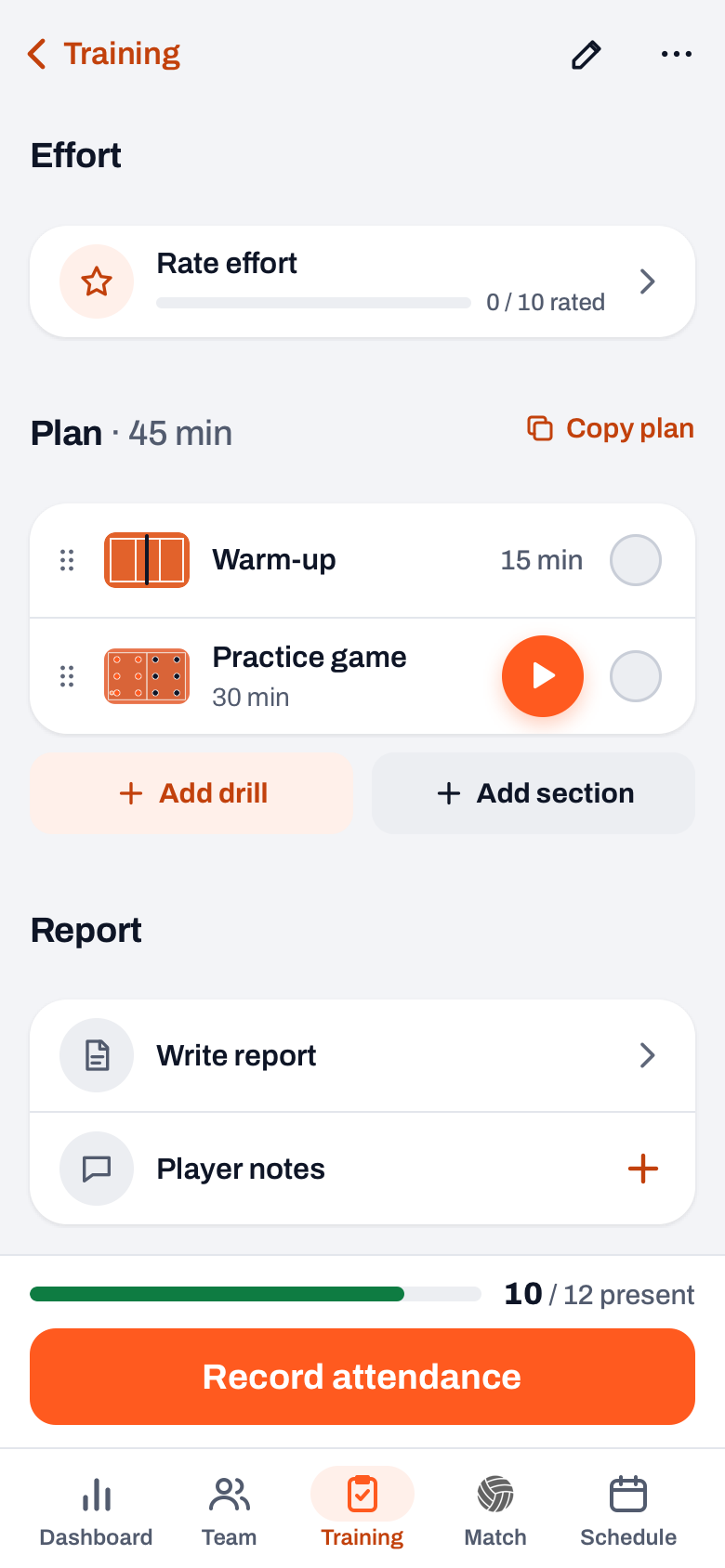
What Koach costs after the 14 free days is on the pricing page.
14 days free, no credit card. Set up your first lesson as a plan and afterwards write in two lines what the next lesson needs.
Plan your lesson in KoachFrequently asked questions
How long should a volleyball lesson for beginners be?
As a rule of thumb an hour is enough for a lesson with one theme: ten minutes of warm-up, a quarter of an hour of teaching, twenty minutes of applying and a quarter of an hour of playing. If you have an hour and a half, stretch the applying and the playing. A longer teaching block doesn't make beginners better, just tired and impatient.
Should beginners learn technique first or play right away?
Both, in the same lesson. Start with a simple game, for example with catching allowed, so the group notices what is needed. Then teach that one skill and play again with a rule that rewards it. If you make beginners wait weeks before they get to play, you lose them.
How many beginners can one coach teach?
A rule of thumb from practice: with twelve players on one court you keep a good overview as the only coach, as long as everyone works in pairs or threes with their own ball. If you have more, divide the net into small courts and give each group a fixed spot, or ask an experienced player to look after a group.
How do you give feedback to a beginner?
Briefly and one thing at a time. First say what went well and then give one point, preferably about the effect: where the ball should go, not which muscle to tense. If the same error comes back in half the group, stop the game for a moment and give the point to everyone.

Set up your first lesson tonight
14 days free, no credit card. After the lesson you know where the next one starts.
Get started with KoachOr read first what the volleyball coaching app does.