
Whole-part-whole in volleyball: three types of drills
The short answer
Whole-part-whole in volleyball links the two ends of how you train: part practice repeats one technique away from the game, whole practice teaches it in the game or a smaller game form. In between sits the combination drill, with skills in sequence such as pass, set and attack. A good practice starts and ends with the whole.
Whole-part-whole in volleyball rests on the two extremes of how you can train: repeat single techniques, or play and let the game do the teaching. Add the combination drill in between and you have three types of drills. Here you read what each type gives you, when to choose which, and how to put them in sequence in one practice.
Analytic, synthetic and global: what is the difference?
In Italy this is standard coaching vocabulary: esercizi analitici, sintetici e globali. Spanish-speaking coaches talk about the método analítico and the método global, German-speaking coaches about the Teilmethode and the Ganzheitsmethode, and English-speaking coaches about part and whole practice, or isolated, combination and game-like drills. The idea is the same everywhere: you can classify a drill by how much of the real game is in it.
| Type | What the player does | Example |
|---|---|---|
| Analytic (part) | One technique, away from the game, usually with a predictable ball | Passing a tossed ball to a target, serving to zones |
| Synthetic (combination) | Two or more skills in sequence as in the game, with a fixed start | Serve from the coach, then pass, set and attack |
| Global (whole) | The game itself or a smaller version, with opponents and decisions | Six against six, four against four on a smaller court |
The global and the analytic method are the extremes, the synthetic drill is the bridge. None of the three is better than the other two. The question is which one you use when, and in what order.
The analytic method: lots of reps, little transfer
An analytic drill takes one element out of the game and has players repeat it often. An example: passing in threes. A tosses or hits the ball from the other side, B passes to C, who stands in the setter's spot. Ten balls, then rotate. The goal: seven out of ten balls within reach of C.
The strength is in the repetition. A player gets dozens of contacts in ten minutes, you see exactly what goes wrong and you can fix one thing at a time. That makes the analytic form the place for a new technique and for a fault that has crept in.
The weakness is in what is missing. There is no opposing serve to read, no choice of who takes the ball and no score. A player who passes twenty balls in a row well on Tuesday can still shank the first serve on Saturday. Why that happens, and how to make a drill more game-like step by step, is in game-like volleyball drills.
The global method: the game as teacher
With the global method you play, and players learn from what the game asks of them: reading where the ball is going, choosing, calling, switching from defense to attack. Players enjoy it more, and what they learn carries over to the match more easily.
The weakness: few repetitions of one technique per player, and a fault is hard to correct while the rally goes on. In six against six a weaker player sometimes does not touch the ball for a few minutes. So you make a global form smaller and steer it with rules:
- Fewer players, a smaller court. Three against three or four against four gives every player many more contacts than six against six.
- A start you control. The rally begins with a free ball or a serve from the coach, so the game starts right on your topic.
- A rule that forces the focus. A point after pass, set and attack counts double, or a team can only score with a back-row attack.
An example: three against three on half a court, lengthwise. The coach tosses in a free ball every rally, and a point that starts with a pass to the setter counts double. More formats like this are in volleyball scrimmage games.
The synthetic drill: the bridge in between
A synthetic drill links two or more skills in the order of the game, but with a start you can repeat. Two examples:
- Serve receive, set, attack. One player serves, the passer passes, the setter sets, the hitter attacks. First without a block, then with one blocker. You train the pass as in the match: with a setter who is already on the move and a hitter waiting for the ball.
- Block, transition, attack. The middle blocker blocks a tossed ball, lands, moves back off the net and then attacks a ball from the setter. This is the transition that never happens in an analytic blocking drill.
The advantage over a global form: you still get many repetitions of the same situation. The advantage over an analytic form: the timing between players is in it.
When do you choose whole or part practice?
Research on motor learning, starting with Naylor and Briggs (1963), gives a useful rule of thumb. When the parts of a movement are tightly linked, you learn them better as a whole. When they are separate steps one after the other, you can practice them apart and join them up afterwards. For volleyball that means: a spike is one continuous movement. If you practice the approach on its own for a moment, attach it to the jump and the arm swing again quickly, and rather make the whole easier, with a lower net or a tossed ball instead of a set. A rally you can cut into pass, set and attack, because those are separate actions.
- A new technique or a beginner: briefly analytic, with a simplified situation, and as quickly as possible to a synthetic form.
- A fault that has crept in: back to analytic for a moment, and build up again in the same practice.
- Timing between players, such as setter and hitter: synthetic.
- Reading, choosing, talking and transition: global. You only learn that in a form with opponents.
- Youth: plenty of global work in small games, with analytic blocks that stay short. How to build that up with younger players is in volleyball lead-up games.
Whole-part-whole: how to build a practice
A fixed combination is called whole-part-whole in English and globale-analitico-globale in Italian. You start with a game to see what goes wrong, then work on that part, and finish with a game in which exactly that part is rewarded. An example for a 90-minute practice with passing as the focus:
| Minutes | Type | Content |
|---|---|---|
| 15 | Warm-up | Loosening up and ball contacts |
| 15 | Global | Four against four, you watch where the pass breaks down |
| 15 | Analytic | Passing a serve from close range, with a target at the setter |
| 20 | Synthetic | Serve, pass, set and attack, with a point for every attack after a good pass |
| 20 | Global | Six against six, a rally that starts with a pass to the setter counts double |
| 5 | Cool-down | Short debrief |
The first game is not a warm-up: it shows you what to do in the middle part, and shows the players why. How to build the blocks of a practice further is in practice blocks, and the whole route from preparation to evaluation in running a volleyball practice.
Measure in the whole, not in the part. In the final game, count how many passes reach the setter. If that number rises over a few weeks, your analytic block works. If it stays the same while the drill itself keeps getting better, you are practicing something that does not carry over to the game.
Three pitfalls
- Staying analytic until it is good enough. Players then wait for a perfection that never comes back in the game. Move on to a synthetic form as soon as the movement is roughly right.
- Global without a focus. A scrimmage at the end teaches something too, but you do not know what. Give every game a rule that fits your topic.
- Going straight from analytic to six against six. That step is too big. Put a synthetic drill or a small game in between.
A separate question is in what order and with how much variation you offer the repetitions within a drill. That is covered in blocked vs random practice and differential learning.
Part and whole in your practice plan in Koach
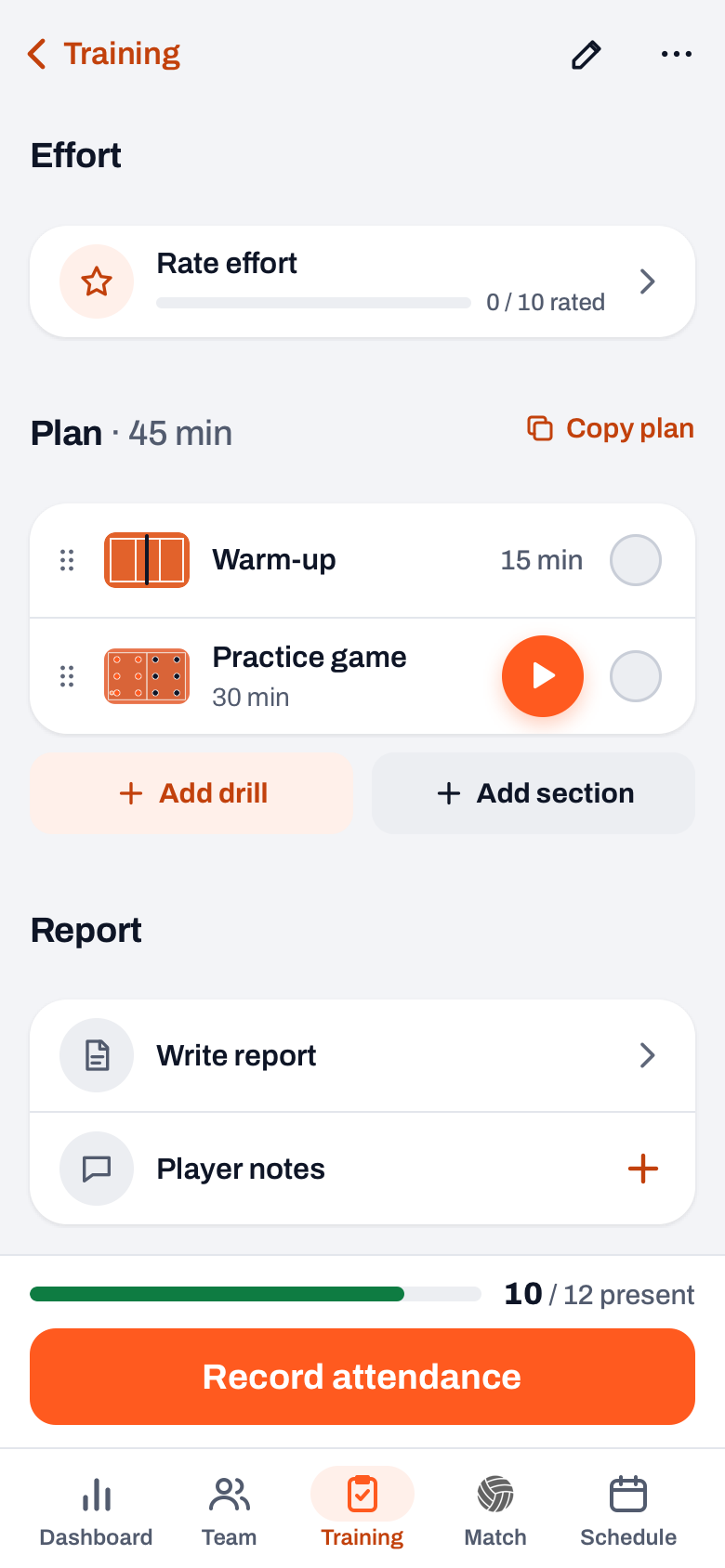
In Koach you build the plan of a practice from sections, each with its own duration. With Add drill you pick from the library, where drills sit in categories such as Pass, Serve, Attack, Match and Teamwork, with the phases as an animation. With Add section you create your own block, for example your opening game with the rules in the description. That way you see in one list how many minutes you spend on part practice and how many you play.
For the whole at the end there is the practice game: your own players in team A and team B. In expert mode you choose a focus, for example Reception, and rate only that skill from 0 to 5; for the rest of the rally you just pick who wins. That shows you whether the analytic block comes back in the game. The stats per player are saved separately and do not count as a match. What Koach costs after the trial is on the pricing page.
14 days free, no credit card. Set up your next practice as whole, part, whole, and measure in the practice game whether it works.
Plan your practice in KoachFrequently asked questions
What is the difference between the whole and the part method?
With the part (analytic) method you take one technique out of the game and repeat it, for example passing a tossed ball. With the whole (global) method players learn in the game itself or in a smaller game form, with opponents and decisions. Part practice gives many repetitions and room for correction; whole practice teaches reading and deciding and carries over to the match more easily.
What is a synthetic or combination drill in volleyball?
A synthetic drill links two or more skills in the order of the game, with a start you can repeat. For example a serve followed by pass, set and attack, or a block followed by moving off the net and attacking yourself. It sits between an analytic drill and a game form and mainly trains the timing between players.
Is the part method better for beginners?
Beginners need more analytic work than advanced players, because a new technique asks for calm and repetition. But beginners, too, only learn the game in a game form. Keep analytic blocks short, simplify the situation and move quickly to a small game, such as two against two or three against three, in which they use the technique right away.
Do you learn the spike better in parts or as a whole?
As a whole, but simplified. Approach, jump and arm swing are so tightly linked that, practiced separately, they do not automatically fit together again. Feel free to practice the approach without a ball for a moment, but attach it to the swing again quickly. Make the whole easier with a lower net, a tossed ball instead of a set or a standing attack first, and remove those aids step by step.
Set up your next practice
14 days free, no credit card. After three weeks you see whether your drills carry over to the game.
Get started with KoachOr read first what the volleyball coaching app does.