
Volleyball scrimmage games: 8 formats with their own scoring
The short answer
Volleyball scrimmage games are games at practice in which adapted scoring rewards what you're training. Useful formats are the three-contact game, a side-out bonus, scoring only on your own serve, an endgame from 20-20 and the rotation challenge. Pick the format that fits the focus of your practice.
Volleyball scrimmage games close almost every practice, and yet they're often the least thought-through part of it. Change the scoring and you change what players think matters in the rally. Below are eight formats with their scoring, what they train and how many players they work for.
What makes a scrimmage game different from just playing?
In an ordinary game every point weighs the same. An ace, an attack past the block and a ball that drops over the net by accident all earn one point. Players then do whatever gets a point fastest, and that's rarely what you worked on that evening.
A scrimmage game changes one thing about the scoring or the rules, so that your focus comes up more often and counts for more. It's the scoring dial from game-like drills: a format without consequences is a format without pressure. Three rules keep a scrimmage game workable:
- One change at a time. With two new rules in one format, players think about the rules instead of the ball.
- Explainable in thirty seconds. If you can't manage that, make the format simpler.
- Count out loud. Have the captain call the score. With bonus scoring you'll otherwise lose track after five minutes.
Eight scrimmage games with their scoring
Each format below works on a normal court. Where fewer players also work, it says so. Two well-known formats have their own article: wash scoring, in which a team only gets a big point if it wins both its serving rally and its receiving rally, and Queen of the Court for groups with waiting teams.
1. Three-contact game
- Scoring: a point only counts if the winning team played the ball three times on its last attack. If the ball goes over in one or two contacts and drops, the rally is replayed.
- Trains: building the attack, calling and the second ball.
- Players: from three against three to six against six.
- Watch out: with advanced teams this takes away the setter's dump. There, let a point after three contacts count double, instead of counting only those points.
2. Side-out bonus
- Scoring: normal scoring, but if the receiving team wins the point with its first attack after the pass, it gets an extra point.
- Trains: pass, set and attack as one movement: the side-out you need in every match.
- Players: five against five or six against six, always with a real serve.
- Watch out: let an ace count double as well. Then it pays for the servers to put on pressure, and the pass stays under real pressure.
3. Breakpoint game: scoring only on your own serve
- Scoring: only the serving team can win a point, the way volleyball used to be scored. If the receiving team wins the rally, it gets the serve but no point. Play to 7 or 10.
- Trains: serving pressure, blocking and defence, and building an attack from a dug ball. The receiving team learns that a side-out is only the condition for being able to score.
- Players: six against six, with rotation.
- Watch out: a round can take a long time. Put a ten-minute clock on it.
4. Endgame from 20-20
- Scoring: every round starts at 20-20 and goes to 25, with a two-point margin. Then a new round follows, with the other team serving.
- Trains: the end of the set: serving under pressure, the attacker's choices and composure in serve receive.
- Players: six against six.
- Watch out: vary the starting score, for example 20-22 or 22-22, so both teams also play from behind. What changes from 20 onwards and how to measure it is in the end of a set.
5. Comeback game: starting behind
- Scoring: one team starts five to eight points behind, for example 12-18, and the round goes to 25. In the next round the other team gets the deficit.
- Trains: coming back without forcing it, and for the leading team, closing out a lead without easing off.
- Players: four against four to six against six.
- Watch out: if the teams aren't even, give the stronger team the deficit. That way a lopsided game still becomes close. More on that in splitting teams fairly at practice.
6. Rotation challenge
- Scoring: team A receives, team B serves, with a different server each time. A stays in the same rotation until it has sided out twice in it, and then rotates. Count how many serves B needs until A has been through all six rotations. Then the roles switch: the team that got round all six rotations against the fewest opposing serves wins.
- Trains: side-out in every rotation, and above all in the rotation where your team struggles, because that's where you get stuck longest.
- Players: six against six, with a real serve.
- Watch out: note down in which rotation it took long. That's usually also the rotation that costs you points in matches.
7. Earned points only
- Scoring: an error by the opponent earns no point, only the serve. A serve error, an attack out or a net fault gives the ball to the other side, but the score stays the same. Only an attack point, a block point or an ace counts.
- Trains: finishing the point yourself instead of waiting for the other side to make a mistake.
- Players: four against four to six against six.
- Watch out: the score goes up slowly. Play to 10 or on time.
8. Pass bonus
- Scoring: after every serve receive the coach calls whether it was good enough. A pass from which the setter can set every attacker earns the receiving team a bonus point, however the rally ends.
- Trains: serve receive against real serves, and passers calling the ball to each other.
- Players: six against six, or three passers against a line of servers.
- Watch out: one person judges, otherwise every rally turns into an argument about the call. How to give a pass a fixed rating is in pass ratings.
Which scrimmage game fits your practice focus?
| Focus of the practice | Scrimmage game |
|---|---|
| Building the attack and calling | Three-contact game |
| Serve receive and side-out | Side-out bonus or pass bonus |
| Serving and defence | Breakpoint game |
| End of the set and pressure | Endgame from 20-20 |
| Coming back and closing out | Comeback game |
| One weak rotation | Rotation challenge |
| Finishing instead of waiting | Earned points only |
Play the format after your technique and tactics block, on the same theme. Then what you trained earlier in the evening comes back in a rally with a score. What a whole practice built that way looks like is in running a volleyball practice. Ready-made game formats with animations are under Match play on the drills page.
How to track a scrimmage game in Koach
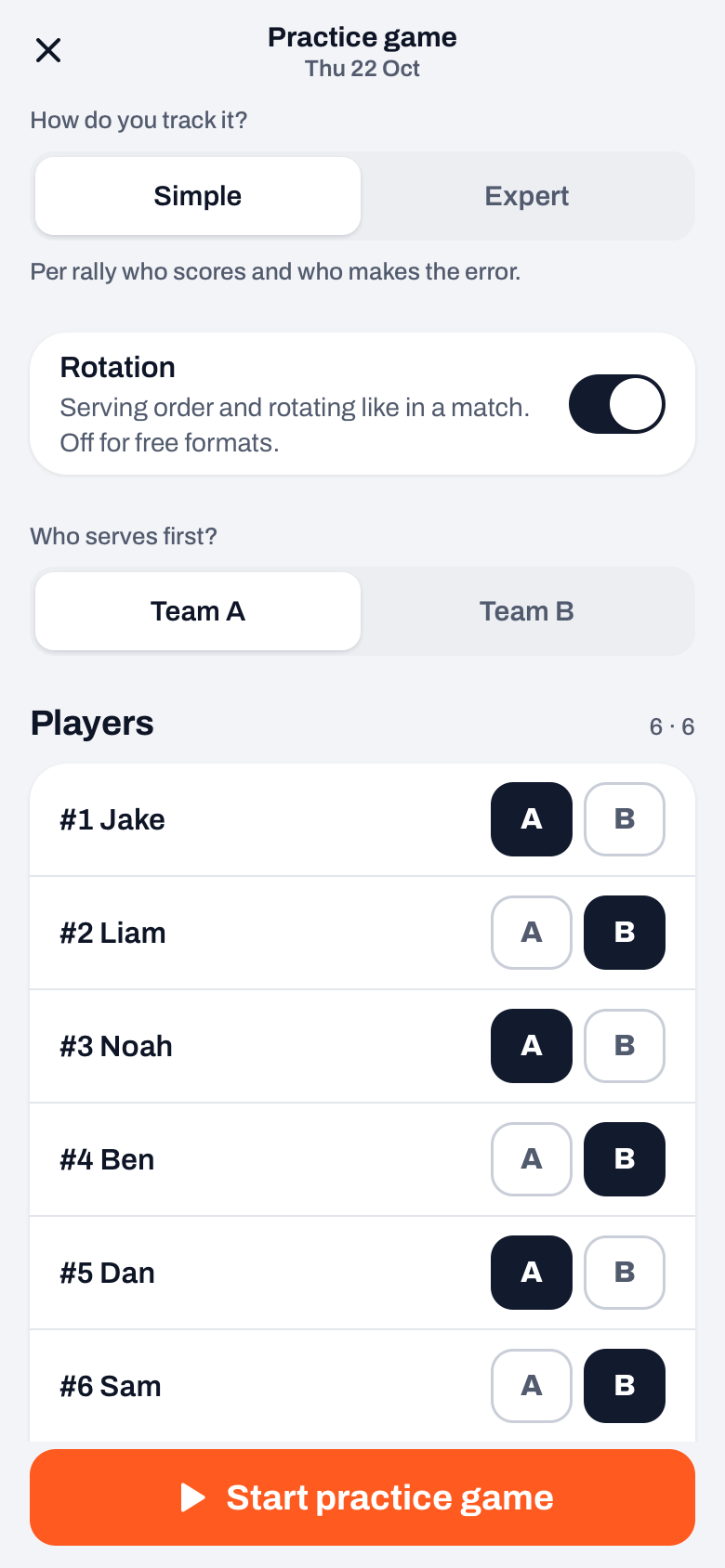
In Koach you play every scrimmage game as a Practice game: your own players in team A and team B, started from a block in your practice plan. The steps are in volleyball scrimmage. Four things are handy for scrimmage games:
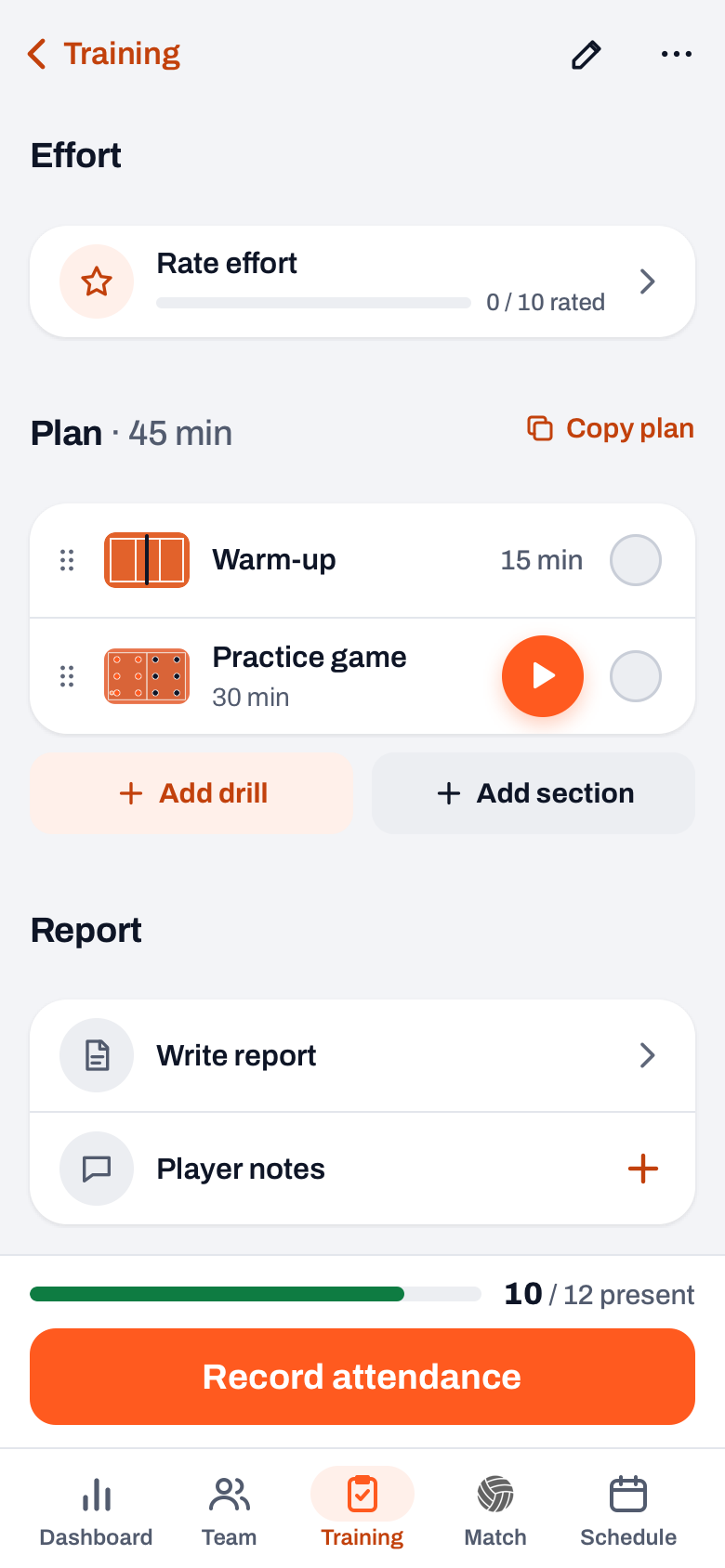
- Give the block the name of the format. Tap the Practice game block in your plan and change the name, for example to Endgame from 20-20. The game will be listed under that name in your Practice games list later. Put the scoring in one sentence in the description.
- Rotation off for free formats. With Rotation on, you serve and rotate as in a match. If you play with fixed positions or in a small format, switch it off.
- New round for each starting score. New round keeps the score and resets the counter to 0-0. For the endgame or the comeback game, you add the starting score yourself.
- Focus in Expert. For the pass bonus, choose Expert with the focus Reception. Then you rate every pass from 0 to 5, and for the rest of the rally you only choose who wins it.
One honest note: the app counts every rally won as one point. It doesn't know bonus points or rallies that don't count. If a rally doesn't count, don't tap anything; count a bonus point out loud. What the app does show is who won the rallies and who scored or made the error, and for most formats that's exactly what you want to know. The Practice game is included in Coach and Club; what those cost after the 14 free days is on the pricing page.
14 days free, no credit card. Put your scrimmage game in your plan as a Practice game on Tuesday and see afterwards who scored the points.
Try Koach at your practiceLet the scoring do the work. Say as little as possible during a scrimmage game. If the scoring is well chosen, the score corrects your players, and all you have to do is watch whether your focus shows up in the rallies.
Frequently asked questions
What is a scrimmage game in volleyball?
A scrimmage game is a game at practice in which you adapt the scoring or the rules, so that exactly what you're training that evening is rewarded. Think of a point that only counts after three contacts, a bonus point for a side-out on the first attack, or a round that starts at 20-20. The difference from an ordinary game is that the scoring steers your players.
How long should a scrimmage game last at practice?
Usually 15 to 25 minutes, at the end of the practice. Play a few short rounds rather than one long one: every new round is a fresh start, and with formats like the endgame from 20-20 you get more tense moments that way. Stop while the format is still going well, and your players will want to play it again next week.
Which scrimmage games work with only a few players?
The three-contact game, the comeback game and the earned-points-only format work from three or four players per team. On a smaller court everyone gets more contacts, which actually makes a small group an advantage. Formats built around rotations and real serve receive, such as the rotation challenge, need six against six.
Can I track a scrimmage game in an app?
In Koach you play a scrimmage game as a Practice game: team A against team B, started from your practice plan, with per rally who scores and who makes the error, or in Expert a rating for each contact. You count bonus points yourself, out loud. You can try Koach free for 14 days, with no credit card and every feature.

Play your next scrimmage game with Koach
14 days free, no credit card. After one practice you'll see who scored the points and who made the errors.
Get started with KoachOr read first what the volleyball coaching app does.