
What Is a Wash Drill in Volleyball? Rules and Scoring
A wash drill is not a particular drill at all — it is a way of scoring. You have to do two things right in a row before a point goes on the board. Fail, and the score washes itself away and you start again.
What wash scoring actually is
In a wash drill, one point consists of two rallies. Team A plays a rally in which it serves, then straight away a rally in which it receives. If A wins both, A gets a big point. If B wins both, B gets one. If each team wins one — the normal outcome — nothing happens at all: the rallies cancel each other out. That cancelling is the wash.
The effect is that a team only scores once it does two different things well back to back: apply pressure with the serve and finish its own side-out. Exactly the combination that separates staying level from pulling away in a match. A team with a solid side-out that never takes a break point stays neck and neck forever — and wash scoring makes that painfully visible in practice.
Why making points disappear works
An ordinary game format rewards every point won equally. That means you can play mediocre volleyball for a quarter of an hour and still end up with a respectable score. Wash punishes exactly the thing an ordinary score hides: inconsistency. Every time you give away the second rally after winning the first, the board still says zero. Teams notice that within five minutes and change how they stand — the second ball of a pair suddenly gets taken seriously.
There is a practical benefit too. Because big points are scarce, a wash format stays tense for a long time. A score of 3-2 after twelve minutes feels sharper than 21-16 in a normal game, and that keeps the intensity up right through to the last block. Write the wash target in the focus field of your Koach session so every coach in the gym that night knows what the game is about.
Setting up a wash drill in four steps
- Pick the two rallies. The classic pairing is a serving rally plus a receiving rally. You can also pick two rallies that both start with a free ball, if what you want to train is out-of-system play.
- Decide what a big point is worth. Usually one; some coaches award two big points if a team finishes both rallies with an attack.
- Set a finishing score. Four or five big points is enough for a block of fifteen to twenty minutes. Otherwise put a clock on it.
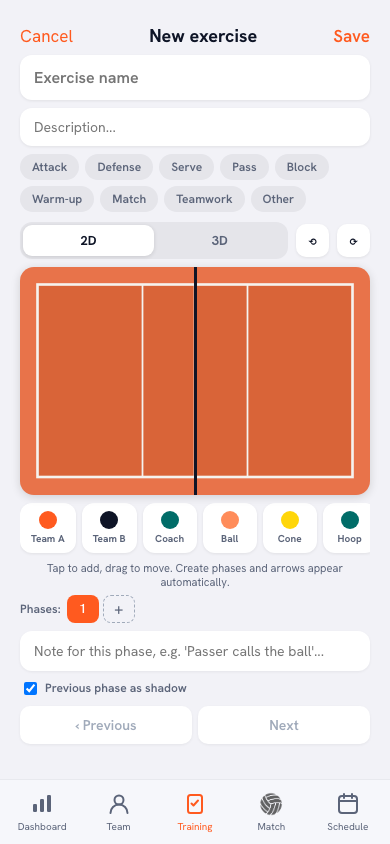
- Write the scoring down. Wash scoring is forgotten within a fortnight. Put it in the drill description — see building your own drills in the editor.
Three wash drills you can run tomorrow
1. Serve-receive wash (6 on 6, 20 min). Team A serves, play out the rally. Immediately afterwards team B serves, play out the rally. Both won by the same team is a big point, otherwise it washes. First team to four big points wins. This is the standard version and the closest translation of a real match.
2. Wash with a free ball (6 on 6, 15 min). Rally 1 starts with a serve, rally 2 starts with a free ball the coach tosses to the team that just received. Harder for the attacking side: a free ball has to be put away, otherwise the wash is lost regardless. Ideal if you notice your team giving away easy balls — see also free balls and down balls.
3. Rotation wash (6 on 6, 25 min). The same as format 1, except the team that scores a big point may only rotate once it has two in a row. You stay in the same rotation much longer, which shows you immediately which rotation of your line-up scores worst. Line that up with what you fixed in the rotation order.
What you correct — and where it goes wrong
The most common problem is the serve. Because a service error automatically hands over half the wash, players start serving carefully and all the pressure evaporates out of the drill. Fix it with a separate rule: an ace is an instant big point, a service error costs a big point. Suddenly playing safe is no longer free. Beyond that, watch for:
- Concentration after the first rally. Almost every team switches off between the two rallies. Send the next ball in straight away, no time to celebrate.
- Counting out loud. Have the captain call the score after every pair; otherwise the count is lost inside ten minutes.
- A score stuck on 0-0. If it is still nil-nil after ten minutes, the format is too hard. Halve the requirement: one rally won plus an attacking point is now a big point.
Wash is a scoring system, not a drill. You can lay it over practically any game format you already run — a 4-on-4, or a drill with fixed rotations. That makes it the cheapest tool in your drill library.
Frequently asked questions
Why is it called a wash drill?
Because the two rallies wash each other out if both teams win one: nothing appears on the board. Only a team that takes two rallies in a row has anything to show for it.
How long does a wash format usually take?
Reckon on fifteen to twenty minutes for four or five big points. If it takes longer, either the requirement is too strict or your players are serving too safely — lower the bar or add a bonus for the ace.
Is wash scoring suitable for youth teams?
From the moment a team can play rallies of three contacts, yes, but keep the bar low: two rallies in a row is already a lot for a young team. For the youngest age groups, ordinary scoring works better.

Try it yourself in Koach
Less admin, more coaching.
Get started with KoachOr read first what the volleyball coaching app does.