
Volleyball concentration drills: staying sharp between points
The short answer
Concentration in volleyball is having your attention on the right thing at the right moment: letting go after a rally, choosing your next task and watching the server and the ball at the whistle. Volleyball concentration drills train it with a fixed routine between points, one cue word per task and games where switching off costs you.
Good volleyball concentration drills don't ask players to stare straight ahead for an hour. A rally lasts a few seconds, and between two rallies there is often more time than in the rally itself. Staying sharp means knowing what to do in that pause, and where to look as soon as the whistle goes.
What concentration in volleyball is: attention that keeps shifting
Volleyball is a sport of short bursts. The ball is in play for a few seconds, then the referee whistles and everyone stands still again. So concentration is not one long effort but switching over and over: letting go of what just happened, seeing what comes next and narrowing your gaze to the ball at the right moment.
Sport psychologists often describe attention along two axes, following the model of the American sport psychologist Robert Nideffer (Nideffer, 1976): broad or narrow, and external (what you see) or internal (what you think and feel). A volleyball player goes through all four in every rally. A player who has lost their concentration is usually in the wrong place: inside their head when they need to look outward, or broad when they need to be narrow.
| Moment | Type of attention | What you are doing |
|---|---|---|
| Right after the rally | Broad, internal | Letting go, breathing out, choosing your next task |
| Getting into position | Broad, external | Who is serving, where is their setter, who is in the front row |
| Whistle to toss | Narrow, external | The server: their body, their toss, their hand |
| In the rally | Narrow, external, constantly switching | Ball, setter, hitter, ball |
Between points: four steps in a few seconds
The time between two rallies is where concentration is won or lost. Give that time a fixed order, so there is no room left for the scoreboard or the last ball:
- Let go. The rally is over, won or lost. A short cheer or a short moment of frustration, then one breath out. How to deal with an error is in mental training for volleyball players; here the point is that the rally is really finished.
- Look around. Broad, all around you: who is serving for them, which rotation are you in, which of their hitters are in the front row? Two seconds, no analysis.
- Choose. One task for the next rally, in one word: "shoulder", "high", "middle".
- Narrow. At the whistle your eyes go to the server and stay there until the ball is released.
For the server it works slightly differently. They have to hit the ball within eight seconds of the whistle (rule 12.4.4 of the FIVB's Official Volleyball Rules 2025-2028), and their serving routine has to fit in that time. For the other five, the huddle after every point is a natural place for steps 1 to 3: you look at each other and everyone says their word.
What do you look at? Attention in the rally
A player who is "concentrating" but does not know what to look at is mostly just tense. Give each role a viewing order. That order is not a gimmick: it decides how much time you have to react.
- Serve receive. Before the serve, the server's body: where are they standing, where is their shoulder pointing? At the toss, the ball and the hand that contacts it. After that, only the ball.
- Block. Ball, setter, ball, hitter. Don't watch the ball for the whole rally, but see where the setter is and which way they set, then watch the hitter's approach and shoulder.
- Defense. The hitter: their approach, their shoulder and their hitting arm. At the moment they hit, you are still and you watch the ball.
- Setter. The pass, and just before you play it a quick glance at their middle blocker.
How fast a player reacts to what they see is a different topic: that is in reaction training for volleyball.
Cue words: one word that steers your attention
A cue word is a short word that sends your eyes or your body somewhere. It works better when it points to something outside your body. Research on attention and movement, across many different sports and tasks, has shown for years that people usually perform and learn better when they focus on the effect of a movement, such as the path of the ball or the target, than on their own arms or legs (a review of fifteen years of research: Wulf, 2013). That is why "ball to the setter" usually works better than "arms still".
| Task | Cue word | Where it sends your eyes |
|---|---|---|
| Serve receive | "Shoulder" | The server's shoulder, before the toss |
| Block | "Setter" | Where the set goes, before you jump |
| Defense | "Arm" | The hitter's hitting arm |
| Serve | "Zone 1" | The target on the other side, not your own hand |
| Attack | "Block" | The hands of the block in front of you |
Choose one word per task together with the player, not five. What you say to yourself about effort and confidence is called self-talk; you can read more about it in visualization and self-talk.
What pulls attention away in a match
In practice it often works. In a match all sorts of things are added that compete for attention. Six familiar distractions, with what to do about them:
- The scoreboard. Especially from 20 points on, players look at the score after every rally. Agree that the captain or the setter keeps an eye on the score; everyone else thinks about their next task.
- The last ball. An error that lingers pulls your attention inward. That is what step 1 between points is for.
- The referee. Anyone who keeps looking or grumbling after a call misses the start of the next rally. Under the rules only the game captain speaks to the referees when the ball is out of play; the others turn toward the huddle.
- The stands. Shouting parents or supporters, especially in youth volleyball. Don't look at the stands, look at your teammates.
- Interruptions. After a timeout, a substitution or the break between sets you have to get back into the match. Give one task for the first rally afterwards in every timeout.
- Fatigue. Tired players stay sharp for less time, and you notice it in the long rallies at the end of a set. So fitness is part of concentration too.
What a team shows after a point or an error is related but is a topic of its own: see body language in volleyball.
Volleyball concentration drills: five formats for practice
Concentration is not a lecture but a skill. You train it with drills where a moment of switching off costs something straight away, and by doing the four steps between points at practice too.
| Format | How it works | What it trains |
|---|---|---|
| Streak with restart | Ten passes in a row to the setter; one bad pass and the counter goes back to zero | Staying sharp for a long time on a simple task |
| Wash | Two rallies form a pair; a side only gets a point if it wins both | Not switching off after winning a rally |
| Word before the rally | In a scrimmage every player says their task word out loud after each rally, and only then does the coach bring in the ball | The four steps between points |
| Read the server | The passers call "short" or "long" at the moment the server contacts the ball | Watching the server's body |
| With noise | Music, a shouting bench or a coach calling out a wrong score during a scrimmage | Holding your attention through distraction |
How to set up and score a wash is in wash drills. Don't put all five in one practice: pick one or two and stick with them for a few weeks, so players start to feel the routine.
With children up to about twelve, keep the blocks short, don't make them wait in line much and give one word instead of three. A child who loses attention because they wait five minutes for their turn does not have a concentration problem but a drill with too much waiting. If you have just started coaching, begin with the basics from your first season as a volleyball coach; concentration drills come after that.
Watch only your players' eyes for one set. Between rallies, do they look at the scoreboard, the stands or the floor, or at each other and then at the server? What you see decides which drill you choose for the next practice.
Planning and reviewing concentration in Koach
We make Koach, an app for volleyball coaches. The app does not measure concentration. What it does let you do is plan the drills above, keep score in a scrimmage and see after a match where your team dropped off.
- Planning. In the training screen, + Add section puts a concentration drill in the plan as a section of its own, with a name, the minutes and a description of the rules. With + Add drill you choose from the drills in the app.
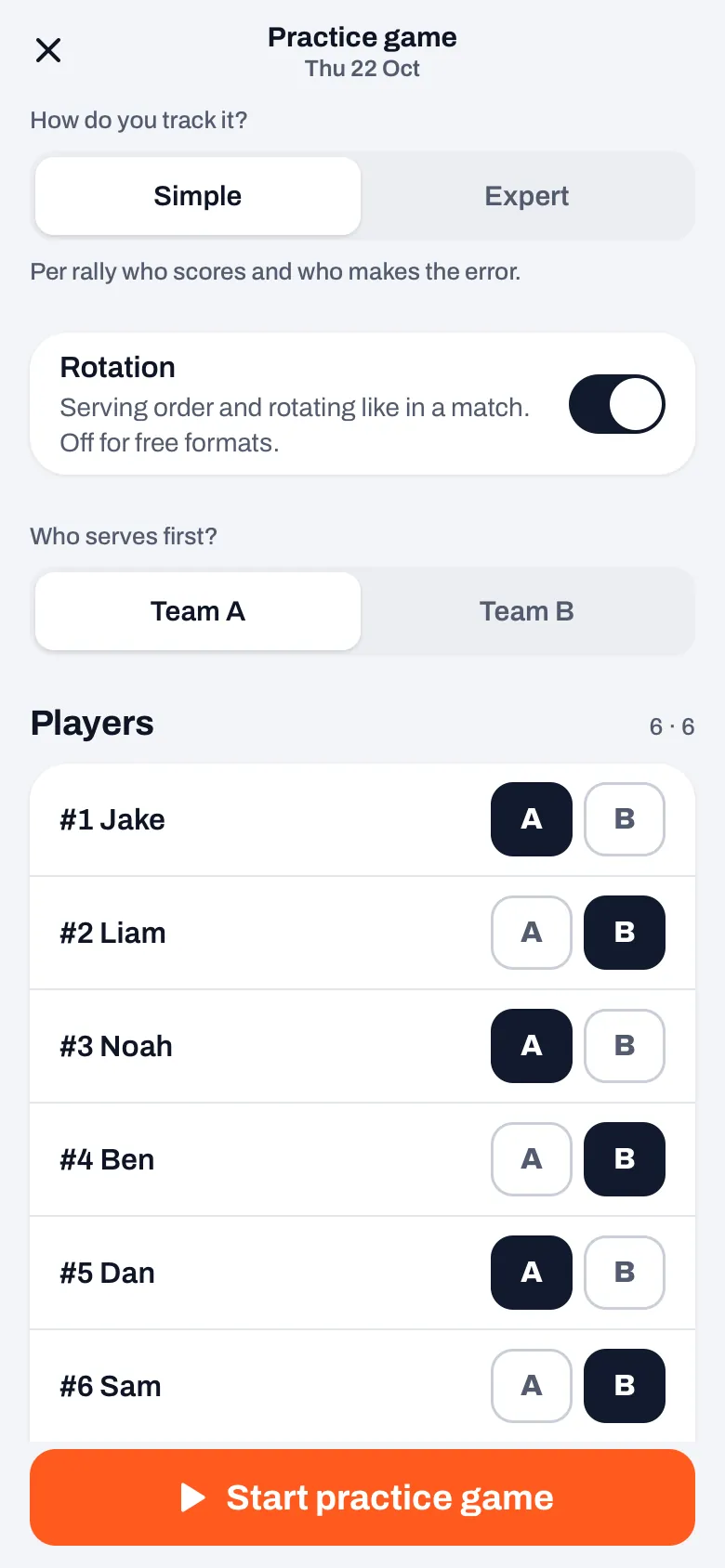
- A scrimmage with a score. Pick Practice game via + Add drill and start it from the plan. You choose Simple (per rally who scores and who makes the error) or Expert, put your players in Team A or Team B, and New round starts you again at 0-0. Afterwards the points and errors for each player are ready.
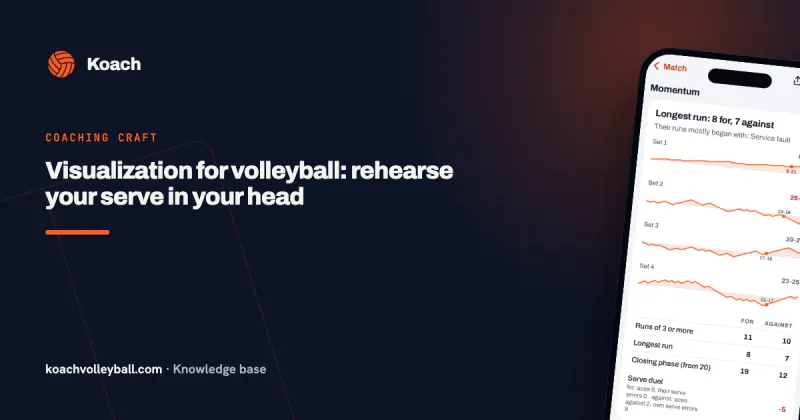
- The closing phase in matches. If you track a match live, afterwards under Stats, at Momentum, you see how your team played in the Closing phase (from 20), what the Longest run for and against was and, if you took timeouts, how the three rallies after a timeout went.
- Passing it on. In the training report you write under Focus for next time what the group is working on. At the next training that focus appears in the training screen above the plan, for your fellow coach as well.
14 days free, no credit card. Put one concentration drill in your plan next week and see after the match how your team played the closing phase.
Plan your practice in Koach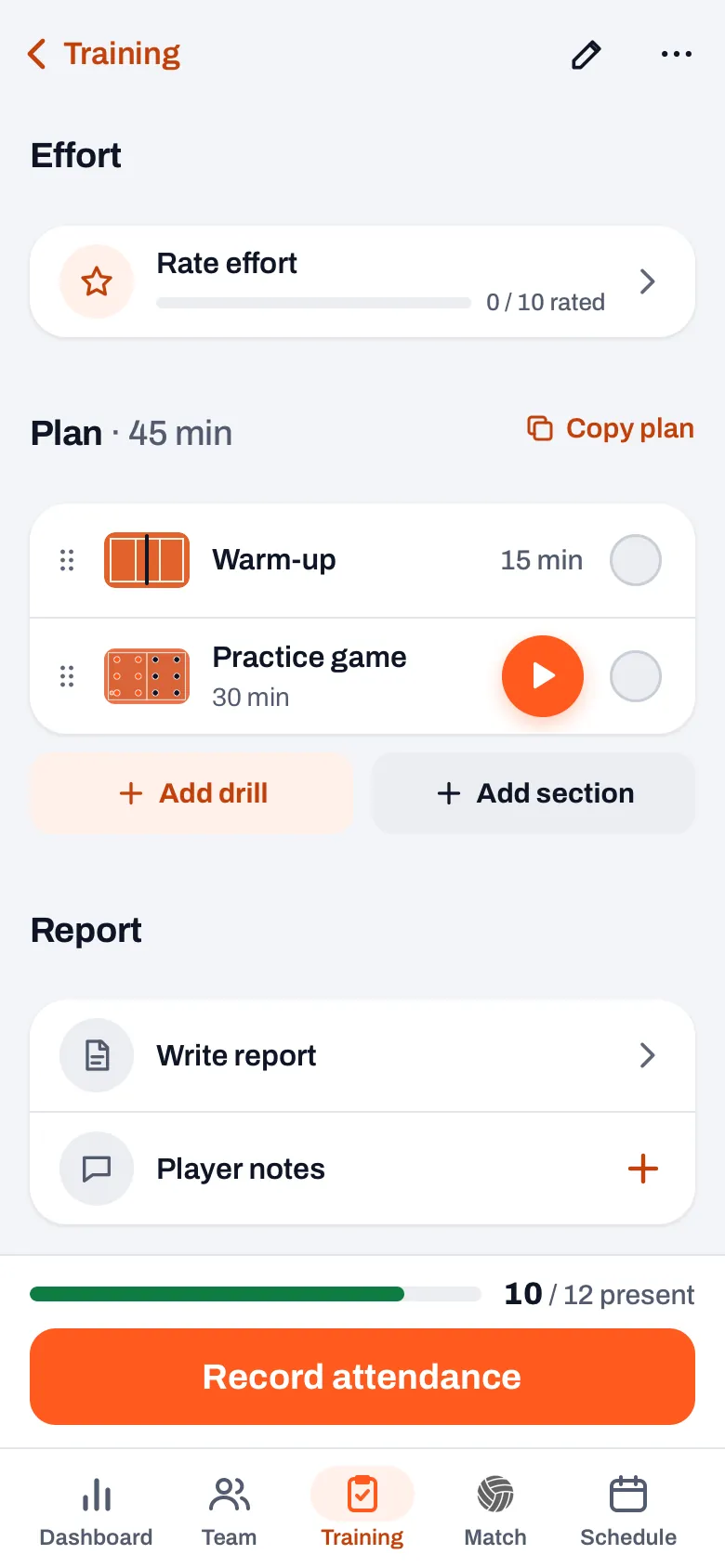
What Koach costs after the trial is on the pricing page.
Frequently asked questions
How can I concentrate better during a volleyball match?
Give the time between rallies a fixed order: let go, look around, choose one task in one word, and at the whistle put your eyes on the server. Know for your role what you look at in the rally, and don't check the scoreboard after every rally. Practice that routine at training too, otherwise it feels strange in a match.
Why do I lose concentration at the end of a set?
From 20 points on the score draws more attention: you think about the result instead of the next ball, and fatigue does the rest. Agree on who keeps an eye on the score, stick to your task word for the rally and now and then play scrimmages at practice that start at 20-20, so the closing phase feels familiar.
What are good concentration drills for volleyball?
Drills where switching off costs you straight away: a streak of ten passes that starts over after an error, a wash where you have to win two rallies in a row, a scrimmage where everyone says their task word before each rally, and passers who call whether a serve will be short or long. Add noise now and then, such as music or a shouting bench.
How do you train concentration in young volleyball players?
Keep drills short, don't let children wait much and give one word per task instead of a list of instructions. Game-like drills with lots of ball contacts hold attention by themselves. After a rally, don't ask what went wrong but what they will look at next time, so their attention goes forward instead of back.
Plan your next practice with a concentration drill
14 days free, no credit card. After your next match you see how your team played the closing phase.
Get started with KoachOr read first what the volleyball coaching app does.