
Volleyball reaction drills: how players react faster to the ball
The short answer
Volleyball reaction drills work best with signals from the game itself: a ball that drops, a ball out of the net, the arm of a hitter. Start with one signal and one response, build up to a choice between two or three directions and finish in a game format where reacting wins points.
Volleyball reaction drills are less about fast muscles than many coaches think. A player who is late to the ball usually does not move slowly but late: they saw too late what was coming. Here you read how reacting works, how to build it in four steps and which seven drills do that.
What is reaction time in volleyball?
Every reaction has three steps: see, decide and move. The player sees a signal, decides what to do and gets the body going. Only that last step is muscle work. The first two happen in the head, and that is where most players have the most to gain.
There are two kinds of reaction. In a simple reaction there is one signal and one response: the ball drops, you go. In a choice reaction there are more options: left or right, short or deep, a hard hit or a tip. The more options, the longer the choice takes. In a match, nearly every reaction is a choice reaction.
The time for it is short. Palao and Valadés measured serve speed in the men's World League (2006) and estimated from that that a passer facing a hard jump serve has roughly half to three quarters of a second, 0.52 to 0.74 seconds (The Sport Journal, 2014). A player who only starts deciding when the ball crosses the net is already too late. Good players solve that by knowing sooner what is coming. A meta-analysis of 42 studies on perception and decision-making in sport found that athletes at a higher level pick up the cues better than athletes at a lower level: they respond more accurately and faster (Mann and colleagues, 2007). That study compares levels and does not say how to train it, but it does show where the difference lies: in what a player sees, and when. That is why reaction training is to a large extent training the eyes.
What exactly a defender watches on a hitter, from the approach to the elbow, is covered in reading the hitter. This article is about the training: how to build reacting as a goal of its own.
Why a light board is not enough
Reaction boards with lights, apps that flash a color and tapping games on cones are popular. They are fun and measurable, but mostly they train reacting to that particular signal. A systematic review of commercial cognitive training products, from brain training apps to a light board on the wall, found little direct evidence that the gains carry over to performance in sport. That was mainly because it had hardly been tested in sport: of the 43 studies, one looked at a sports task (Harris, Wilson and Vine, 2018). So it has not been shown that it does not work either. But in a match, no light comes on.
Hence one rule of thumb: the closer the signal is to the match, the bigger the chance that it carries over. A coach shouting is the furthest away, a color or a number a bit closer, a ball that drops or comes out of the net closer still, and the arm of a real hitter is the signal itself. Separate signals have a place in the warm-up and with young players. The core of your reaction training has a ball and a choice.
The progression: from one signal to game-like
Make a drill harder one step at a time. This ladder of four steps works for every skill:
| Step | What the player does not know | Example |
|---|---|---|
| 1. One signal, one response | The moment | A ball that drops right in front of you |
| 2. A choice of two or three | The moment and the direction | Left, right or short |
| 3. A signal from the game | What is coming: they have to read it themselves | A ball out of the net or off the block |
| 4. Game format | Everything, and reacting earns a point | A scrimmage with a second ball |
Only move up a step when a player mostly chooses well and is on time at the current step. If that slips, go back a step instead of shouting louder.
Seven volleyball reaction drills
Steps 1 and 2: getting going and choosing
- 1. Ball over the head. The player stands in ready position facing the net, and a partner stands two meters behind them with a ball. The partner tosses the ball in an arc over the player's head to the front. The player goes as soon as they see the ball and, after one bounce at most, forearm passes it high back to the partner. Ten balls, then switch. Step 2: the partner throws left, right or short in no set order.
- 2. Numbers on the ball. Write large numbers on a few balls with a marker. The tosser throws from the other side, and the passer calls out the number they see before touching the ball. Step 2: an even number goes to position 2, an odd number to position 4. That way the player keeps their eyes on the ball until just before contact, and still has to choose on the way.
- 3. Short or deep. In Short-deep serve receive the coach alternates short and deep balls and the passer chooses to go forward or back. Turn it into a reaction drill by playing every ball with the same arm action, so the player has to read the ball and not the coach.
Step 3: reading what the game shows
- 4. Ball out of the net. The coach stands next to the net and throws balls into it: high near the tape, halfway or low, soft or hard. A defender stands about three meters from the net, reads how the ball comes out and plays it high to the middle. Twelve balls per player. How to play such a ball technically and who takes it is covered in playing a ball out of the net.
- 5. Block deflection. A player stands on a sturdy bench at the net with their hands up as a block. The coach stands on a box on the other side and hits into those hands, and two defenders behind the block play the ball that deflects. Nobody knows where it goes, not even the coach. That is exactly the ball that drops so often in a match.
Step 4: reacting that wins points
- 6. Second ball within two counts. Play three against three or four against four. As soon as a rally ends, the coach immediately throws in a new ball, to a random side and spot. Anyone still celebrating or grumbling is too late. The full six-against-six version is called Speedball 6-6 in the Koach library.
- 7. Double point for a save. A normal scrimmage, but a rally you win after a ball out of the net, a picked-up tip or a ball off the block counts double. That way you reward the reacting itself, not just the attack that follows.
Give a point for the right first step. In choice drills, count whether the player moved the right way, even if the ball goes wrong afterwards. If you only reward the successful ball, players learn that guessing pays.
How often, and where in your practice?
- Fresh. Put reaction drills straight after the warm-up or at the start of your defense block. On tired legs you mostly train fatigue.
- Short. Series of six to ten balls per player, with enough rest to play every ball at full speed. Eight to twelve minutes per practice is enough.
- Inside your regular drills. Add one unknown to an existing drill: the direction, the moment or the type of ball. Then reaction does not even need a block of its own.
- By age. Up to about twelve, work with games: tag, catching, a ball that bounces oddly. Teenagers do steps 1 to 3, adults mainly steps 3 and 4.
Reaction touches on other skills, and those have their own article. Formats such as colored cones and a dropped tennis ball are in volleyball coordination and agility drills, the defensive posture and diving in volleyball defense drills. How such a block fits into the rest of your evening is covered in running a volleyball practice.
Finding reaction drills for your practice plan
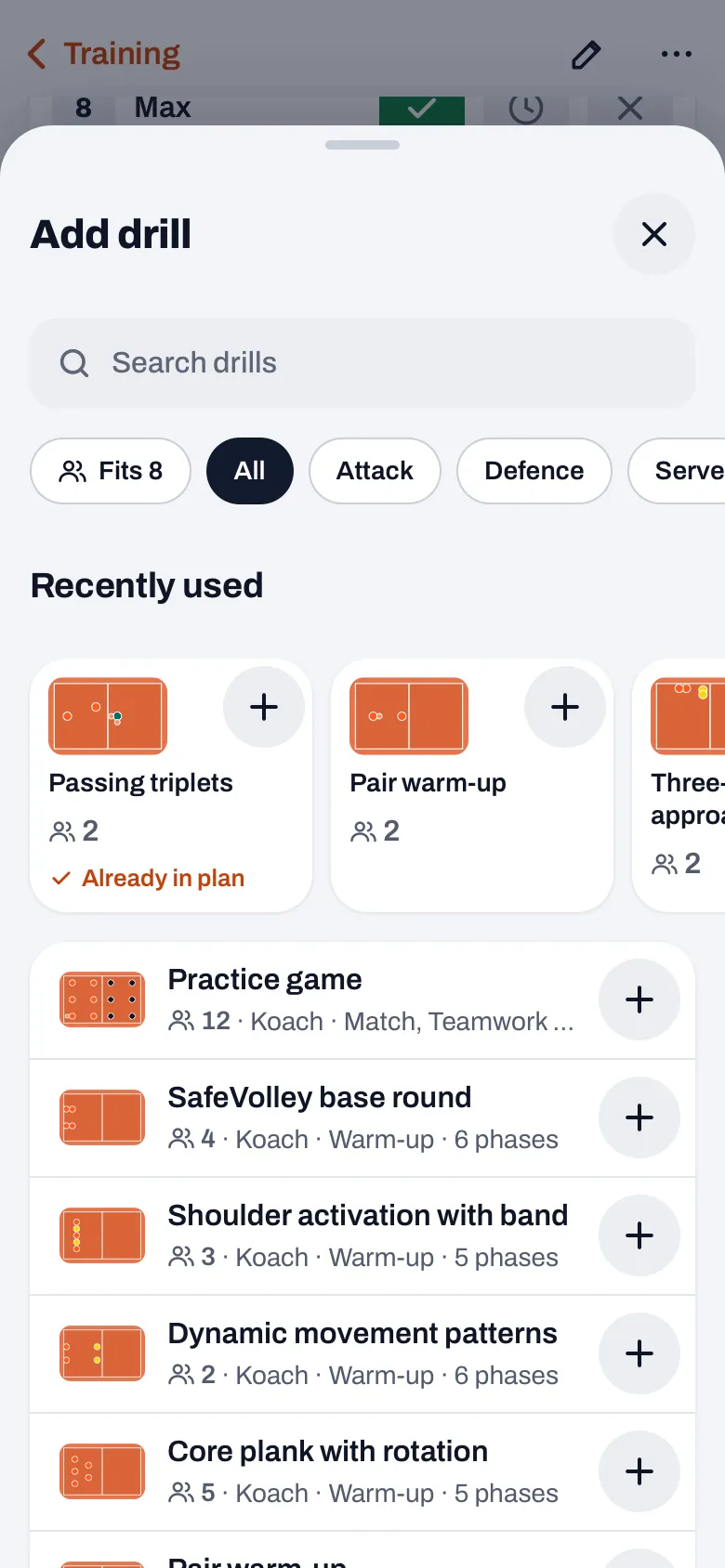
In Koach you put a reaction block in the plan of your practice. With + Add drill you open the Add drill sheet. Type a word such as reaction or read in Search drills: the app searches the name and the description, so you find drills like Bench block reaction, Short-deep serve receive and Coach on the box. Each drill shows the number of players drawn in it. Tap Fits, with that evening's number after it, and you only see drills for that number of players or fewer. A drill that is already in the plan gets the label Already in plan.
A drill of your own, such as the block deflection, you draw once in the drill editor; after that it sits with your other drills. A worked-out defense drill with a fixed moment to freeze is Defensive posture (base & read). There the team steps from base to read position on a signal from the coach and freezes at the moment the coach hits. Leave out that signal, and your players have to see for themselves when to move to their read position. What Koach costs after the 14 free days is on the pricing page.
14 days free, no credit card. Put two reaction drills in the plan of your next practice and see whether your defenders get moving sooner.
Plan your reaction block in KoachFrequently asked questions
Can you train reaction time in volleyball?
Yes, but most of the gain comes before the movement. A player learns where to look, chooses faster between a few options and is set in time to be able to move. You train that with signals from the game, such as a ball out of the net or the arm of a hitter, and with drills in which the player does not know what is coming.
Does a reaction ball or a light board help?
As a warm-up or as a game for young players they are fine: they are fun and you see right away whether someone is on time. There is just little evidence that reacting to lights carries over to the court. So use them briefly, and spend most of the time on drills with a volleyball, a net and a choice that also comes up in a match.
How do you train reaction with kids?
With games. Tag, catching after one bounce, a ball you drop or one that comes over their head: kids up to about twelve learn most from many different signals in short rounds. Keep the turns short, switch often and count something they want to improve, such as how many balls they catch in time.
How long should a reaction drill last?
Not long. Six to ten balls per player per series, with enough rest to play every ball at full speed. In total, eight to twelve minutes per practice is enough. Do it early in practice, while the legs are still fresh; a tired player mostly learns to be late.
Put your reaction block in your plan
14 days free, no credit card. Next week you will see whether your players get moving sooner.
Get started with KoachOr read first what the volleyball coaching app does.