
Volleyball agility drills: 12 coordination drills for practice
The short answer
Volleyball agility drills and coordination drills train how a player steers their movements: reacting, keeping balance, judging distance and getting feet, eyes and hands to work together. They work best short and fresh after the warm-up, and they finish with a ball or a choice so they carry over into the match.
Volleyball agility drills turn a player who is fast into a player who gets to the ball on time. Here you read what coordination and agility are, you get twelve drills in four groups, and you see how to fit them into your practice for each age group.
What is coordination in volleyball?
Coordination is the ability to steer your movements precisely and match them to each other. A widely used model from German movement science (Meinel and Schnabel) describes seven coordinative abilities. You meet all of them in a single volleyball rally:
| Ability | What it looks like in volleyball |
|---|---|
| Reaction | Moving off the attacker's swing or off a ball that drops from the net tape |
| Orientation | Knowing where you are in relation to the net, the lines, the ball and your teammates |
| Balance | Landing still after a jump, staying low and stable in defense |
| Differentiation | Judging a set of four or of eight meters with the same hands |
| Coupling | Joining approach, arm swing and hit into one movement |
| Rhythm | The rhythm of the approach and of the block jump |
| Adaptation | Adjusting a planned action when the ball deflects off the block |
Agility: changing direction on the right cue
In sports science, agility is a rapid whole-body movement with a change of speed or direction in response to a stimulus (Sheppard and Young, 2006). There are two parts to that: how fast you change direction, and how fast you see and decide when and where to go. An agility ladder or a fixed cone course mainly trains the first part. In volleyball, the ball, the attacker or your teammate's pass decides when you move, and you only train that second part with a cue the player does not know in advance. A review in Sports Medicine names reaction time, accuracy and foot placement as factors, and points to small-sided games as a format that seems to improve agility (Paul, Gabbett and Nassis, 2016).
So coordination is something other than conditioning. Jumping power and repeated sprints are covered in conditioning for volleyball players, and the footwork patterns themselves (split step, shuffle and crossover) in volleyball footwork. This article is about the steering: when you move and how precisely.
Twelve volleyball agility and coordination drills
The drills come in four groups, each with a basic version and a progression. Work in short sets of five to ten seconds with twenty to thirty seconds of rest. Train coordination while players are fresh: a tired player mostly drills in their own sloppiness.
Reaction and agility
- 1. Colored cones. Four cones in different colors in a three by three meter square, the player in ready position in the middle. The coach calls a color, the player touches that cone and comes back to the middle. Progression: the coach holds up a colored card instead of calling, so the player has to look. Then the coach tosses a ball into a corner and the player passes it back with a forearm pass.
- 2. Tennis ball drop. The coach stands three to four meters away with a tennis ball in each hand at shoulder height and drops one. The player starts from ready position and catches the ball after one bounce. Progression: more distance, or the player stands with their back to the coach and only turns on a hand clap.
- 3. Read the hitter. The coach stands on a box at the net and makes an attacking motion, but hits or throws the ball to one of three zones. Two defenders land their split step at the moment of contact and dig the ball to a target zone. Progression: the coach mixes hard hits, tips and a ball over the block, so defenders have to read instead of guess.
Hand-eye coordination and ball feel
- 4. Two balls at once. Pairs four meters apart, each with a ball. On a signal they throw at the same time: one underhand, the other overhand, so the balls do not collide. Each catches the other's ball. Progression: catch with one hand, then the overhand throw becomes a set.
- 5. Wall ball switch. Two meters from a wall, the player throws a tennis ball with the right hand and catches with the left, and the other way round. Progression: a quarter turn after every catch, or a partner behind the player throws the ball against the wall, so the player only sees it as it bounces back.
- 6. Judging distance. The player sets to three targets at two, four and six meters (a hoop or a partner with hands up), in the order the coach calls. Progression: alternate a light training ball and a regular ball. That difference forces the player to adjust power and distance again and again.
Balance and landing
- 7. Passing on one leg. Pairs: A tosses, B passes on one leg and only puts the other foot down after contact. Progression: B first makes a small hop on one leg, lands still and then passes. Switch legs every five balls.
- 8. Land and freeze. A jump from standing or from a short approach, landing on two feet with the knees over the toes, and holding still for two counts. Only when the landing is stable does a partner toss a ball for the player to play. Progression: a quarter turn in the air before the landing.
- 9. Spin and play. The player does a forward roll on a mat or spins twice around their own axis, and immediately plays a ball the partner tosses. Progression: the partner tosses during the spin and calls left or right. This rehearses what happens in a match after a dive or a collision: quickly knowing where you are again.
If you also want to use balance to prevent ankle injuries, you need a set program with a progression over several weeks. That is in balance and proprioception training.
Rhythm and coupling
- 10. Approach rhythm on markers. Put down three markers for the steps of the approach. The player first runs the rhythm without arms (slow, quick-quick), then with the arm swing, then with the jump, and finally catches a tossed ball at the highest point.
- 11. Ladder with a ball at the end. One ladder pattern, followed straight away by a pass off a tossed ball. The ladder gives the rhythm, the ball turns it into volleyball. Which patterns make sense is covered in agility ladder drills for volleyball.
- 12. Juggling on the move. The player keeps the ball up, alternating forearm passes and overhand passes, while walking from the end line to the net and back. Progression: moving sideways, moving backwards, or one contact with the fist every five contacts.
Start on the hitter's hand, not on your whistle. A whistle is a cue that never comes in a match. In the reaction drills, let players move off a ball contact, a gesture or a dropping ball, and they train the looking they need on Saturday.
Coordination by age
- 8 to 11 years. As many different movements as possible, as a game: tagging, throwing and catching with different balls, rolling, turning and jumping. Variety is the goal here, perfection not yet. From the list above, drills 2, 4, 5 and 9 fit best.
- 12 to 15 years. All twelve drills, more and more often with a ball and a choice. Keep growth in mind: a player who grows a lot in a few months can become clumsier for a while, and that is not a lack of effort. More on that in what a growth spurt does to a youth player.
- 16 and older. Short and volleyball-specific: two or three drills right after the warm-up, with the focus on reacting, landing and the approach.
How to fit coordination into your practice
Plan for ten to fifteen minutes, right after the warm-up, when the legs are warm but not yet tired. Pick three drills from three different groups per practice and rotate the groups each week, so all four come up within a month. How a block like this fits into the rest of your session is explained in running a volleyball practice.
Four rules keep it workable:
- Make one thing harder at a time. More distance, a different ball or a different cue, but not all of them in the same round.
- From known to unknown. First a fixed task, then a cue the player has to see, then a choice between two or three directions.
- Finish with a ball. A drill without a ball gets a pass, a set or a catch at the end. That keeps the link with the game.
- Stop when the quality drops. If knees cave inward on the landing or players start standing up straight, the set is too long or the rest too short.
A coordination block in your practice plan
In Koach you add a block like this as a section in the plan of a practice. With Add section you create a block with a name, a duration and a description where you can note that evening's three drills. With Add drill you pick drills from the library, with animated phases; type a word like ladder or reaction in the Search drills field and you see which drills are already there. If the block worked, bring it back at a later practice with Copy plan and only swap the drills.
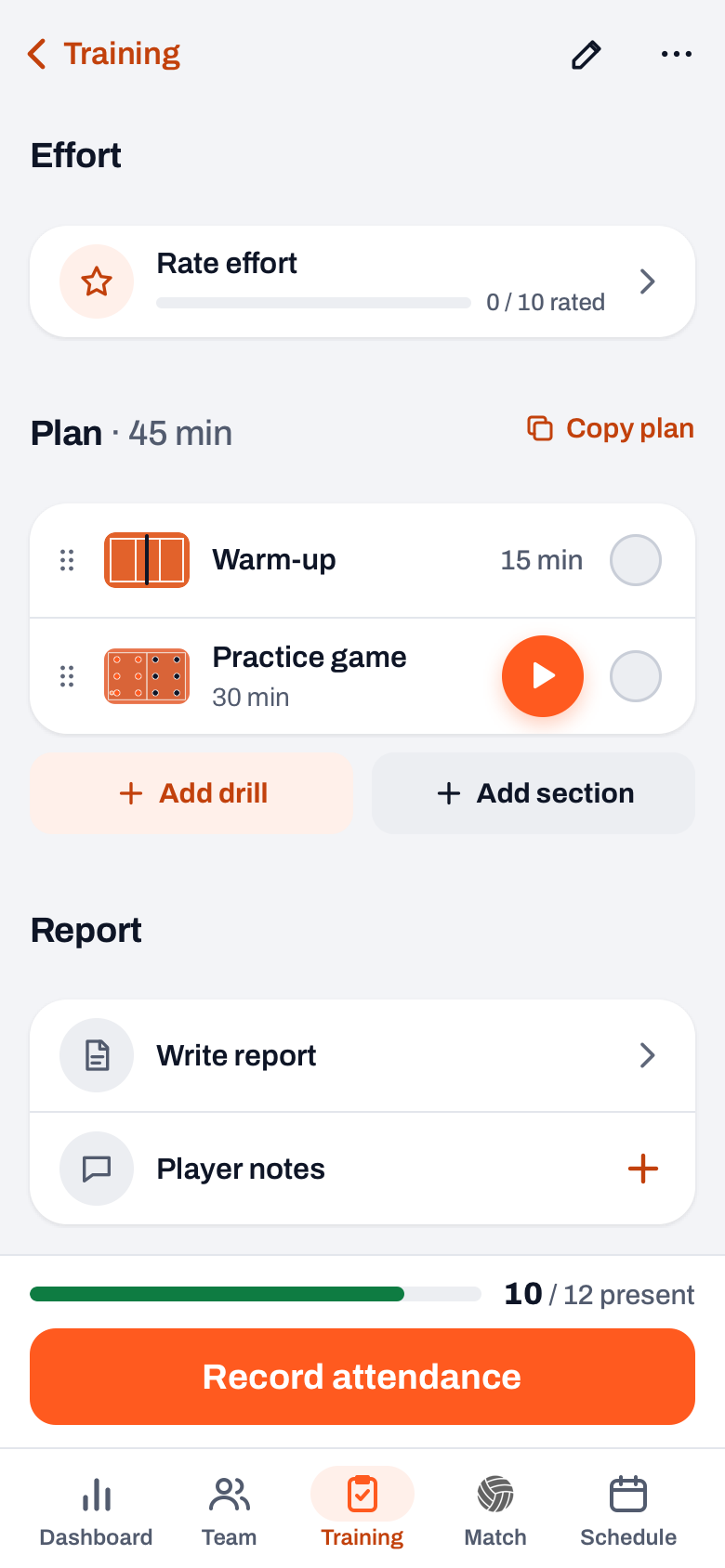
After practice you mark for each section whether it was done, so you can see how often the coordination block really made it in. What Koach costs after the 14 free days is on the pricing page.
14 days free, no credit card. Put your first coordination block in the plan of your next practice and copy it to the week after.
Plan your practice in KoachFrequently asked questions
What is the difference between coordination and conditioning?
Conditioning is about how much your body can handle: jumping power, speed and recovery between actions. Coordination is about how precisely you steer your movements: reacting on time, landing in balance and playing the ball with the right amount of force. A player with a big jump and poor timing still gets to the ball late. You train both, but with different drills.
How often should you train coordination in volleyball?
Short and often works better than a long block now and then. Ten to fifteen minutes in every practice, right after the warm-up, is enough for most teams. With youth teams it can be more, because coordination is a bigger part of their development. Change the drills each week, but keep the block itself as a fixed part of your program.
What equipment do you need for coordination drills?
Not much: cones or disc markers in a few colors, a few tennis balls, a mat and your regular volleyballs. An agility ladder is handy but not necessary; lines on the floor or loose markers do the same job. A lighter training ball next to the regular ball helps in drills where players have to judge power and distance.
Does coordination training help prevent injuries?
Balance and a good landing are a standard part of programs that aim to prevent ankle and knee injuries, so the drills in the balance and landing group contribute to that. A complete prevention program is more than a few drills a week, though. If a player has persistent or severe complaints, have them see a doctor, a sports physician or a physical therapist.


Put your coordination block in your plan
14 days free, no credit card. Next week you copy it with one tap.
Get started with KoachOr read first what the volleyball coaching app does.