
Volleyball ladder drills: footwork that carries over to the court
The short answer
Volleyball ladder drills train foot coordination, rhythm and quick small steps. They belong in the warm-up, short and early, and only pay off when every rep ends in a real volleyball action: a split step, a move to the ball or a block jump. Reacting to the ball is something the ladder does not teach.
Volleyball ladder drills are a common sight in gyms: quick feet through a ladder on the floor. They are useful, but less than they look. Here you read what the agility ladder trains, which eight patterns suit volleyball and how to set the ladder up so the footwork carries over to the court.
What an agility ladder does and does not train
An agility ladder is a strip of about ten boxes on the floor that players move through with a fixed step pattern. It trains foot coordination, rhythm, quick small steps and landing on the balls of the feet. Players learn to control their feet while their upper body stays calm. That is valuable, especially for youth players and beginners.
What it does not train is what volleyball is all about: reacting. Sport science distinguishes a change of direction you know in advance from agility in the strict sense, where you react to something you do not know beforehand, such as a hitter who turns their swing (Sheppard and Young, 2006). In the ladder every pattern is fixed. In a small controlled study of eighteen 12-year-old soccer players (Padrón-Cabo and colleagues, 2020), one group did ladder drills three times a week for six weeks, the other only their normal training. Afterwards there was no difference between the two groups in sprinting, agility or dribbling.
On top of that, the steps in the ladder are smaller than on the court. In volleyball you usually move a few meters with a shuffle or a crossover, and you are balanced and still when you play the ball; how those steps work is in volleyball footwork. So the ladder is a stepping stone. It wakes the feet up, and only the transition to a real volleyball action turns it into training.
Eight volleyball ladder drills
Start each pattern slowly and correctly, and only raise the tempo once it is error-free. For every pattern: on the balls of your feet, knees slightly bent, arms moving as in running, and look ahead as soon as the pattern is in, not at your feet.
1. One foot in each box
Forward, one foot in each box, left and right alternating. The basic rhythm. Make small, quick contacts instead of big strides.
2. Two feet in each box
Forward, with both feet in every box. This trains step frequency. Stay on the balls of your feet; you can hear anyone who lands on their heels.
3. Lateral, two feet in each box
You stand next to the ladder and move sideways, with both feet in each box and without crossing. This is the rhythm of the shuffle. Keep your hips low and your shoulders square to the front, as if you are facing the net.
4. Two in, one out
You move diagonally forward: two feet in the box, then one foot outside the ladder on the other side, and so on in a zigzag. This trains quick changes of direction with your feet under your hips. Your upper body stays above the ladder.
5. In, in, out, out
You face the ladder and shuffle sideways along the boxes: both feet into the box, both feet out again, one box further. You keep landing wide, just like in a split step. Land softly, with your knees over your toes.
6. Open and close
Forward with small hops: feet together in the box, then apart on either side of the next box, then together again. This trains landing on two feet and getting back into a ready position fast. Small hops, not high ones.
7. Lateral crossover
Sideways along the ladder, with the trailing foot crossing alternately in front of and behind the lead foot. Your hips rotate with it, your shoulders as little as possible. This is the start of the crossover step you use in defense and at the block.
8. Single-leg hops
On one leg forward, one hop per box, then on the other leg. This trains ankle and knee stability on landing. Keep your knee straight over your foot, not caving in. Players with ankle or knee problems skip this pattern.
From the ladder to the court: the transition is the drill
Set the ladder up so players do something volleyball-specific straight away at the end. Then the footwork does not stop at the last box, and a reaction is added: to the ball, to a signal or to an opponent. Three setups that work:
| Ladder | Transition | Finish |
|---|---|---|
| Two feet in each box, towards the net | Split step the moment the coach hits the ball, then a shuffle to the ball | Pass to the setter's spot |
| Lateral, ladder parallel to the net | Two crossover steps along the net | Block jump with the hands over the net |
| In, in, out, out from the end line | The coach points left or right, the player chooses shuffle or crossover | Digging a tossed ball |
The signal is the most important part. Do not let players go at their own pace, but on the coach slapping the ball, a called-out color or a pointing hand. Only then do you train the reaction the ladder itself is missing. The drill agility ladder circuit shows the basic form: after the ladder the player steps through, the coach immediately plays a ball in and the player passes it back.
Never let the last step end in the ladder. Put a cone or a ball two meters past the last box and agree: anyone coming out of the ladder makes a split step first. That way the ladder becomes a run-up to volleyball instead of a trick of its own.
How long, how often and where in your practice
- In the warm-up, after the general part. Five to eight minutes is enough. The ladder belongs at the start of practice, when the legs are warm and not yet tired; how to build the rest of the warm-up has its own article. At the end of practice the steps get sloppy, and then you are training the wrong ones.
- Quality before speed. Two to four times per pattern, with the walk back as rest. If a player stumbles or sits back on their heels, the tempo goes down, not up.
- No line. With twelve players you put down two or three ladders, with at most four players per ladder. The next player goes when the previous one is halfway.
- No ladder? Tape on the floor, chalk lines or the court lines work just as well. A real ladder lies flat on a dry floor; a ladder that slides is a tripping hazard.
- Change the patterns, not the principle. Two or three different patterns every week, but always with a ball action at the end.
With youth players the ladder can last longer and be more playful: a relay, copying what the player in front does, or a pattern they invent themselves. At that age coordination is a goal in itself; more ideas are in volleyball agility drills.
When to leave the ladder on the shelf
- You practice once a week. Then footwork with a ball gives you more than ladder work without one.
- Your players are experienced and already move well. Quicker feet in the ladder do not make a good defender any better.
- It turns into a speed race with straight legs and players staring at their feet.
- The floor is slippery or the ladder slides away.
If a player has ankle or knee problems, leave out the hopping and jumping patterns and have the problem checked by a physiotherapist or sports medicine doctor. If you have just started coaching and are unsure what belongs in your first practices, have a look at starting as a volleyball coach.
Putting ladder drills in your practice plan
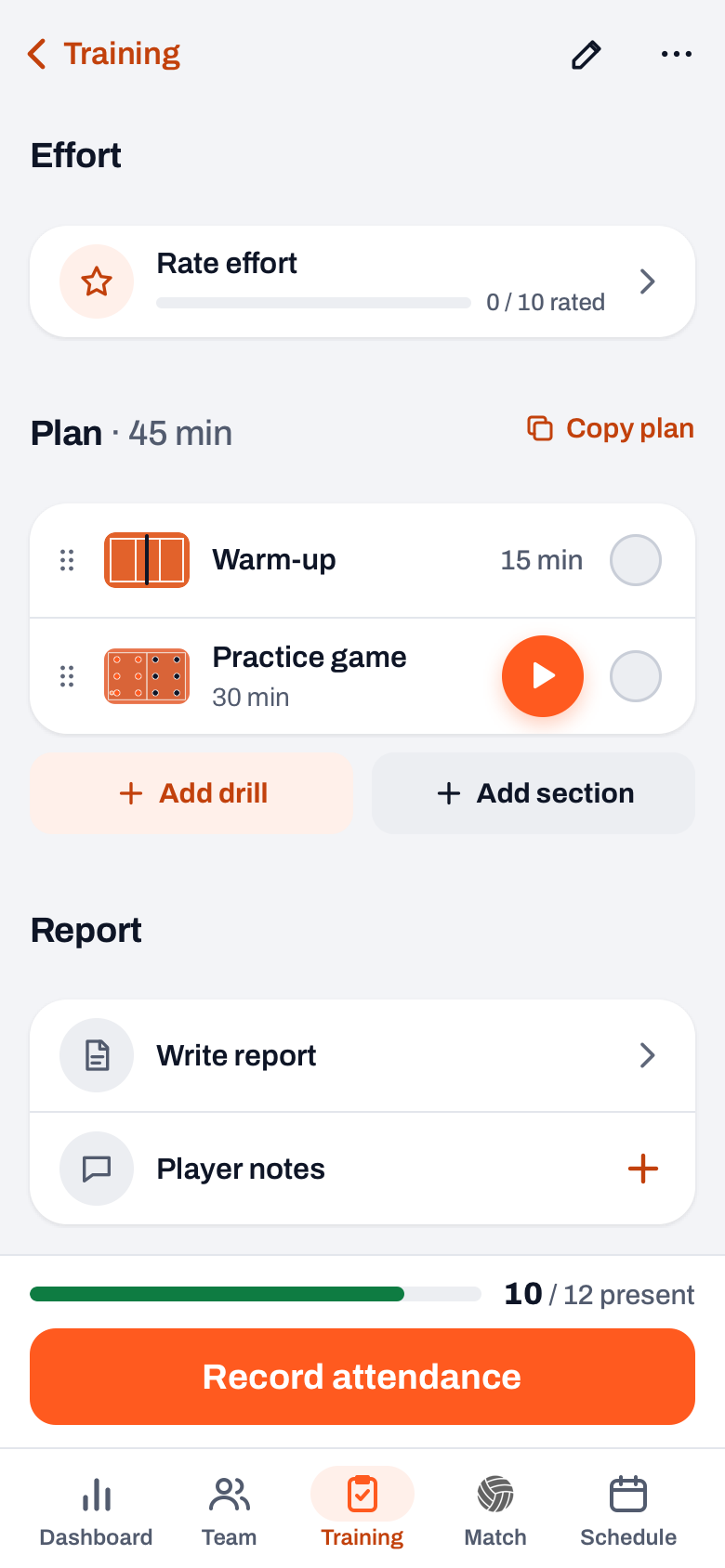
In Koach you put the ladder block into a practice plan as a section. With + Add section you create a block with a name, the duration and a description, where you can list the patterns and the finish. With + Add drill you search the drills for "ladder" and add, for example, the agility ladder circuit, with its animation. After practice you mark per section whether it was done, and with Copy plan you take the block along to the next practice.
What Koach costs after the 14 free days is on the pricing page.
14 days free, no credit card. Put your ladder block with its finish into your plan and copy it to the next practice.
Plan your practice in KoachFrequently asked questions
Is an agility ladder useful for volleyball?
Yes, as a warm-up and coordination drill, short and early in practice. It trains rhythm and quick steps, but not reacting to the ball. So let every rep end in a split step, a move and a ball action, and do not use it to replace footwork with a ball.
How many ladder drills should you do per practice?
Two or three patterns in five to eight minutes are enough. Do each pattern two to four times, with the walk back as rest. More patterns in one practice make it busy in the head, not quicker in the legs. Better to switch patterns from week to week.
Can you do ladder drills without a ladder?
Yes. Tape on the floor, chalk lines outside or the court lines will do. What matters is the pattern and the transition to the ball, not the equipment. Do make sure the surface is flat and dry, so nobody slips or trips over a loose ladder.
Are agility ladder drills good for kids?
Yes, for kids they are useful as coordination training, as long as you make a game of it: a relay, copying or inventing a pattern themselves. Keep the patterns simple and the line short. Do hopping and jumping patterns with small hops, and leave them out if there is ankle or knee pain.


Put your ladder block in your plan tonight
14 days free, no credit card. After a month you see which sections you actually did.
Get started with KoachOr read first what the volleyball coaching app does.