
Proprioception exercises for volleyball: fewer ankle sprains
The short answer
Proprioception exercises for volleyball train your sense of where your ankle and knee are: standing on one leg, with your eyes closed, on an unstable surface and landing after a jump. In volleyball players, five minutes of balance work in every warm-up reduced the number of ankle sprains, especially in players who had sprained an ankle before.
Proprioception exercises for volleyball are balance exercises that teach your ankle to correct quickly when your foot lands wrong. For a volleyball team they cost five minutes per practice and little equipment. Here you read what research in volleyball players found, which exercises to do and in what order, and for whom they count extra.
What is proprioception, and what does your ankle get out of it?
Proprioception is your sense of the position and movement of your joints, without looking. Sensors in ligaments, tendons and muscles constantly report how your foot is placed, and your muscles respond. If your foot comes down at an angle, the muscles around the ankle correct in a fraction of a second. After a sprain that system often works less well, and that is one of the reasons an ankle that has been sprained once rolls over more easily again.
Balance training, or proprioceptive training, practices that response. You keep putting the body slightly off balance: on one leg, with your eyes closed, on an unstable surface, or while also playing a ball. In volleyball many ankle sprains happen when a player lands on someone else's foot under the net. So balance training is an addition to agreements about the center line and a good landing, not a replacement. That broader story is in injury prevention in volleyball.
What research in volleyball players shows
- Norway. In the two highest Norwegian leagues, Bahr and colleagues introduced a program with education, training of take-off and landing in blocking and attacking, and balance board training for players who had sprained an ankle more often. Over two seasons the number of ankle sprains dropped from 0.9 to 0.5 per 1,000 hours of volleyball (Bahr et al., 1997).
- The Netherlands. Verhagen and colleagues followed 116 volleyball teams for a season. The 66 teams in the intervention group did one balance exercise of at most five minutes in every warm-up, for 36 weeks, chosen from fourteen basic exercises on and next to a balance board that got progressively harder. They had 0.5 ankle sprains per 1,000 hours, against 0.9 for the teams without the program. The effect could only be shown in players who had sprained an ankle before (Verhagen et al., 2004; the program is described in the economic evaluation).
- After a sprain. In a study of 522 athletes aged 12 to 70 who had recently sprained an ankle, about half got an eight-week home program: three times a week for at most half an hour, preferably as part of their own warm-up. In the year that followed they sprained their ankle again 35 percent less often (Hupperets et al., 2009). How to build a player back up after a sprain is covered in returning after an ankle sprain.
One side finding from the Dutch volleyball study is worth knowing. Players who had a previous knee injury got overuse knee complaints more often in the group with the balance program. The researchers therefore called a previous knee injury a possible reason to be careful with balance board training. Have those players do the exercises on the floor instead of on the board, and check with their physiotherapist if in doubt.
The lesson for a coach: a few minutes per practice, all season, is enough to see an effect, and you gain the most in players with a previous sprain. Because you don't always know who they are and it takes little time, you have the whole team join in.
Twelve proprioception exercises in four levels
Start at level 1 and only move up a level once a player can hold the exercise for thirty seconds without putting the free foot down. Do everything on both legs and in court shoes, and put quality before time: a knee that wobbles or caves inward doesn't count.
Level 1: stable floor, eyes open
- Single-leg stance. On one leg, knee slightly bent, hips level. Thirty seconds per leg.
- Clock taps. On one leg you tap the toes of the free leg as far as you can forward, to the side and backward, without putting weight on it. Three rounds per leg.
- Passing on one leg. In pairs three meters apart, pass the ball overhead while standing on one leg. Twenty contacts, then switch legs.
Level 2: eyes closed or head moving
- Single leg with eyes closed. Twenty to thirty seconds; compare left with right.
- Look and turn. On one leg you follow with your eyes and head a ball your partner moves slowly from left to right.
- Catching off balance. On one leg; your partner throws the ball just beside you, so you have to reach to catch it and throw it back.
Level 3: unstable surface
- Balance board on two legs. Keep the board level for half a minute, then with your eyes closed.
- One leg on a pad or folded mat. Thirty seconds, then with small knee bends.
- Passing on the pad. Exercise 3, but on the soft surface.
Level 4: jumping and landing
- Hop and stick. A hop forward and hold still for three counts on the same leg. Five per leg.
- Sideways over the line. Hop over a line on the floor, left and right, and hold still for three counts on every landing. Five times there and back.
- Block, land, hold. Block jumps at the net, land on two feet and straight away stand on one leg for three counts. Five times.
What makes it volleyball-specific is the combination: playing or catching a ball while keeping your balance, and landing after a jump. That is closer to a match than standing still on a board.
How balance training fits into the warm-up
Follow the setup of the Dutch volleyball study: one exercise per practice, at most five minutes, every practice, all season. Put it in the part of your warm-up where you activate the muscles, after loosening up and before the first work at the net.
- Work in pairs. One does the exercise, the other throws, counts or watches the knee. Switch after thirty seconds.
- Equipment is not a requirement. Levels 1, 2 and 4 can be done on the bare floor. For level 3 a few balance pads or folded mats are enough. If you only have three, three pairs work on the pad and the rest do a floor exercise.
- Change exercises every two to three weeks. The same exercise for a whole season gets boring. A progression in difficulty keeps it fresh, and that is also how the studied program worked.
- Don't let it drop out in busy weeks. The effect in the research came from five minutes per practice, every practice. A long balance block once a month is something else.
At the first practice, ask who has ever sprained an ankle. In the research, balance training paid off most for those players. Make sure they really do the exercises, and only give them the harder versions once the easy ones go well.
Who needs extra, and when not to do it
- Players with a recent sprain need more than five minutes in the warm-up: a program from their physiotherapist, or an eight-week home program like the one in the research. For them a brace or tape can make sense too, see ankle brace, tape or nothing.
- Players with knee complaints do the exercises on the floor and skip the balance board and the hops until their clinician says it is fine.
- A swollen or painful ankle sits out. Balance training is prevention, not treatment for a fresh injury.
- Youth players can do everything. Make it a game, for example who can stand on one leg longest with their eyes closed, and keep it short.
Balance matters for the knee too: it is a fixed part of the warm-ups that help prevent an ACL injury. This article gives general sports medicine knowledge, not treatment advice. Pain that doesn't go away, an ankle that keeps giving way or a fresh injury belong with a family doctor, sports physician or physiotherapist.
Five minutes of balance in every practice plan
A program only works if it comes back every practice, and that is exactly what goes wrong in a busy week. In Koach you add the balance block to the practice plan with + Add section, straight after the warm-up: a name, five minutes and in the description the exercises at the level the team is at. For the next practice you bring the plan back with Copy plan: one tap on an earlier practice and the sections are back. Afterwards you mark each section as done.
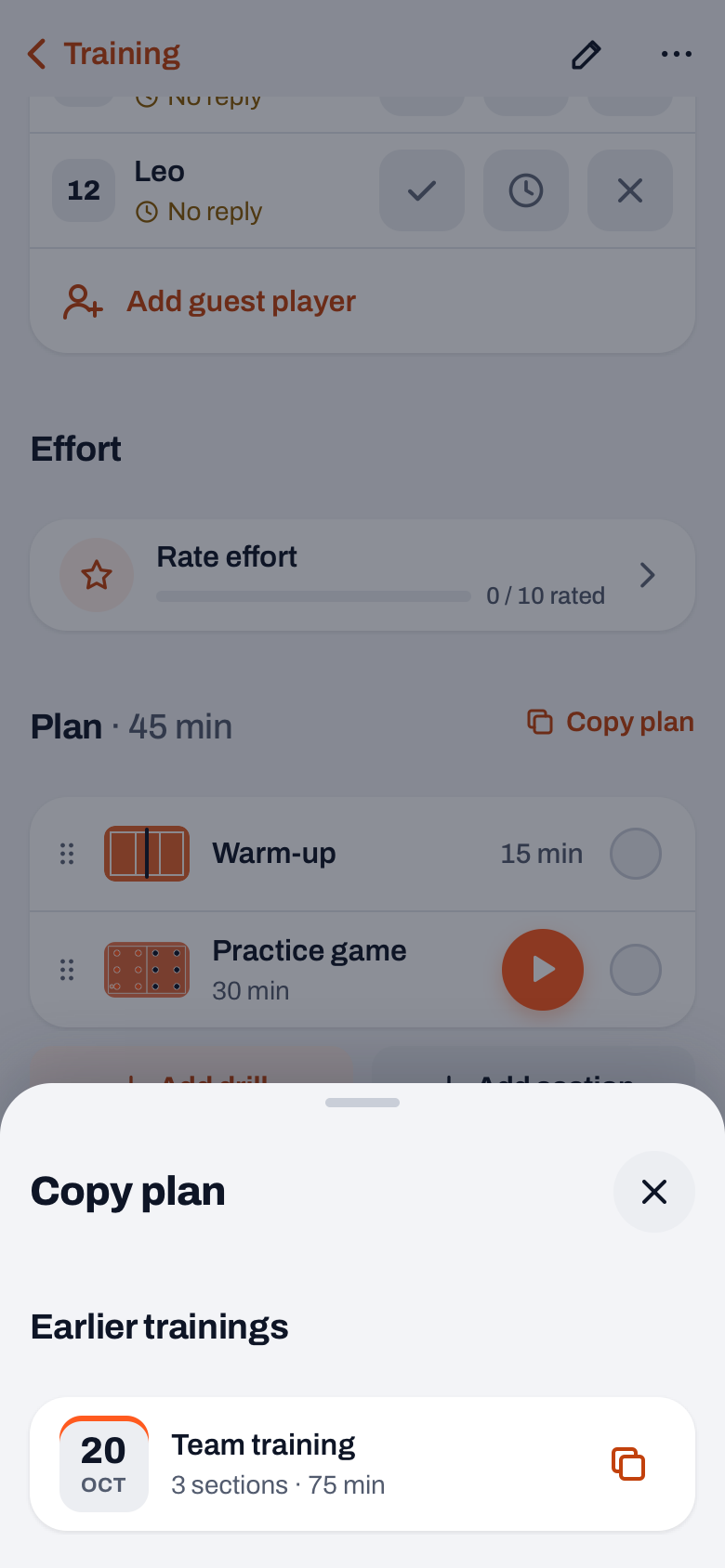
If you have just started as a coach and are looking for the rest of a fixed practice structure, read starting as a volleyball coach. What Koach costs after the 14 free days is on the pricing page.
14 days free, no credit card. Put the balance block in Tuesday's plan and bring it back at every following practice with Copy plan.
Plan your practice in KoachFrequently asked questions
What are proprioception exercises?
Exercises that train your sense of where your joints are, so your muscles correct faster when your foot or knee comes down wrong. Examples are standing on one leg, the same with your eyes closed, standing on a balance pad or balance board, and landing after a hop with a three-count hold. For volleyball players a ball comes in: passing or catching while standing on one leg.
How often should you do balance training to prevent ankle injuries?
In a study of volleyball teams, players did one balance exercise of at most five minutes in every warm-up, all season long, and they had fewer ankle sprains. After a sprain, an eight-week home program with three sessions a week worked in another study. So short and often, all season long, is the form that worked in research.
Do you need a balance board for proprioception exercises?
No. On the bare floor you get a long way: on one leg, with your eyes closed, with a ball added and with landings after a hop. A balance pad, folded mat or balance board makes it harder and is handy once the floor exercises get too easy. If you only have a few, have a few pairs at a time work on the pad.
Does balance training help if you have never sprained an ankle?
In the volleyball research the effect could only be shown in players who had sprained an ankle before; for the others the difference was too small to measure. Still, it is wise to have the whole team join in: it takes little time, you don't always know who has an old sprain, and balance and landing are also part of preventing knee injuries.

Put your balance block in the plan tonight
14 days free, no credit card. Next week you copy it with one tap.
Get started with KoachOr read first what the volleyball coaching app does.