
ACL injury in volleyball: risk, prevention and return to play
The short answer
An ACL injury in volleyball almost always happens without contact, on a landing or a sudden stop in which the knee caves inward. A fixed warm-up with strength, balance and landing technique roughly halves the risk. Returning within nine months of surgery means a higher chance of a new injury.
An ACL injury in volleyball is less common than a sprained ankle, but it can easily cost a player a whole season. It almost always happens without contact, on a landing that goes just slightly wrong. Here you read who is most at risk, which warm-up lowers the risk and what your role is in the return to play.
What is an ACL injury, and how does it happen in volleyball?
The anterior cruciate ligament (ACL) runs through the middle of the knee from the thighbone to the shinbone. It keeps the lower leg in place when you stop, land or turn. If it tears, it happens in a single moment. So it is a different injury from jumper's knee, which builds up slowly through overload.
In volleyball it rarely goes wrong through a collision. In a Japanese study of 1,000 ACL injuries in school students, 86.5 percent of the volleyball cases happened without contact, more than in basketball and handball (Takahashi et al., 2019). In the two highest Italian women's leagues, researchers counted 34 ACL tears: 33 without contact, and 21 of those on the landing after an attack jump (Devetag et al., 2018).
A typical picture: an attacker takes off for a set that is too far off the net, hits with a twist and lands on one leg. The knee is almost straight, caves inward and the lower leg rotates with it. The same can happen to a defender who stops hard and turns in one movement. Often the player hears or feels a pop, the knee gives way and it is swollen within a few hours.
Who is most at risk of an ACL injury?
- Attackers. They most often land after a jump with a twist or off balance. In the Italian study above, 24 of the 34 tears were in outside hitters and middle blockers.
- Girls and women, especially from puberty on. In contact sports such as soccer and basketball women run about three times the risk of men (Montalvo et al., 2019). In that review volleyball falls under the limited-contact sports; no clear difference showed up there, but almost all the volleyball data came from women. What is known is that the number of ACL injuries in girls rises during the teenage years, with a peak in the mid to late teens (Myer et al., 2013).
- Players who have had an ACL injury before. A previous injury to the same or the other knee is one of the clearest predictors of a new one.
- Tired players with a sloppy landing. Knees that cave inward on landing, landing with straight legs and little strength in the hips and hamstrings increase the load on the ACL. What a good landing looks like and how to teach it is covered in learning to land safely.
The broader story on ankles, knees and shoulders is in injury prevention in volleyball.
Can you prevent an ACL injury? What the research says
You can't prevent it completely, but you can reduce the risk considerably. What works is not a brace or a stretching routine, but a fixed warm-up with strength, balance and landing technique, known in the field as a neuromuscular training program. Webster and Hewett pooled eight meta-analyses: programs like these halve the risk of an ACL injury, and in women non-contact ACL injuries drop by two thirds (Webster and Hewett, 2018).
A well-known example comes from Swedish soccer. More than 4,500 female players aged 12 to 17 took part. At half of the clubs the teams did a fifteen-minute warm-up with core stability, balance and correct knee alignment twice a week for a whole season. There were 64 percent fewer ACL injuries there than at the clubs with their usual warm-up (Waldén et al., 2012).
Most studies come from soccer, handball and basketball. The mechanism in volleyball is the same, a landing or stop without contact, and the parts of those programs fit easily into a volleyball practice. A volleyball warm-up for youth teams has been studied too: teams that used it had fewer acute injuries, but only 44 percent of the teams did it in full (Verhagen et al., 2023).
Two things make the difference. Do it often and all season: in studies in which teams stuck to such a program, there were far fewer ACL injuries than in studies in which it was often skipped (Sugimoto et al., 2012). And start young: in the analysis by Myer and colleagues the effect was greatest in girls in their mid-teens, and in young adults no effect could be shown anymore.
A knee warm-up for volleyball in four blocks
This example translates the parts of the studied programs to the gym. Count on twelve to fifteen minutes, at least twice a week, as the first part of practice. It replaces your usual warm-up block; it doesn't come on top of it.
- Loosen up (3 minutes). Easy jogging back and forth across the width of the court: forward, sideways with a shuffle step and backward. Stop on two feet a few times, with the knees over the feet.
- Strength (5 minutes). Ten squats with the knees pointing toward the toes, ten lunges per leg, three to five Nordic hamstring curls in pairs (a partner holds your ankles and you slowly lower yourself forward) and thirty seconds of side plank per side. Build up the Nordic hamstring curl gradually; in the first weeks three reps are enough. More core and strength work is in core stability for volleyball players.
- Balance (2 minutes). Stand on one leg and pass the ball overhead in pairs, twenty contacts per leg. If that is easy, briefly close your eyes between contacts or stand on a folded mat. More exercises and a progression are in balance and proprioception exercises for volleyball.
- Jumping and landing (4 minutes). Five two-footed jumps with a landing held still for three counts. Then five hops per leg forward and five to the side, each with a stuck landing, and three approach jumps with an arm swing and a landing on two feet. Finish with block jumps along the net: move, jump and land on two feet on your own side.
In every block, watch one thing: the knee stays over the foot and doesn't cave inward. If you still see it happen in a player, make the exercise easier (less deep, less high) instead of harder.
Don't drop the program when time is tight. If you lose fifteen minutes because the gym frees up late, take it off the scrimmage at the end. A prevention program only works if it comes back every practice, and if you skip it once, it gets easier to skip it the second time.
What do you do if it happens in the gym?
You don't make a diagnosis, and you don't have to. A player who felt a pop after a landing or turn, feels the knee give way or has a swollen knee within a few hours stops playing and goes to a family doctor or sports physician. Don't let them "just try" to jump or run it off: a knee that gives way can get more damaged that way. In the gym you raise the leg, cool it with a cold pack wrapped in a cloth and arrange a ride home. With severe pain, a knee that is locked or a visibly misaligned leg, go straight to the emergency department.
Whether there will be surgery or rehabilitation without surgery is decided by the player together with the orthopedic surgeon or sports physician.
Return to play after an ACL injury: months, not weeks
The return is the moment the second accident happens. Grindem and colleagues followed 106 athletes after ACL surgery for two years. The risk of a new knee injury dropped by about half for every month that the return to sport was delayed, up to nine months after surgery. Those who returned with nearly equally strong thigh muscles in both legs ran less risk (Grindem et al., 2016).
For you as a coach that means three things:
- The clinician decides, not the calendar. The nine months from that study are a minimum, not a date on which the player is automatically cleared. The physiotherapist tests strength, jumps and agility and says what the player may do in the gym. You adjust practice to that, even if you could really use them on Saturday.
- Keep the player in the team. Players who don't play for months drop out easily. Give them a job: keeping stats, running a drill, helping think during the timeout. Let them know they are welcome at practice, even if they can't touch a ball yet.
- Expect doubt. Many players don't dare to land fully straight after their return. Build up the match minutes gradually and talk it through with the player and the physiotherapist.
This article gives general sports medicine knowledge, not a diagnosis or a rehabilitation plan. If a player has knee problems, pain that doesn't go away or a knee that feels unstable, they belong with a family doctor, sports physician or physiotherapist.
The prevention program in every practice, all season
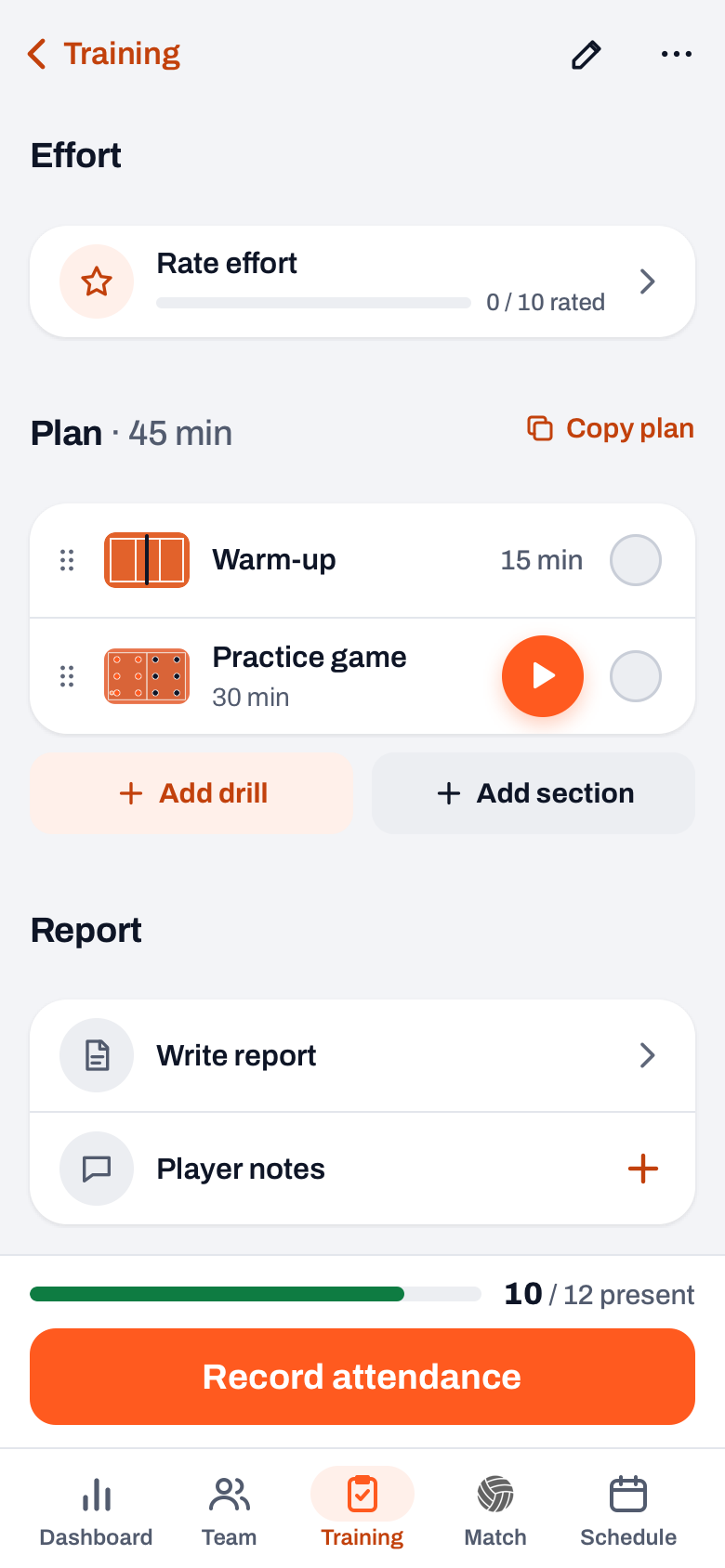
The hard part of prevention is not the exercise but keeping it up. In Koach you put the knee warm-up in a practice plan as the first section: with + Add section you give it a name, a duration of fifteen minutes and a description with the four blocks. Through the practice menu you save that plan with Save as template. If your team belongs to a club, all the club's coaches see that template, so every team can do the same program.
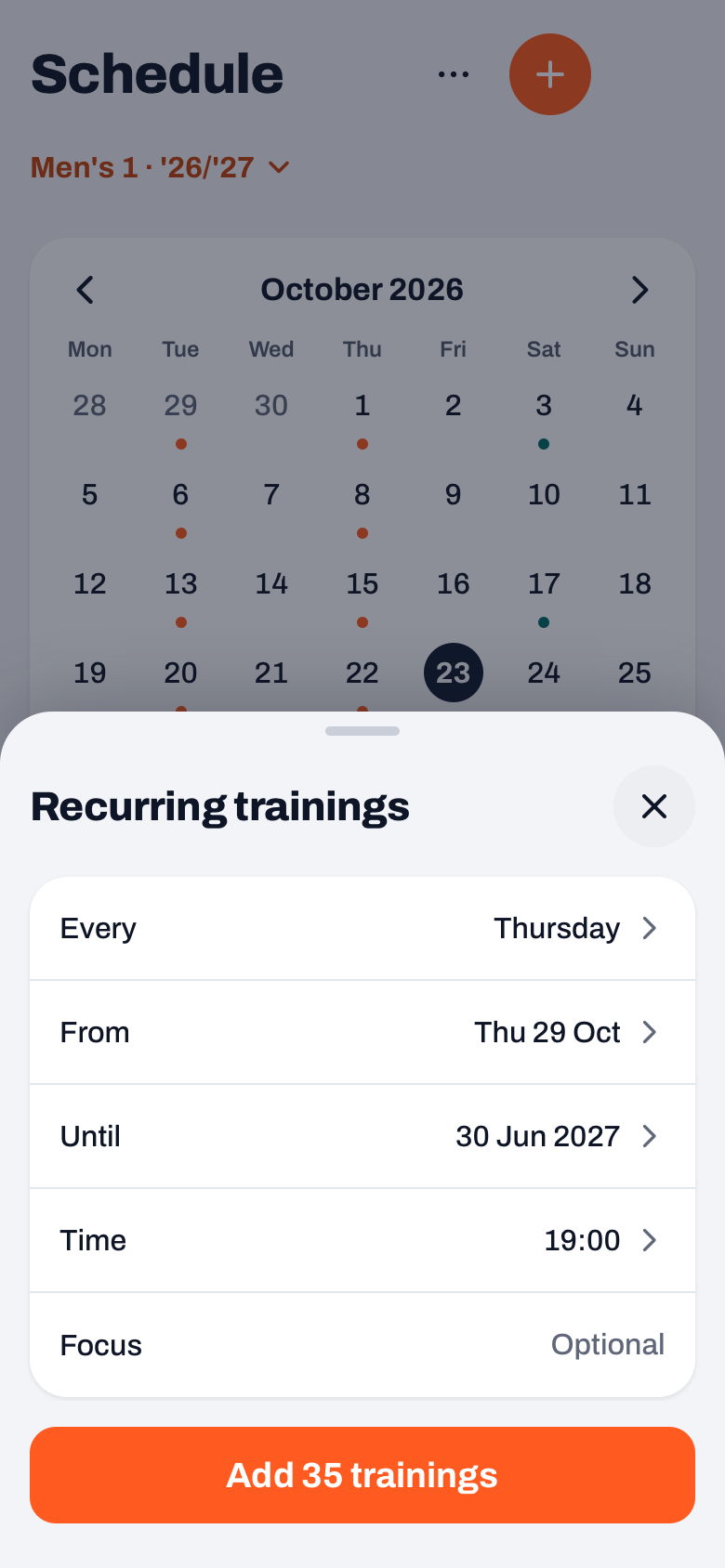
If you plan a whole season in one go with Recurring trainings in the schedule, you choose the template there, and every new practice gets the program straight away. Afterwards you mark each section as done, so you can look back on whether the program really came back every week.
If a player does get injured, you set the status to Injured under Edit player in their profile. You see that in the player list; teammates only see Absent for that player, so the injury doesn't become news for the whole group. If you are just starting out as a coach, you find the rest of the season build-up in starting as a volleyball coach. What Koach costs after the 14 free days is on the pricing page.
14 days free, no credit card. Save your knee warm-up as a template and give it to every practice of the season.
Plan your warm-up in KoachFrequently asked questions
How do you recognize an ACL injury in volleyball?
Typical is a landing or turn without contact, after which the player hears or feels a pop, feels the knee give way and has a swollen knee within a few hours. Many players can't continue, although some can still walk reasonably well. Only an examination by a doctor or physiotherapist gives certainty. So have the player stop and refer them on, even if the pain fades quickly.
How long are you out after an ACL injury?
After surgery it often takes nine months or longer before a player jumps and turns fully again. Research by Grindem and colleagues showed that the risk of a new knee injury drops with every month the return is delayed, up to nine months. The clinician decides the moment with strength and jump tests, not the match schedule.
Are girls more at risk of an ACL injury?
In sports such as soccer and basketball women and girls are clearly more at risk than men, and in girls the number of ACL injuries rises during the teenage years. For volleyball there is too little data for a fixed number. In research a prevention program had the largest effect in girls who started it in their mid-teens, so don't wait until they reach the senior team.
Does a knee brace or knee pad protect against an ACL injury?
Not in healthy players. Knee pads soften a fall on the floor, but they don't protect the ACL, and there is no good evidence for a brace as prevention in volleyball. A warm-up with strength, balance and landing technique does lower the risk. After surgery the clinician decides whether a brace makes sense in the first period.

Set up your knee warm-up tonight
14 days free, no credit card. Every practice of the season gets it.
Get started with KoachOr read first what the volleyball coaching app does.