
Core exercises for volleyball: five for the jump and the swing
The short answer
Core exercises for volleyball train core stability: keeping your trunk under control while your arms and legs produce force, at takeoff, in the arm swing and on landing. You train it with exercises that resist arching, rotating and bending sideways, for example in a short ten-minute block twice a week.
Core exercises for volleyball sound like ab work, but they are about something else: whether the power from your legs reaches your arm intact, and whether your trunk stays still when you land off balance after a block. Here is what the research says about it, with five exercises for a fixed block in your practice.
What is core stability, and what does a volleyball player get from it?
The core is everything between your hips and your shoulders: abs, back, pelvis and the muscles around them. Stable here doesn't mean stiff, but under control. A stable core doesn't let itself be bent, twisted or pushed sideways when you don't want it to, and does rotate when you want it to. In volleyball you see that at four moments:
- The takeoff. The power comes from your legs and has to travel up through hips and trunk. A trunk that sags leaves part of that power behind on the way.
- The attack and the serve. In the arm swing the trunk first opens and then closes. A player who does that in a controlled way usually hits harder and more accurately than one who swings with the arm alone.
- The landing. After a block or an attack you often land on one leg and rarely straight. Then your trunk has to stay over your knee instead of bending sideways.
- Reaching in defense. For a ball to the side or low, your trunk has to give the arm a fixed point, or the ball goes anywhere.
So you train core stability in three directions: resisting arching (anti-extension), resisting rotation (anti-rotation) and resisting bending sideways. Strength training with big movements such as squats and a hip hinge belongs to it too; that program is in strength training for volleyball players. This article is about the short core block you do alongside it.
What the research does and doesn't say
Be honest with your players: core exercises don't automatically make anyone jump higher. A systematic review by Reed and colleagues (2012) concluded that targeted core training gives at most a small direct benefit for sports performance. The gain lies in the combination with strength, jump and technique training, not in the ab exercise itself.
On the injury side there is an indication, though. In a prospective study of 277 college athletes, poorer trunk control after a sudden perturbation predicted who later got a knee injury, in women but not in men (Zazulak and colleagues, 2007). That doesn't prove that core training prevents knee injuries, but it is a good reason not to skip trunk control. What the rest of a good landing looks like is covered in landing technique in volleyball.
Five core exercises for volleyball
1. Dead bug with a ball (anti-extension)
How: lie on your back, arms straight up toward the ceiling, hips and knees at 90 degrees. Press your lower back lightly into the floor. Lower your right arm behind your head and your left leg forward until just above the floor, breathe out, come back and switch. Dose: two to three sets of six to eight per side, slowly. Progression: squeeze a volleyball between your left hand and your right knee and press it in place while the other arm and leg lower. Watch for: if your lower back lifts off the floor, make the movement smaller. This is the pattern of the takeoff and the arm swing: arms and legs move, the trunk stays the fixed point.
2. Side plank (against bending sideways)
How: lie on your side on your forearm, elbow under your shoulder, and lift your hips until your body forms one line from head to feet. Dose: three times 20 to 30 seconds per side. Progression: start on your knees, then on your feet, then with the top leg raised. A next step is threading the top arm under your body and opening it again, without your hips dropping. Watch for: hips that drop or rotate forward. This exercise goes with the one-leg landing and reaching for a ball to the side.
3. Pallof press (anti-rotation)
How: attach a resistance band at chest height to a post or a rack, and stand sideways next to it. Hold the band with two hands against your breastbone, press it straight forward until your arms are extended, hold for two counts and come back. The band pulls you toward the post; you don't let your trunk turn with it. Dose: two to three sets of eight to ten per side. Progression: start kneeling on both knees, then standing, then in a split stance and finally with a step to the side while the arms stay extended. More band exercises are in resistance band exercises for volleyball. This is the trunk of the attack and the serve: it rotates when you want it to, not because something pulls it along.
4. Bird dog with a ball on your back
How: hands and knees on the floor, hands under your shoulders, knees under your hips. At the same time extend your right arm forward and your left leg back until they line up with your trunk, hold for two counts and come back. Dose: two sets of eight per side. Progression: place a volleyball on your lower back that must not roll off; then bring elbow and knee toward each other under your body before extending again. Watch for: an arched back or a hip that rotates open. Arm and opposite leg work together here as in the approach and the arm swing.
5. Land and stick with the ball overhead
How: hold a volleyball with two hands above your head, make a small jump and land on one leg. Hold the landing still for three counts: trunk upright, knee over your foot, ball above your head. Dose: two sets of five per leg. Progression: first land on two legs, then on one leg, then after a jump to the side. The last step is a partner who pushes lightly against the ball just after the landing. Watch for: a trunk that bends sideways or a knee that caves in. This exercise is close to the match: a landing after a block, with a trunk that has to hold.
Short and tight beats long and sloppy. A 25-second side plank with full tension and a straight line does more than a two-minute plank in which the hips already drop after thirty seconds. Stop a set as soon as the form is gone, not when the time is up.
How to turn it into a fixed ten-minute block
Put the five exercises in a circuit: 40 seconds of work, 20 seconds to move to the next exercise. One round then takes five minutes, two rounds ten. In the side plank and the Pallof press you switch sides halfway, in the other three with every rep. With pairs at each exercise, a whole group fits into one corner of the gym.
- Twice a week. A rule of thumb, not a standard from research: a fixed ten-minute block kept up all season achieves more than a long program that dies after a month.
- Where in the practice. After the warm-up it works as activation for the jumps to come; how to build that warm-up is covered in building a warm-up. At the end of practice works too. Don't do it to exhaustion right before an attacking block: a tired trunk doesn't learn timing.
- Progressing. Only move one step up per exercise once the current step goes cleanly for two practices in a row. Usually that is after two to three weeks.
- Youth players. All five exercises use body weight. Youth players can do them too, as long as form comes before duration.
Five mistakes you often see
- Long planks. The time goes up, the control goes down. Keep sets short, with full tension.
- Sets of sit-ups. Sitting up again and again trains bending, not stability. The trunk of a volleyball player has to learn exactly the opposite: to stay still while the rest moves.
- Holding your breath. Breathe out during the movement and keep breathing. In a rally your trunk has to stay stable while you breathe and call, so train it that way too.
- Speed over control. A dead bug in two seconds is a different exercise from a dead bug in four. Slow is the point here.
- Only on the floor. Volleyball is played standing and in the air. So progress to the standing Pallof press and the landing, or the gain stays on the mat.
How do you know it's working?
At the start of the block and six weeks later, look at three things: can the player hold a 30-second side plank in a straight line, does the trunk stay still in a Pallof press in a split stance, and does the player land still on one leg for three counts without the knee caving in or the trunk bending sideways? Write down per player what works. It is not a scientific test, but it is an honest gauge of whether your block is doing anything.
Lower back pain during or after these exercises is not a sign of good training: stop that exercise. If the complaints keep coming back, the player should see a physical therapist, sports physician or doctor. What you as a coach can and can't do with a back that acts up is covered in back pain in volleyball.
The core block in your practice plan
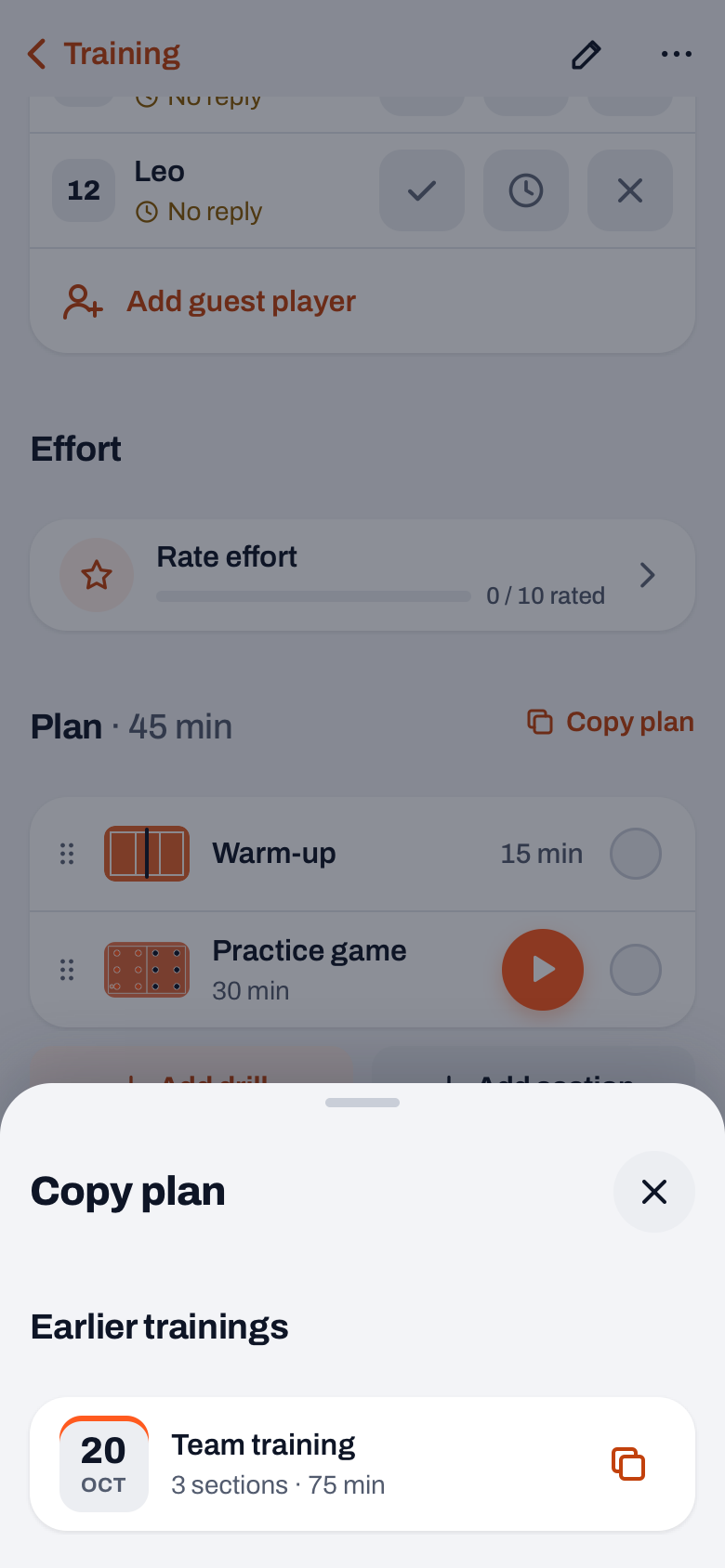
A fixed block only works if it's there every week. In Koach you put it as a section in the practice plan, with a name, a duration of ten minutes and the five exercises in the description. With Copy plan you bring the plan of an earlier practice to the next one, so you don't have to type the block again every time.
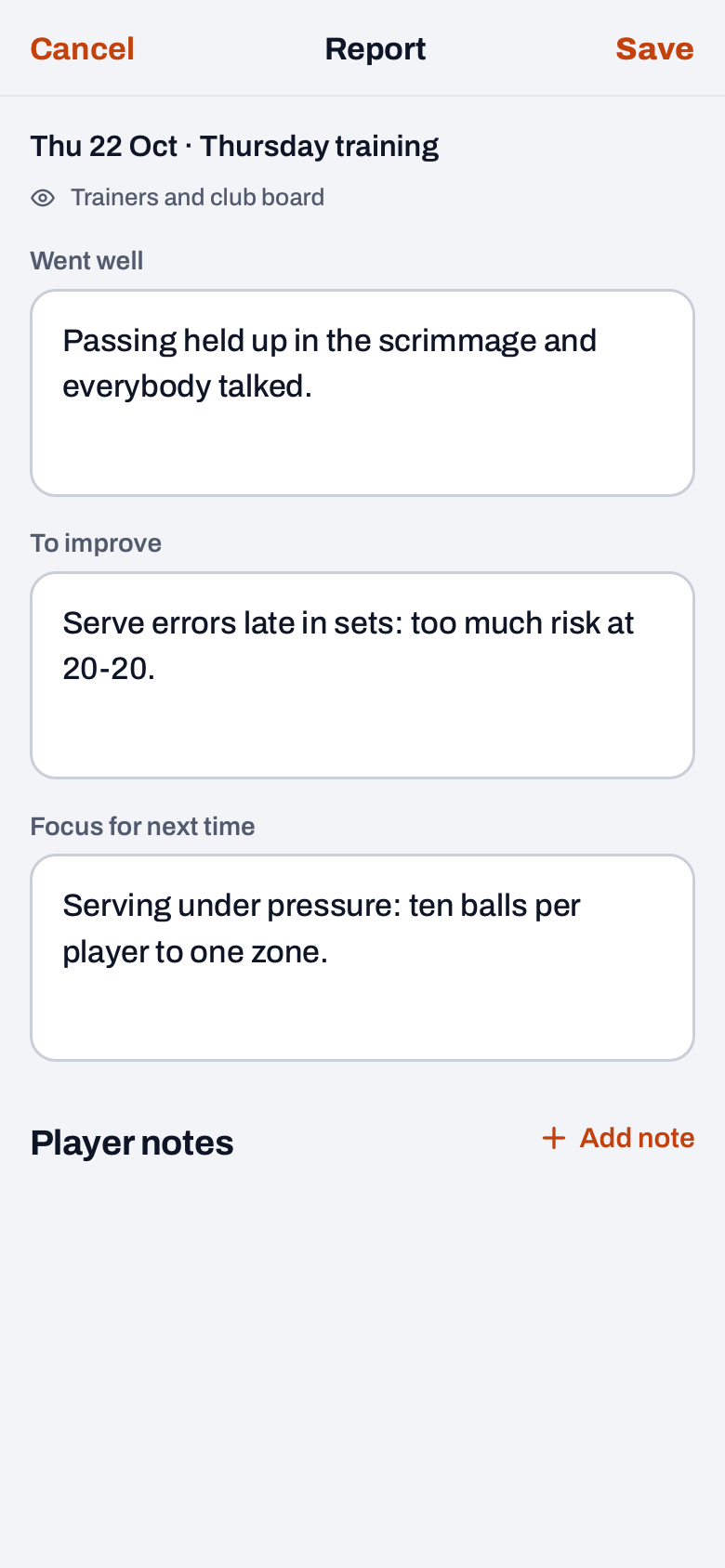
After practice you write in the report under Focus for next time which step the team can handle, and with Player notes you record per player who needs to take a step back. If you have just started as a coach and want to see how such a block fits into your whole season, read starting as a volleyball coach.
What Koach costs after the 14 free days is on the pricing page.
14 days free, no credit card. Put your core block in Tuesday's plan tonight and take it along to Thursday with one tap.
Plan your practice in KoachFrequently asked questions
How often should you train your core for volleyball?
A useful rule of thumb is a block of about ten minutes twice a week, as long as you keep it up all season. More important than the duration is the progression: only move a step up once the current step goes cleanly for two practices in a row. Combine it with strength and jump training, because core exercises on their own don't automatically make anyone jump higher.
Are sit-ups good for volleyball players?
For core stability they do little. A sit-up trains sitting up again and again, while the trunk of a volleyball player mostly has to stay still while arms and legs move, at takeoff, in the arm swing and on landing. Exercises such as the dead bug, the side plank and the Pallof press fit that better.
Can you train core stability without equipment?
Mostly, yes. The dead bug, the side plank, the bird dog and landing with a ball overhead only need a volleyball and some floor. Only the Pallof press needs a resistance band. If you don't have one, do the side plank with the top arm threading under your body as an extra exercise against rotation.
Does core training help with back pain in volleyball?
A stable core belongs in every program for players who jump and hit a lot, but core exercises are not a treatment. If a player has lower back pain during or after the exercises, stop that exercise. If the complaints keep coming back, or the pain radiates to the buttock or leg, the player should see a physical therapist, sports physician or doctor.


Put your core block in your practice plan
14 days free, no credit card. Next week you copy the plan with one tap.
Get started with KoachOr read first what the volleyball coaching app does.