
Resistance band exercises for volleyball: shoulder and jump
The short answer
Resistance band exercises for volleyball mainly train the small muscles that slow your shoulder down after the swing and keep it stable, and the hip and ankle muscles that keep your knee in line on takeoff and landing. Do them two to three times a week, 10 to 15 reps per set, slow and controlled.
Resistance band exercises for volleyball fit in every gym bag and every warm-up. With a long band and a small loop you train the shoulder, the chain of the arm swing, and the hips and ankles under your jump. Here are eleven exercises, how to build them up safely and what you can and cannot expect from them.
What a resistance band does and does not do
A band gives resistance that increases the further you stretch it. That makes it good for training what often lags behind in volleyball players: the small muscles around the shoulder and shoulder blade that slow the arm down after the swing, and the muscles around the hip and ankle that keep your leg in line on takeoff and landing. A band is light, cheap and fits in a warm-up, at a tournament and at home.
What a band does not do: make your legs strong enough to jump higher. For that you need heavier resistance and jump training, as in strength training for volleyball players. See the band as an addition to that work, not a replacement.
How much it delivers is less certain than often thought. In a study with 660 elite Norwegian handball players, a sport that like volleyball has lots of overhead throwing and hitting, 22 of the 45 teams did a shoulder program three times a week in the warm-up, including elastic band exercises. Averaged over the season, 17 percent of players in those teams had shoulder problems, against 23 percent in the teams without the program (Andersson et al., 2017). A later study with 579 handball players, using a program of elastic band exercises and stretching, found no difference (Achenbach et al., 2022). So do not count on a band to prevent problems. The number of hard swings per week matters at least as much; how to count those is in shoulder problems in volleyball.
Which band do you need?
- A long band or large loop. For the shoulder and trunk exercises. You tie it to or hook it around a fixed point.
- A mini band. A small loop around the legs, for hip and knee.
- Two strengths. A light one for the shoulder and a heavier one for the legs. The color shows the strength, but those colors differ per manufacturer, so check the chart of the brand you have.
Working safely with a band:
- Check the band before use for small tears and thin spots. A band that snaps whips back.
- Attach it to something that does not move: wall bars, a net post that is fixed in the floor, or a door anchor behind a closed door that opens away from you.
- Keep your face out of the line of the band and never let go while it is under tension.
- Many bands are made of latex. If a player has a latex allergy, use a latex-free band.
Shoulder: four exercises for stability
- External rotation at your side. Band fixed at elbow height, on the side of your other arm. Elbow bent to 90 degrees against your side, with a rolled-up towel in between if you like. Rotate your forearm outward and let it come back over three counts. 2 to 3 sets of 12 to 15 per arm.
- Row. Band fixed at chest height in front of you. Pull your elbows back along your body and bring your shoulder blades back and down, without shrugging your shoulders. 2 to 3 sets of 12.
- Pull-apart. Hold the band with straight arms in front of your chest and pull it apart until it touches your chest. Variation: one hand high, one hand low, then pull apart diagonally. 2 sets of 12 to 15.
- Forward punch. Band fixed behind you at chest height. Punch one arm forward and at the end reach a few centimeters further, so your shoulder blade slides along your ribs. Keep the shoulder down. 2 sets of 12 per arm.
Arm swing: the chain of hitting and slowing down
- Rotation in hitting position. Band fixed in front of you, at shoulder height. Elbow at shoulder height and slightly in front of your body, forearm pointing forward. Rotate your forearm up until it is upright, the position just before the hit, and let it sink back over three counts. That slow lowering is similar to slowing the arm down after the swing. Light band, 2 sets of 10 per arm.
- High-to-low woodchop. Band fixed high on the side of your hitting arm. Grab it with both hands and pull it diagonally down towards the other hip, while your trunk rotates with it and your weight shifts. Slowly back. 2 sets of 10 per side. More on the trunk in the swing is in core exercises for volleyball.
- Slow-motion arm swing. A light band fixed behind you at shoulder height, the end in your hitting hand. From the cocked position, slowly make the whole hitting motion through the contact point and back again. 2 sets of 8. Only do this with a light band and as preparation for hitting: with a heavy band your technique changes.
Jump and landing: hip, knee and ankle
These exercises train the muscles that keep your knee and ankle in line on takeoff and landing. They do not make your jump higher; they belong to the foundation underneath it.
- Lateral band walk. Band just above the knees or around the ankles. Sink into a half squat and take small steps to the side, with your knees over your feet. 2 sets of 10 to 12 steps each way.
- Mini band squat. Band just above the knees. Go as deep as you can with a straight back and push your knees gently out against the band, so they stay over your toes. 2 to 3 sets of 10.
- Glute bridge with mini band. On your back, feet flat, band above the knees. Push your hips up and your knees gently apart, hold for two counts. 2 sets of 12.
- Ankle eversion. Seated, leg straight, band around the forefoot and anchored on the inside. Turn your foot outward against the band and let it come back over three counts. 2 sets of 15 per foot. After an ankle sprain, an exercise like this is often part of the rehab; in that case follow your physiotherapist's plan.
Dosage and progression
Two to three times a week is enough. Pick a band with which the last two or three reps feel hard while you can still do them cleanly. If you no longer can, the band is too heavy or you are too tired. Progress in this order: first control and the slow return, then more reps, and only after that a heavier band. Band exercises can be demanding, but not painful. If an exercise hurts, leave it out and ask a physiotherapist for an alternative.
| Block | Exercises | Time |
|---|---|---|
| Warm-up in the gym | 1, 3, 5, 8 and 9, 1 to 2 sets each | 8 to 10 minutes |
| At home or after practice | All eleven, 2 sets per exercise | About 20 minutes |
In the gym, put the block before the first hard hitting, so the shoulder is switched on when the hitting drill starts. Band exercises also suit youth players, as long as technique comes before resistance; what is appropriate from which age is in strength training for young athletes. And if you have just taken on a group: a fixed band block is an easy habit to introduce in your first season, along with the rest of starting as a volleyball coach.
Let the players lead the block themselves. Put the five exercises of the warm-up block on a card by the ball cart and give a different player the lead each week. After a month it runs without you, and you have those ten minutes to put up the net.
The band block in your practice plan and as homework
In Koach you put the warm-up block in the practice plan with + Add section: a name such as "Band: shoulder and hip", the duration, and under Add description the five exercises with the reps. After practice you mark whether the section was done, and at the next practice you bring the whole plan back with Copy plan.
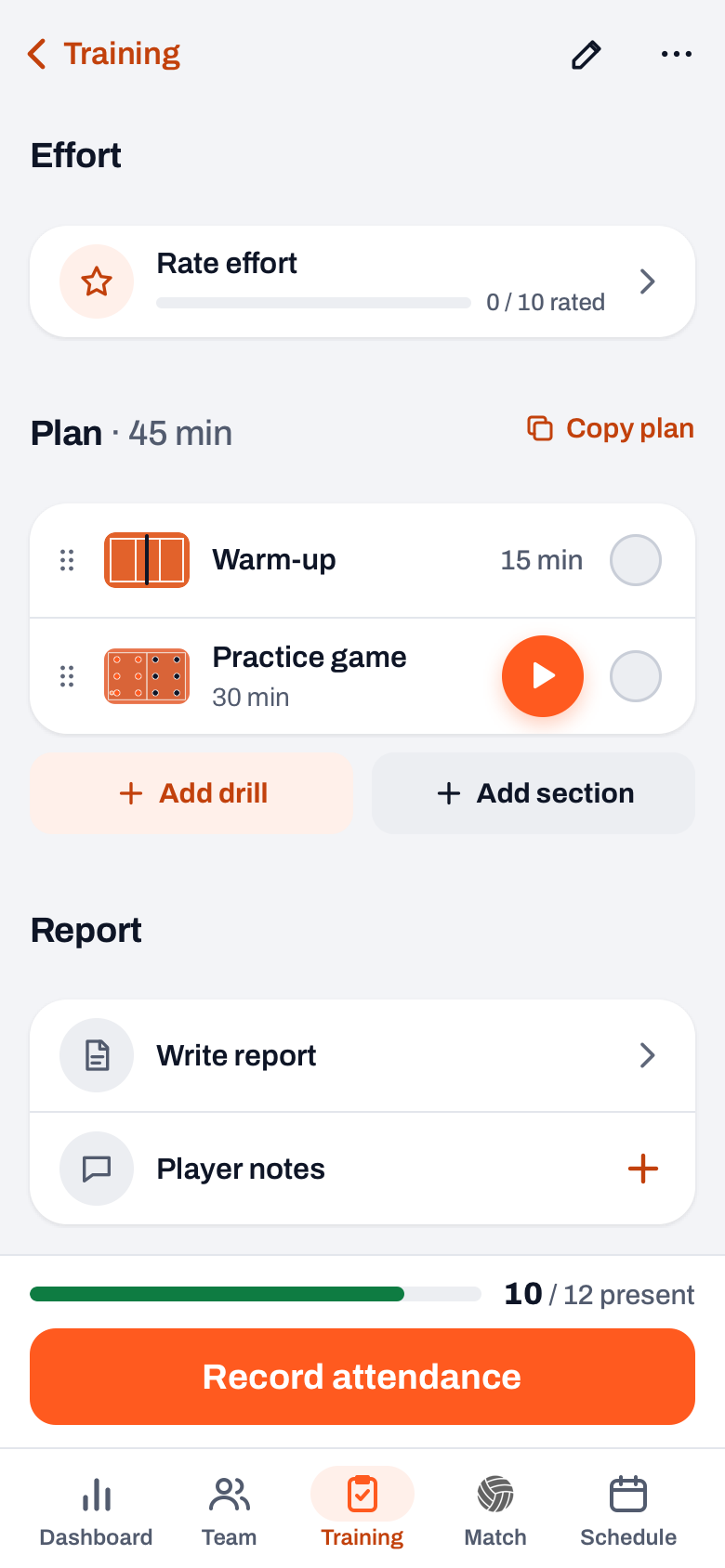
Prefer a drill with an animation? With + Add drill you find the Koach drill Shoulder activation with band in the library, with pull-aparts, external rotation and Y, T and W raises for three players with one band.
For home you turn the eleven exercises into a drill of your own, with the + in the Drills segment. On that drill you tap Homework and in the Assign as homework sheet you tick the players, or Everyone. Only the selected players and their parents get a notification, and the homework shows on the player's dashboard. More exercises for home, without a band, are in volleyball workout at home. What Koach costs after the 14 free days is on the pricing page.
14 days free, no credit card. Put the band block in your next practice and send the home program along as homework.
Plan your practice in KoachFrequently asked questions
Which resistance band is good for volleyball?
Start with two strengths: a light long band or large loop for the shoulder, and a heavier mini band for hip and knee. The colors show the strength but differ per brand, so check the manufacturer's chart. A good band is one with which you can still do the last reps of a set cleanly.
How often should you do resistance band exercises?
Two to three times a week is enough, for example as an eight to ten minute block in the warm-up and the full program once at home. Do two to three sets of 10 to 15 reps per exercise, with a slow, controlled return. More is not better if your technique gets sloppy.
Will a resistance band make your spike stronger?
A band mainly trains the small muscles that keep your shoulder stable and slow the arm down after the swing. How hard you hit depends more on technique, trunk and legs. So see band exercises as shoulder maintenance, alongside strength training and hitting itself. Whether they prevent shoulder problems, the research does not show clearly.
Can youth players train with a resistance band?
Yes, band exercises suit young players, as long as technique comes before resistance and someone watches and corrects. Start with a light band and few sets. If a young player has pain during an exercise, leave it out and ask a physiotherapist for an alternative.


Put the band block in your plan
14 days free, no credit card. Next week it is back in with one tap.
Get started with KoachOr read first what the volleyball coaching app does.