
Strength training for young athletes: what age and how to start
The short answer
Strength training for young athletes is safe and useful when it is well supervised and technique comes before load. There is no fixed minimum age: a child can start once they can follow instructions and have enough balance. Without a weight room you work with body weight, bands and a light medicine ball.
Strength training for young athletes raises the same questions from parents and coaches every time: from what age is it OK, and won't it stunt their growth? This article lays out the international guidelines and gives you a fifteen-minute strength block you can do in the gym hall, without a weight room.
Strength training for kids: from what age?
First, what strength training is: any training in which your muscles work against resistance. That can be your own body weight, a band, a medicine ball or a barbell. A child who does a push-up or throws a medicine ball against the wall is already doing strength training. It is not about heavy weights.
The guideline sports physicians and strength coaches fall back on is the Position statement on youth resistance training: the 2014 International Consensus by Lloyd and colleagues in the British Journal of Sports Medicine. Organizations including the American Academy of Pediatrics and the National Strength and Conditioning Association have put their name to it. The consensus gives no fixed minimum age. It does give two conditions, regardless of age: the child is emotionally mature enough to accept and follow instructions, and has enough balance and postural control. According to the same consensus, even children of five or six already improved with simple exercises.
The WHO looks at it from a health perspective. Its 2020 guidelines on physical activity and sedentary behaviour say that children and adolescents aged 5 to 17 should do an average of at least 60 minutes a day of moderate to vigorous activity, including vigorous activity on at least three days a week, plus activities that strengthen muscle and bone. As examples of bone-strengthening activity the WHO names running, jumping rope and lifting weights, and play and sport count too. So the question is not whether youth players work on strength, but in what form.
| Phase (age as a guide) | What it is about | Examples |
|---|---|---|
| Starting out (often up to about 11) | learning to move through games | crawling, hanging, jumping and landing, throwing, animal walks |
| Basic technique (often 11 to 14) | the big movements with body weight | squat, lunge, glute bridge, push-up, plank, band row |
| Building up (once the technique is solid) | more resistance, fewer reps | squat with a medicine ball or dumbbell, throws; free weights under expert supervision |
The ages in the table are a guide, not a limit. How long someone has been training, how good their technique is and how far a child is into puberty count for more than their year of birth.
Will it stunt their growth? What the consensus says
The most persistent myth is that strength training damages the growth plates and makes children shorter. The 2014 consensus is clear on this: that fear is not supported by scientific research or by what doctors see in practice. There is no evidence that strength training slows growth in height during childhood or puberty, or lowers adult height. Childhood and puberty are precisely the years when the body builds bone mass, and loading the body helps with that.
According to the same consensus, injuries in youth strength training happen mainly without supervision, with poor instruction or with weights that are too heavy. So the risk is not in strength training itself, but in how it is delivered. This is general sports knowledge, not medical advice: if a player has pain that comes back or doesn't go away, they should see a family doctor, a sports physician or a physiotherapist.
How much, how often and how heavy?
The consensus by Lloyd and colleagues gives this progression for young people:
- Those who have never trained strength start with 1 to 2 sets per exercise and light to moderate resistance. For a compound movement such as a squat, start with 1 to 3 reps, with a short cue after each rep.
- Once the technique is solid, move to 2 to 4 sets of 6 to 12 reps, still without going to failure. Heavier blocks with few reps come later, with more years of training and stable technique.
- Rest: about a minute between sets, and two to three minutes for heavier or explosive exercises.
- How often: 2 to 3 times a week, not on consecutive days. In season 1 to 3 times, and then not on top of all the practices, but in place of part of the sport training.
Without weights you translate that like this: stop a set while the player still has two or three clean reps in the tank, and only make an exercise harder once all sets look clean. A player whose knees cave in on the eighth squat had their set at seven.
One cue per rep. When you teach a child a new exercise, have them do one to three reps and give one short cue after each rep, such as 'knees over your toes'. That is slower than a set of ten, but this way they learn the movement instead of grooving in a mistake.
Strength training without a weight room: a fifteen-minute block
Most volleyball clubs have no weight room, and you don't need one. A corner of the gym, a bench, a few bands and a light medicine ball are enough. Do the block straight after the warm-up, twice a week, and alternate the two versions. This is an example for players who already have the basic technique down:
Block A: legs and landing
- Body-weight squat, 2 sets of 8. Later holding a medicine ball at the chest.
- Reverse lunge, 2 sets of 6 per leg.
- Glute bridge, 2 sets of 10. Later on one leg.
- Land and stick: step off a low bench, land on two feet and hold still for three counts, 2 sets of 5. How to teach that is covered in learning to land safely.
- Calf raise, 2 sets of 12.
Block B: core and shoulders
- Plank, 2 sets of 20 seconds, and side plank, 2 sets of 15 seconds per side.
- Push-up with hands on a bench, 2 sets of 6 to 10.
- Band row, 2 sets of 10.
- Band external rotation, elbow against your side, 2 sets of 12 per arm.
- Chest pass with a light medicine ball against the wall, 2 sets of 8.
With twelve players you can't watch everyone at once. So work in pairs: one does the exercise, the other watches one point you name in advance, such as the knees or a straight back, and then they switch. More core exercises for volleyball players are in core stability for volleyball.
During a growth spurt: what you adjust
During fast growth, bones briefly run ahead of muscles and tendons, and the places where tendons attach are more sensitive. Body-weight strength training can simply continue, but the number of maximal jumps goes down and the attention to landings goes up. Pain just below the kneecap or at the heel are well-known signals in jumping youth athletes; what is going on at the knee is covered in Osgood-Schlatter, and what else a growth spurt does in what a growth spurt does to a young player.
Count strength training in the total load of the week too. A player who already has two practices, a match and another sport doesn't get a third hard evening on top; see how often young players can train.
Who supervises the strength training?
The consensus sets the bar at qualified supervision: someone who can demonstrate and correct the technique and knows what suits a growing body. At a club that is often not the volleyball coach alone. Ask a physiotherapist or a strength coach to set up the program with you once and teach the coaches the exercises. After that the coach can run the block. If you are a new coach on your own, stick to body weight and light resistance, and read how to build your first season in starting as a volleyball coach. For older players who have finished growing, a full program is in strength training for volleyball players.
The strength block in your practice plan
A strength block only works if it comes back every week. In Koach you add it as a section of its own in a practice plan: with + Add section you create a block with a name, a duration and a description, for example "Strength A, 15 minutes" with the exercises and reps in it. For the next practice you bring it back from an earlier practice in one tap with Copy plan. Afterwards you mark each section as done, and who was there you see in the attendance. That way after a month you know whether a player did the block twice a week, or once every two weeks.
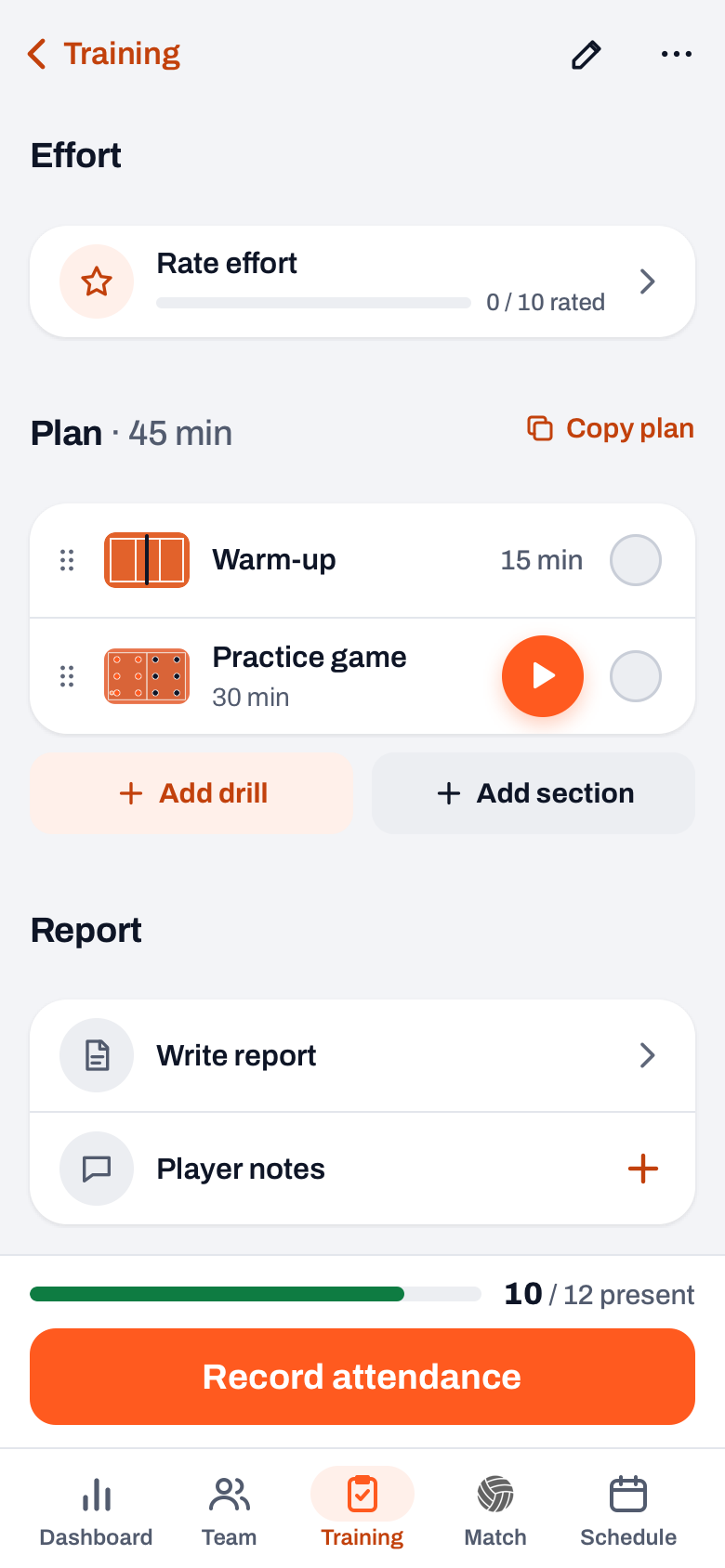
What Koach costs after the 14 free days is on the pricing page.
14 days free, no credit card. Add your strength block as a section in Tuesday's plan and bring it back on Thursday with Copy plan.
Plan your practice in KoachFrequently asked questions
Can a 10-year-old do strength training?
Yes, in a form that suits that age: with body weight, through games and with a lot of attention to technique. The international consensus gives no minimum age, but it does give two conditions: the child can follow instructions and has enough balance. Maximal weights and unsupervised training are not part of it.
Does strength training stunt children's growth?
According to the 2014 international consensus there is no evidence that supervised strength training slows growth in height or lowers adult height, and the fear of damaged growth plates is not supported by research. Injuries happen mainly without supervision or with weights that are too heavy. If a child has pain that comes back or doesn't go away, see a family doctor or a sports physician.
How often should a young athlete do strength training?
The consensus names 2 to 3 times a week, not on consecutive days, and in season 1 to 3 times, as part of the program and not as an extra evening. For a volleyball team a fifteen-minute block after the warm-up, twice a week, works well. The WHO advises children and adolescents aged 5 to 17 to also do activities that strengthen muscle and bone on at least three days a week, and jumping counts.
Can my child lift weights at the gym?
Lifting weights is fine once the body-weight technique is good and someone is there who can coach and correct young people. Unsupervised heavy lifting is exactly the situation in which, according to the consensus, most injuries happen. So ask for a trainer with experience coaching young people, and start light.


Put your strength block in your plan tonight
14 days free, no credit card. After a month you see who took part every week.
Get started with KoachOr read first what the volleyball coaching app does.