
Medicine ball exercises for volleyball: 7 throws and progression
The short answer
Medicine ball exercises for volleyball are fast throws that resemble the spike, the serve and the takeoff: overhead, with a trunk rotation and from a squat upward. Pick a ball that keeps the movement fast, do few reps at full effort and stop as soon as the throws slow down.
Medicine ball exercises for volleyball are the bridge between the weight room and the gym: you train explosive power in movements that resemble hitting, serving and jumping. Here are seven throws, the weight that goes with them, how to build them up safely and what a 15-minute block looks like.
Why a medicine ball fits volleyball
A spike, a jump serve and a block all ask the same thing: power that travels in a fraction of a second from the legs through the trunk to the arms. With a barbell or a squat you train the strength itself, but at the end of that movement you slow down, because you are holding on to the weight. A medicine ball you let go of. That lets you do the whole movement at full speed, just like a swing or a takeoff.
Do not expect miracles. A medicine ball does not automatically turn anyone into a better hitter: technique, timing and the strength underneath remain the foundation. Players who do not yet have a solid squat or push-up start with strength training for volleyball players and add the medicine ball after that. For the jump itself, the steps are in jumping higher in volleyball.
Which medicine ball and what weight?
- Rubber medicine ball. Bounces back. Good for throws to a partner or against a wall.
- Slam ball. Filled and barely bounces. This is the only one you slam on the floor: an ordinary medicine ball can bounce back into your face or split.
- Soft wall ball. Large and soft, for throws high against a wall that you catch again.
You choose the weight for speed, not heaviness. There is no official standard; start light and only go heavier if the throw stays fast and clean. A rule of thumb from practice is, for example, 2 to 3 kilos for adults on two-handed throws, 1 to 2 kilos for youth players and around 1 kilo for a one-arm throw. If the movement slows down or the technique changes, the ball is too heavy. A medicine ball that is too heavy turns explosive power into plain strength, and you train that better with other tools.
Seven medicine ball exercises for volleyball
- Chest pass with a step. Ball at your chest, step forward and push it with both hands to a partner or against a wall, driving from legs and trunk. A simple throw to start with.
- Overhead throw. Ball in both hands behind your head, one foot forward. Arch your trunk like a bow and throw with your whole body forward. The same chain as the arm swing of spike and serve. Variation: on both knees, so the trunk does most of the work.
- Rotational throw against the wall. Stand sideways one or two meters from a solid wall, ball at your hip. Rotate away from the wall and then rotate back explosively, hip first, and release the ball against the wall. Both sides, including your weak side. This resembles the trunk rotation in the swing; more on the trunk is in core exercises for volleyball.
- Backward throw. Ball between your legs, bend your knees and then explosively extend ankles, knees and hips while throwing the ball over your head backward. The same extension as the takeoff. Only with plenty of empty space behind you.
- Vertical throw. From a half squat, throw the ball straight up as high as you can, with a small jump. Then step aside and let it drop: you do not catch a heavy ball from a great height.
- Slam. Reach up with the slam ball above your head, rise onto your toes and slam it on the floor in front of you with your whole body. A gym floor often cannot take that; ask the facility manager first or do this one outside.
- One-arm throw. A light ball of about one kilo, with the hitting arm against a wall or to a partner, in the line of the hitting motion. Only once the two-handed throws go well, and only for players without shoulder problems.
| Throw | Resembles | Sets |
|---|---|---|
| Chest pass with a step | Extending legs and arms | 3 of 5 |
| Overhead throw | Arm swing of spike and serve | 3 of 5 |
| Rotational throw | Trunk rotation in the swing | 3 of 5 per side |
| Backward throw | Takeoff for the jump | 3 of 4 |
| Vertical throw | Takeoff for block and attack | 2 of 4 |
| Slam | Trunk flexing forward in the swing | 2 of 6 |
| One-arm throw | Hitting motion | 2 of 6 per arm |
How to build up medicine ball training safely
- Warm first, then fresh. Do the throws after the warm-up and before the tiring part of practice. Throwing when tired only gives you slow throws.
- Few reps, full effort. Three to six throws per set, with enough rest to throw the next set just as fast. With a partner taking turns, you get that rest automatically. Stop as soon as the throws slow down.
- Once or twice a week. Two blocks in preseason, one in season to maintain. Not on the day before a match.
- Progress in three steps. The first weeks technique with a light ball, then the same throws faster, and only after that a heavier ball or a combination, such as an overhead throw followed by a jump.
- Space and agreements. No throws against windows, wall bars or a wall with things sticking out, because the ball then rebounds unpredictably. Have throwers call before they throw, and make sure nobody stands behind a backward throw.
- Complaints come first. A player with shoulder pain leaves out the overhead and one-arm throws; a player with back pain the rotational throw and the slam. Check with a physiotherapist what is possible.
Youth players can also work with a light medicine ball, supervised and with technique first; what suits which age is in strength training for young athletes. If you have just started coaching, start small: two or three throws you can demonstrate and correct well are worth more than seven that half work. What else you will run into in your first season is in starting as a volleyball coach.
Combine the throw with the real movement. Have a player hit three attacks straight after three overhead throws, or do three block jumps after three backward throws. That way they feel for themselves how the movement with the ball connects to the movement at the net, and it does not stay a separate strength block.
A 15-minute block
This is what a medicine ball block looks like in preseason, after the warm-up and before the technical work:
- Chest pass with a step, 2 sets of 5, as a warm-up with the ball.
- Overhead throw, 3 sets of 5.
- Rotational throw against the wall, 3 sets of 5 per side.
- Backward throw, 3 sets of 4.
With pairs taking turns, that fits comfortably into fifteen minutes. Feel free to combine the block with the shoulder exercises from resistance band exercises for volleyball: the band for control, the medicine ball for speed.
The medicine ball block in your practice plan
A block you have set up well once, you do not want to reinvent every week. In Koach you put it in the practice plan with + Add section: a name like "Medicine ball", fifteen minutes, and under Add description the throws with the sets. After practice you mark whether the section was done or partly done. If someone skipped the overhead throws because of their shoulder, you put that in a player note with the report.
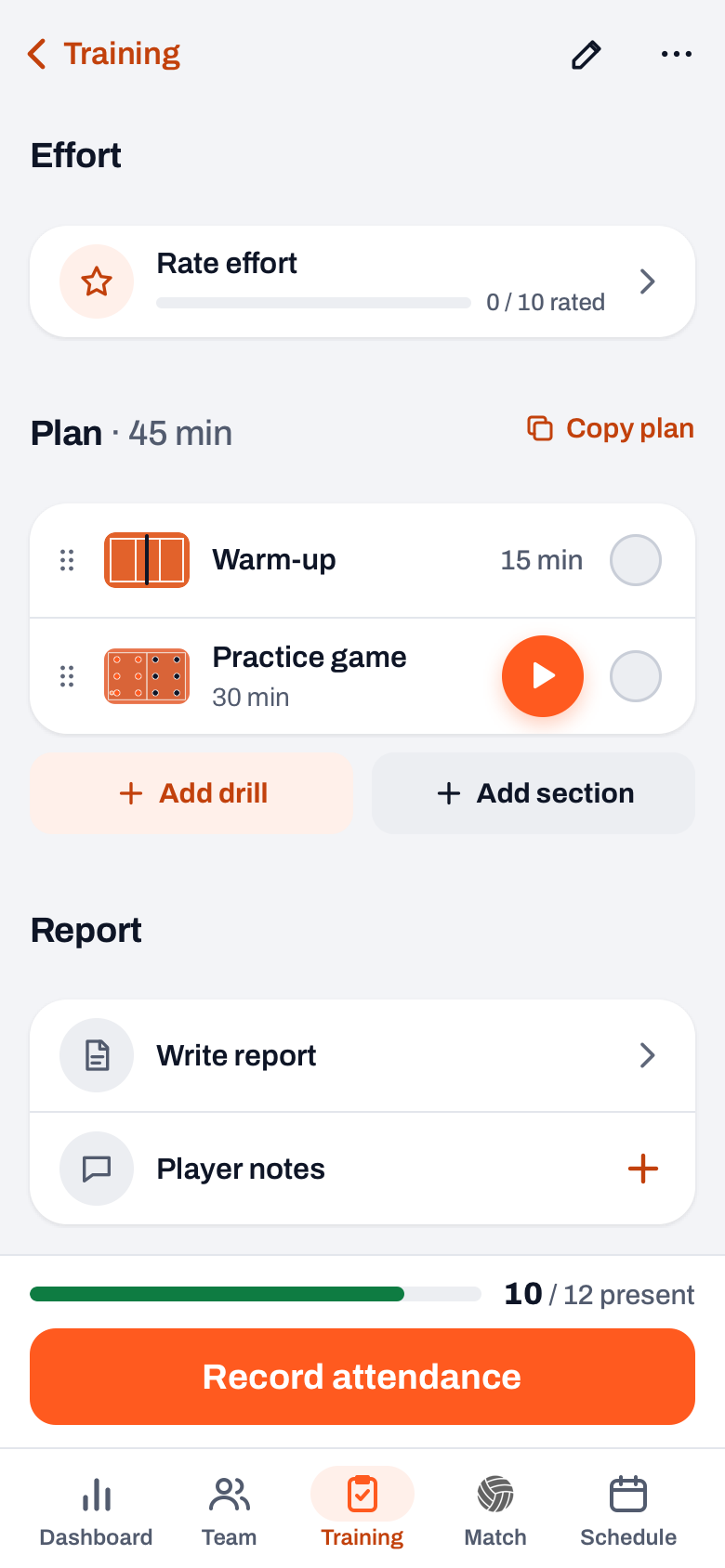
At the next practice you bring the whole plan back with Copy plan, where you pick an earlier practice. That way the block stays in every week, even when another coach runs the session. What Koach costs after the 14 free days is on the pricing page.
14 days free, no credit card. Put the medicine ball block in your next practice and copy the plan to the week after.
Plan your practice in KoachFrequently asked questions
How heavy should a medicine ball be for volleyball?
Choose for speed, not heaviness, and start light. A rule of thumb from practice is, for example, 2 to 3 kilos for adults on two-handed throws, 1 to 2 kilos for youth players and around 1 kilo for one-arm throws. If the movement slows down or the technique changes, the ball is too heavy. For slams, use a slam ball that barely bounces.
How often should you train with a medicine ball?
Once or twice a week is enough: two blocks in preseason, one in season to maintain. Do three to six throws per set at full effort with enough rest in between, and stop as soon as the throws slow down. Do not plan the block for the day before a match.
Can you throw a medicine ball against the wall of a sports hall?
That depends on the wall and on the facility manager. Only throw against a flat, solid wall without windows, wall bars or things sticking out, with a rubber or soft medicine ball. Slamming a slam ball on the floor is not allowed in many sports halls; ask first or do that exercise outside.
Is medicine ball training suitable for youth players?
Yes, with a light ball, for example 1 to 2 kilos, supervised and with technique first. Start with the chest pass and the overhead throw, and leave heavy slams and one-arm throws out for now. If there is pain, the exercise stops and you work out with a physiotherapist what is possible.


Put your medicine ball block in the plan
14 days free, no credit card. Next week you copy it with one tap.
Get started with KoachOr read first what the volleyball coaching app does.