
Volleyball workout at home: drills without a net, wall or partner
The short answer
A volleyball workout at home needs no net: set and pass the ball to yourself, practise footwork and your approach without a ball, and build strength and jump with your own body weight. Three sessions of twenty minutes a week keep your ball feel and your jump sharp between practices.
A volleyball workout at home sounds tricky without a net, without a wall and without anyone to hit the ball back. Yet a living room or a back garden lets you train more than you think: your ball feel, your footwork, your jump and the strength you need in the gym. Below is what works, with a weekly plan and a separate part for kids.
What can you train at home, and what not?
At home you can train everything that does not need an opponent. That is more than it looks: the shape of your hands when you set, a steady platform when you pass, the rhythm of your approach, and the strength in your legs, core and shoulders that every jump and every swing rests on. What does not work at home is everything that involves reading and choosing: digging an attack, timing your approach on a set from your setter, playing together. That stays for the gym.
If you have a solid outside wall or a garage door, you can do a lot more with the ball; the series for that are in volleyball wall drills. This article is about the situation without a wall: a living room, an attic, a patch of garden.
Take a look around before you start:
- The ceiling. In many living rooms the ceiling is around 2.5 metres (about 8 feet) high. So keep the ball low indoors, or go outside for anything that needs height.
- What can break. Lamps, windows and the TV. Pick the corner of the room where nothing hangs.
- The neighbours. A bouncing ball or jumping on an upper floor is something the people downstairs will hear. Do the jump work outside or on the ground floor.
- The floor. In socks you slip. Train barefoot or in clean sports shoes.
Ball control without a wall: five drills with a ball
- Self-setting (5 minutes). Set the ball straight up above your head every time: within half a metre above your hands indoors, one to two metres outside. Sets of twenty without an error; after a mistake you start counting again. Watch the triangle of thumbs and index fingers above your forehead and play with your fingers, not your palms. Once twenty works, turn a quarter turn after every contact.
- Setting lying down (3 minutes). Lie on your back and set the ball straight up, half a metre above your hands. This is the drill for a low ceiling: you cannot make up for it with your legs, so only your hand shape counts. Sets of thirty.
- Self-passing (5 minutes). Keep the ball in the air at chest height with a steady platform: arms straight, thumbs together, and the movement comes from your legs, not from swinging your arms. Sets of twenty, then alternate a low and a high ball.
- Alternating set and pass (4 minutes). One ball with your hands, the next with your forearms. A set of twenty switches. You are training the switch that happens all the time in a rally.
- The serve toss (3 minutes). Stand in your serving stance, toss the ball as you would for your serve and let it drop without hitting it. Twenty times. If it lands in the same spot in front of your front foot every time, your toss is consistent. You can do this on any patch of grass outside.
Footwork and approach: drills without a ball
Footwork needs no ball and little space. Four drills, each three to four reps of twenty seconds with the same amount of rest:
- Shuffling in a ready position. Knees bent, weight on the balls of your feet, three metres back and forth without your feet touching.
- Step and stop. Two quick steps to the side, then stop in a stable passing position. If you wobble when you stop, you are standing too tall.
- The approach without a jump. Walk through your three or four step approach in a hallway or the garden: start slowly, make the last two steps quick, and finish with both feet side by side and your arms back. Do not jump yet; this is about the rhythm.
- Reacting to a signal. Someone at home points left or right, you move two steps that way and back.
Strength and jumping without equipment
Your body weight is enough for a first strength block. Do every exercise slowly and through the full range; speed comes later.
| Exercise | What it trains | Volume |
|---|---|---|
| Deep squat | Legs and take-off | 3 x 10 to 15 |
| Reverse lunge | Knee and hip, one leg at a time | 3 x 8 per leg |
| Single-leg glute bridge | Glutes | 3 x 10 per leg |
| Single-leg calf raise on a stair | Calf and ankle | 3 x 12 per leg |
| Plank and side plank | Core | 3 x 20 to 40 seconds |
| Push-ups, on your knees is fine | Chest and shoulders | 3 x 6 to 12 |
| Y, T and W lying on your stomach, arms off the floor | Shoulder blades | 2 x 8 per letter |
Do jump work outside or on a solid floor on the ground floor. Start with squat jumps and small side-to-side hops over a line: three sets of five jumps, with all your attention on the landing. Land softly on two feet, knees over your toes and not caving inwards. A full jump programme with plyometrics is in jumping higher in volleyball.
Two limits. Do not plan jump work on the same day as a hard practice, because your legs need to recover. And stop when it hurts: if pain in a knee, ankle or your back does not go away, have it checked by your doctor, a sports physician or a physiotherapist.
With a parent, brother or sister: three drills with a tosser
A tosser does not need to play volleyball, only to throw well. Have them toss the ball underhand with a bit of an arc from three metres away.
- Pass to their hands. The tosser throws, you pass the ball back with your forearms so they can catch it at chest height. Ten good ones in a row, then one step further back.
- Laundry basket target. Put a laundry basket two metres away. The tosser throws, you set or pass the ball into the basket. Count the hits per ten balls.
- Tossing left or right. The tosser throws the ball a metre to your side every time. You move first and then play the ball, instead of reaching with your arms.
For kids: short, with a game and a record
Young children keep going for ten to fifteen minutes, and only if it is a game. Three formats that work at home:
- Balloon volleyball. A balloon floats down slowly, so a child has time to get under it and put their hands in the right shape. How many times can they set it without it touching the floor? Throw away pieces of a popped balloon straight away, because a small child can choke on them.
- The fridge record. How many self-sets in a row with a light ball? Write the record on a note on the fridge and try to break it every day.
- Basket shot. The laundry basket game above, with a parent tossing and keeping score.
Indoors, use a light or soft ball, and stop while it is still fun. A child who asks whether they can do it again tomorrow has learned more than a child who had to keep going for half an hour.
A weekly plan: three sessions of twenty minutes
| Day | Content | Time |
|---|---|---|
| Monday | Self-setting and self-passing, alternating, footwork | 20 min |
| Wednesday | Strength block from the table, plank and side plank | 20 min |
| Saturday or Sunday | Setting lying down, serve toss, approach and jump work | 20 min |
Move the days around so the jump work does not land next to your hardest practice. Start every session with five minutes of loosening up: jogging on the spot, arm swings, a few easy squats. How your coach builds the week in the gym, and why your work at home adds to it rather than replacing it, is in running a volleyball practice. If you have your own patch of grass and want a net on it, setting it up at the right height is covered in a volleyball net for the garden.
Count everything. Twenty sets without an error, seven balls in the basket, forty seconds of plank. Players who count see progress after three weeks, and that keeps them going longer than any plan.
Homework from your coach in Koach
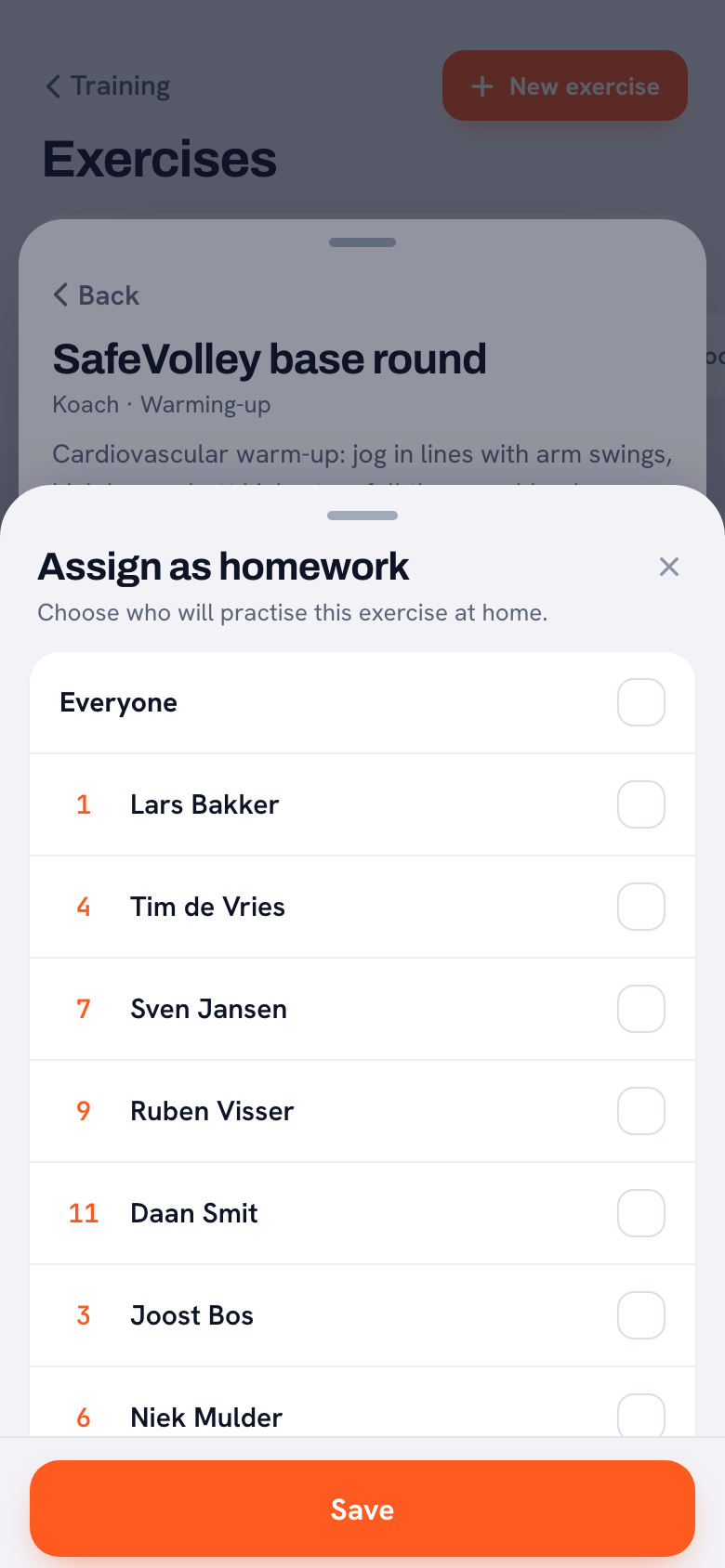
If your coach uses Koach, they can give you a drill to do at home. On a drill in the library they tap Homework, tick the players (or Everyone) in the Assign as homework sheet, and the chosen players and their parents get a notification. The drill then appears on the player's dashboard, with the diagram and the animation of every phase, so at home you can see what the idea is. How that works for a coach is explained in giving players homework.
You can also look around without an account: the animated drills are on the drills page. Players pay nothing: their account falls under the team's subscription. The coach tries Koach free for 14 days first; what it costs after that is on the pricing page.
14 days free, no credit card. Are you a coach? Give your players one drill this week and ask them for their record on Saturday.
Assign homework in KoachFrequently asked questions
How can I practise volleyball at home without a ball?
Without a ball you train everything around it: footwork in a ready position, the rhythm of your approach, and body weight strength such as squats, lunges, a plank and single-leg calf raises. Small jumps with a soft landing belong in there too. Ball control comes once you add the ball, but without one you already build the base for your take-off and your movement.
How often should you do a volleyball workout at home?
Two to three times a week for fifteen to twenty minutes is enough. Regularity matters more than length: three short sessions give you more than one long one on Sunday. Do not plan jump work on a day with a hard practice, so your legs can recover, and stop a set as soon as your technique gets sloppy.
Which volleyball drills can a child do at home?
For young children games work best: balloon volleyball, a record for self-setting with a light ball, or playing the ball into a laundry basket while a parent tosses. Keep it to ten to fifteen minutes and stop while it is still fun. Jumps and body weight exercises are fine too, done calmly and with attention to a soft landing.
Can I play volleyball indoors with a low ceiling?
Yes, if you keep the ball low. Setting while lying on your back works under any ceiling and trains exactly your hand shape. Self-passing at chest height and setting half a metre high also fit in most rooms. Use a soft or light ball, find a corner without lamps and windows, and do high balls and jump work outside.
Can my coach send me drills to do at home?
If your coach uses Koach, they can assign a drill from the library as homework. You get a notification and see the drill with its animation on your dashboard. As a player you pay nothing: your account falls under the team's subscription. Your coach tries Koach free for 14 days first.

Give your players homework they actually do
14 days free, no credit card. After a week you know who beat their record.
Get started with KoachOr read first what the volleyball coaching app does.