
Volleyball net for your backyard: choosing, setup and net height
The short answer
For a volleyball net for your backyard, choose poles that stand firmly and lift the net high enough: up to 2.43 meters if adult men play, 2.24 meters for women. An official beach court is 16 by 8 meters; in a backyard you usually play smaller, with free space around it and a net that is tight along the top.
A volleyball net for the backyard goes up in an afternoon, but whether you enjoy it all summer depends on the poles, the tension and the spot. Here you read which types there are, what to look for when buying, how to lay out the court and at what height the net hangs.
Which volleyball net suits your backyard?
A backyard net is always a net with two poles; the difference is in how those poles stay upright. You will come across four types:
| Type | Strength | Watch out |
|---|---|---|
| Set with poles and guy lines | Quick to put up and take down, height often adjustable | The lines take up space and are a tripping hazard |
| Poles in ground sleeves | Stands firmly without lines; poles come out when you are not playing | You have to dig and commit to a fixed spot |
| Freestanding frame with a weighted base | Also works on a patio or other hard surface | Less stable in hard play; no diving on paving |
| Loose net between trees or existing posts | Needs little equipment | Height and tension are tricky, and the rope damages the bark |
If you play in the same spot every summer, ground sleeves serve you best. If you also take the net to the park or a campsite, choose a set with guy lines. A real sand court is a different project; that is covered in building a beach volleyball court.
What to look for when buying a backyard net
- The height of the net, not of the pole. Check how high the top of the net can go. If adult men play, that needs to be 2.43 meters; for women it is 2.24 meters. Official posts are 2.55 meters high and preferably adjustable (FIVB indoor rules, rule 2.5). A set that goes no higher than a badminton net is too low for volleyball with adults.
- A tight top edge. An official net has a band along the top with a cable inside it that keeps the top tight (rule 2.2). A net with only a thin cord sags in the middle, and then your height is no longer right.
- The length of the net. An indoor net is 9.50 to 10 meters long, a beach net 8.5 meters, and both are 1 meter wide from top to bottom. The net has to be at least as long as your court is wide; on the beach the posts officially stand 0.70 to 1 meter outside the sideline (FIVB beach rules, rules 2.2 and 2.5).
- Material made for outdoors. A backyard net stands in sun and rain. Choose a net and lines that can handle UV light and moisture, and poles that do not rust.
- Lines and stakes. A set with tape and stakes for the court lines saves work. On the beach the lines should be ribbons and the anchors soft and flexible (beach rule 1.3.2); in a backyard that is sensible too, because hard tent stakes in the corner of the court are a risk when someone dives.
How much space do you need?
An official indoor court is 18 by 9 meters, a beach court 16 by 8 meters, both with a free zone of at least 3 meters around them and 7 meters of free space above (rule 1.1 in both rulebooks). Hardly any backyard has that much room, and it does not need to. Say your backyard is 15 by 9 meters: then you play two against two on a court of 12 by 6 meters and keep one and a half meters free all round. For three or four a side you want to get close to the 16 by 8 meters of a beach court. Which game formats and agreements work on grass is in grass volleyball.
When you pick the spot, also look at:
- The surface. Flat, mown short and without holes, stones or sprinkler heads. For outdoor courts the rules allow a slope of 5 millimeters per meter for drainage (indoor rule 1.2); a yard that clearly slopes sends the ball and your ankles in every direction.
- What stands next to and above the court. No fence, window, pond or garden furniture within a few steps of the lines, and no branch or cable above the net.
- The sun. Lay out the court with the long side roughly north to south. Then neither team looks straight into the afternoon or evening sun.
How to set up the volleyball net firmly
- Lay out the court. Put down the lines with tape and stakes. Then measure both diagonals: if they are the same length, your corners are square.
- Place the poles. They stand in line with the center line, the same distance outside the sideline on both sides. If you are going to dig or drive in long stakes, check first where cables and pipes run.
- Anchor them. With guy lines: two lines per pole in a V pointing outward, away from the court, at about 45 degrees. The stake then sits roughly as far from the pole as the attachment point is high. With ground sleeves: follow the depth the manufacturer gives and choose a sleeve with a cap that sits level with the grass.
- Hang the net and tension it. First the top, then the bottom. The top edge should be straight, with no belly in the middle.
- Measure the height in the middle. Officially you measure at the center of the court, and above the sidelines the net may be no more than 2 centimeters higher (rule 2.1). How to do that exactly is in hanging a volleyball net and getting it tight.
- Test how firm it is. Pull on the top of the net. If a pole moves, it will fall over as soon as someone runs into the net.
Re-tension the net before every game. Guy lines and grass give a little after a few days, especially after rain. A minute of measuring in the middle and pulling the lines tight saves you a net that ends up in the grass halfway through the afternoon.
What height should a backyard volleyball net be?
The official heights are 2.43 meters (7 ft 11 5/8 in) for men and 2.24 meters (7 ft 4 1/8 in) for women. For youth players the FIVB beach rules give lower heights: 2.24 meters for 16 and under, 2.12 meters for 14 and under and 2.00 meters for 12 and under (beach rule 2.1). For younger children the net goes lower still, so they can really get the ball over it. All heights by age are in how high a volleyball net hangs.
If you play with the whole family, choose the height for the youngest person who really joins in, or change the net between games. With a mixed group of adults, many recreational teams pick a height between the women's and the men's height; that is an agreement, not a rule.
Playing safely in the backyard
- Nobody hangs on the net or climbs into it. Explain that to children in particular: a pole that falls over falls on someone.
- Make guy lines clearly visible with a piece of ribbon or tape, and never let them run through a run-off area.
- Play on grass in sports shoes with grip. Wet grass is slippery; after a shower it is better to wait a while.
- Choose a softer ball for children. Which ball suits outdoor play is in which volleyball to buy.
- Loosen the net or take it down when you will not be playing for a while. Wind and sun wear it out, and small animals can get tangled in a net that hangs low or lies on the ground. In winter, store the net and lines somewhere dry.
Planning summer practices with your team
Does your team use the net for summer practices, say every Thursday in someone's backyard or on a field in the park? Then the question of who is coming soon gets stuck in the group chat, for the reasons in why a WhatsApp group does not work for a volleyball team. In Koach you put a series like that in the schedule in one go: under More you choose Recurring trainings, with the weekday, the start and end date and the time. Players sign up for each practice or say they are not coming, and you see beforehand whether you have enough people for four against four.
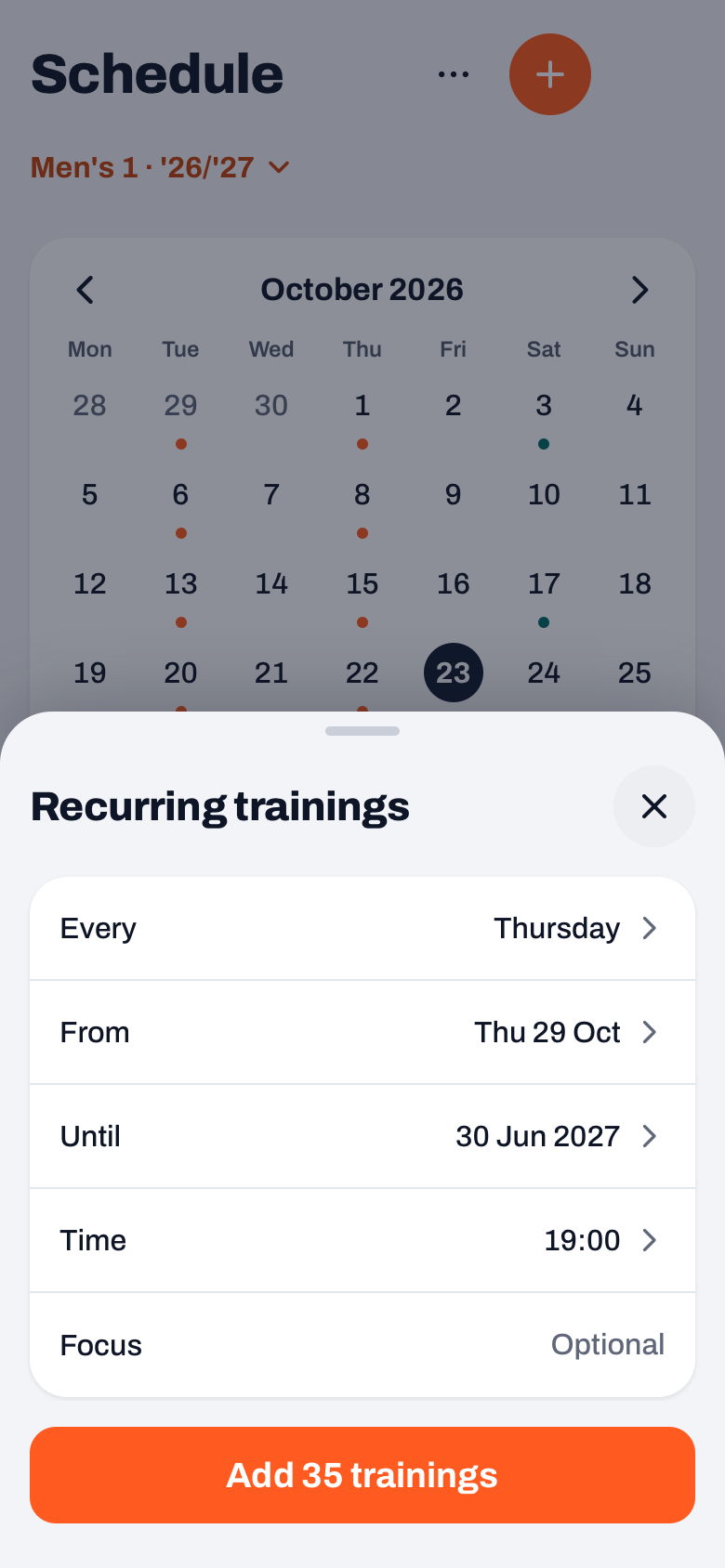
What Koach costs after the 14 free days is on the pricing page.
14 days free, no credit card. Put your summer practices in the schedule and see who is coming, without counting replies in the group chat.
Plan your summer practices in KoachFrequently asked questions
How high should a backyard volleyball net be?
That depends on who is playing. The official height is 2.43 meters for men and 2.24 meters for women. For youth players the FIVB beach rules give 2.24 meters for 16 and under, 2.12 meters for 14 and under and 2.00 meters for 12 and under. If you play with children or the whole family, hang the net lower so everyone can get the ball over.
How much space do you need for volleyball in the backyard?
An official beach court is 16 by 8 meters with a free zone of at least 3 meters around it; hardly any backyard has that. For two against two, a court of about 12 by 6 meters already plays well, with as much free space around it as you can spare. Make sure there is no fence, window or pond within a few steps of the lines.
Can a volleyball net stay up in the backyard all summer?
The poles can stay, especially in ground sleeves. It is better to loosen the net itself or take it down when you will not be playing for a while: wind, sun and rain wear it out faster, and small animals can get tangled in a net that hangs low. Re-tension it before every game, because lines and grass give a little after rain.
Can you use a badminton net for volleyball?
A badminton net hangs a lot lower than a volleyball net, so for volleyball with teenagers or adults it is too low. There are combination sets with poles you can set at both heights. If you buy one, check the highest setting: for adult men the top of the net has to reach 2.43 meters.

Plan your summer practices in Koach
14 days free, no credit card. You see beforehand who is coming.
Get started with KoachOr read first what the volleyball coaching app does.