
Grass volleyball rules: court, gear and summer tournament tips
The short answer
Grass volleyball rules have no worldwide rulebook of their own. Tournaments with two to four players per team mostly use the beach rules, six against six mostly the indoor rules, and the organizer adds house rules. The difference is the surface: grass is harder than sand and slippery when wet.
Grass volleyball rules are the summer variant you see on school fields, in parks and at club tournaments, from two-on-two to six-on-six. Here you read which rules apply, how big the court is for each format, what makes grass different from sand or a gym floor, and how to prepare for a tournament day.
Which rules apply in grass volleyball?
The FIVB has rulebooks for indoor and for beach volleyball, but not for grass. On grass the organizer therefore uses one of those two as a base and adds house rules on top. Usually the choice follows the number of players:
- Two, three or four players per team: the beach rules. No positions and no positional faults, but a fixed serving order. A block touch counts as a team contact. An open-hand tip or a tip with loose fingers is a fault (with stiff, closed fingertips it is allowed), and a player who plays the ball over the net with an overhand set must play it straight forward or straight back in line with their shoulders (beach rule 13.2). All of two-on-two is in the beach volleyball rules.
- Six against six: the indoor rules. Positions and rotation, the three-meter line and a block that doesn't count as a contact. Those rules are listed in all volleyball rules at a glance.
On top of that come the house rules, and that is where tournaments differ: one set or two, to 21 or timed, side switches or not, coed rules and substitutions. With three or four players per team it is also not a given that the block counts as a contact; some organizers use the indoor rule there. Which questions to ask at the tournament desk when you arrive is in the rules for 4v4 beach volleyball. That list works just as well on grass. The rulebooks themselves are on the FIVB site: the Official Beach Volleyball Rules 2025-2028 and the Official Volleyball Rules 2025-2028.
How big is a grass volleyball court?
The organizer also chooses the court size. No rulebook sets a size for 3v3 and 4v4; this is what you often come across in practice:
| Format | Court organizers often choose | Rules used as a base |
|---|---|---|
| 2 vs 2 | 16 x 8 m | Beach rules |
| 3 vs 3 | 16 x 8 m or 18 x 9 m | Beach rules with house rules |
| 4 vs 4 | 16 x 8 m or 18 x 9 m | Beach rules with house rules |
| 6 vs 6 | 18 x 9 m | Indoor rules with house rules |
Only the two extremes come from a rulebook: 16 by 8 is the size in the beach rules (rule 1.1), 18 by 9 the size in the indoor rules (rule 1.1). Anything in between is the organizer's choice; ask if you are not setting up a court yourself. Both rulebooks require a free zone of at least 3 meters around the court, and that applies on grass just as well: between two courts there should be room to chase a ball without ending up on the court next door. The net height in both rulebooks is 2.43 meters for men and 2.24 meters for women; at coed tournaments the organizer often picks a height in between.
On grass, lines are usually ribbons with ground pegs or a chalked line. The beach rules require visible anchors to be made of soft, flexible material (rule 1.3), and the indoor rules prohibit lines made of solid material (rule 1.2). So on a court you set up yourself, no tent pegs or boards stick out. Mark the guy ropes of the net posts with a flag or a cone, or place them outside the free zone.
What makes grass different from sand or a gym floor
On grass you stand more firmly than in sand: you jump higher and get to the ball faster, so the game feels more like indoor volleyball. But grass is less forgiving:
- Landing and diving hurt more. A defensive dive that lands softly in sand scrapes on grass and hits the hips and knees hard. Roll or slide rather than diving flat on your chest, and choose long sleeves or knee pads if you defend a lot.
- Wet grass is slippery. Morning dew or a shower turns a firm court into a slide. Take shorter steps, get lower in your legs and plant your feet before you play the ball. If it gets truly dangerous, the organizers may stop play: the indoor rules prohibit playing on a slippery surface (rule 1.2), and the beach rules state that the weather must not pose any danger to the players (rule 1.5).
- The field is never flat. Holes, molehills, stones, tree roots and sprinkler heads only show up when you walk over them. Walk the whole court once before your first match and report what you find to the organizers.
- Long grass holds a ball. A rolling ball stops sooner, and anyone searching for a ball behind the court loses playing time. Put spare balls behind your half of the court.
Shoes, clothing and the ball
- No indoor shoes. An indoor sole is made to grip a wooden or synthetic floor. On wet grass it slips, and afterwards you carry mud and grass into the gym. Choose shoes with molded plastic studs or a sturdy treaded sole. Screw-in studs and metal studs have no place here in practice: under the net you stand close together and on each other's feet. If the invitation says nothing about it, ask beforehand what the tournament allows. What to look for in indoor volleyball shoes is in buying volleyball shoes.
- Barefoot works on a short-mown, clean field, but you feel every pebble and a toe quickly hits another foot under the net. Ask whether the tournament allows it.
- An outdoor ball. A leather indoor ball absorbs moisture, gets heavy and slippery in wet grass and wears on the ground. The beach rules require a ball made of material that doesn't absorb moisture, suitable for outdoor conditions (rule 3.1). Which ball to choose for outdoors is in choosing a beach volleyball.
- Sun and heat. A cap, sunscreen and a water bottle per player. Drink between matches and look for shade. A player who gets dizzy, nauseous or a headache in the heat stops, sits in the shade and drinks; with persistent or severe symptoms, go to the first aid station or a doctor.
At the toss, choose your side, not the serve. On a court with a low sun or a lot of wind, the side is often worth more than the first serve. Let the opponent receive facing the sun. If you serve a float, it moves the most into the wind.
Playing in sun and wind: what you adjust
- Serve. With the wind behind you, a serve travels further and faster, so aim shorter than you are used to. Into the wind it drops sooner and a float wobbles more, so serve deeper.
- Pass and set. Play the pass higher to the middle of your court, not tight to the net: the wind can push a ball that looks just right over the net. Set lower than indoors, so the wind has less time with the ball.
- Communication. Outdoors your voice carries less far than in a gym. Call early and loud, and agree beforehand who takes the balls between two players.
- A ball from the next court. If a ball from another court rolls onto yours in the middle of a rally, stop. In both rulebooks that is external interference and the rally is replayed (rule 17.2). In which other cases a rally is replayed is in double fault in volleyball.
If you are organizing a grass tournament yourself, with courts, a match schedule and referees, read how to organize a volleyball tournament.
Tracking a grass tournament with your indoor team
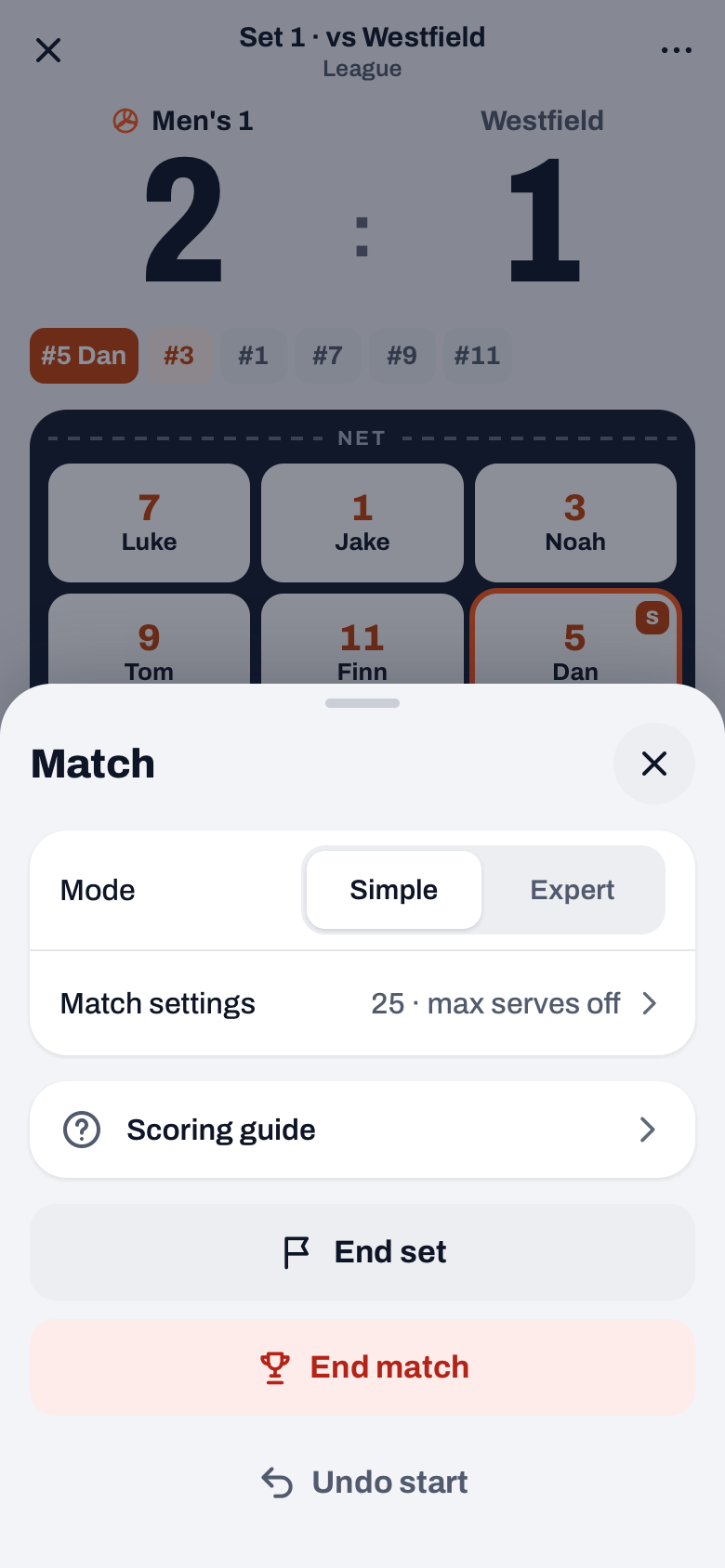
Koach is made for indoor volleyball with six players on court. If you play with two to four players per team, the app is not the right place. If your indoor team goes to a grass tournament with six players, you can track the day. On the Match tab you tap + and choose Tournament, with the name, the date and the opponents of that day. You start each match from the tournament.
In the app a set goes to 25 or to 15. If the tournament plays to 21 or on time, tap the three dots at the top right of the live screen and close the set with End set. The tournament screen then shows the results, a standing for your day and the points per player across all matches together.
14 days free, no credit card. Put your next tournament day in the app and see afterwards who scored on grass.
Track your tournament in KoachWhat Koach costs after the trial period is on the pricing page.
Frequently asked questions
What are the rules of grass volleyball?
There is no official rulebook for grass. With two to four players per team, most tournaments use the beach rules: no positions, a block that counts as a contact and no open-hand tip. Six against six usually uses the indoor rules. The organizer also decides the court size, the set length, the net height for coed play and whether you can substitute.
How big is a grass volleyball court?
The organizer chooses. For two-on-two it is usually 16 by 8 meters, the size of a beach court. For six-on-six it is 18 by 9 meters, the size of an indoor court. Three-on-three and four-on-four are played on both. Keep at least 3 meters clear around each court, including between two courts side by side.
What shoes do you wear for grass volleyball?
Shoes with molded plastic studs or a sturdy treaded sole give grip, even when the grass is wet. Indoor shoes slip on wet grass and carry mud into the gym. Screw-in and metal studs are dangerous under the net; ask beforehand what the tournament allows. Bare feet can work on a clean, short-mown field, if the tournament allows it.
Can you use an indoor ball for grass volleyball?
You can, but it is not a good idea in wet weather. A leather indoor ball absorbs moisture, gets heavier and more slippery and wears on the ground. A beach ball or a ball made for outdoor use doesn't absorb moisture. At a tournament, the organizer decides which ball is used.

Track your summer tournament in Koach
14 days free, no credit card. After one tournament day you see who scored on grass.
Get started with KoachOr read first what the volleyball coaching app does.