
Double fault in volleyball: when is the rally replayed?
The short answer
A double fault in volleyball happens when players of both teams commit a fault at the same moment. No point is scored: the referee raises both thumbs and the rally is replayed, with the same server (rule 6.1.2.2). If the teams commit their faults one after the other, only the first one counts.
A double fault in volleyball is rare, which is why hardly anyone in the gym knows what happens when the referee raises both thumbs. Here you read what the rule says, when two faults are simultaneous and when they are successive, which situations are wrongly called a double fault, and what it means for the score.
What is a double fault in volleyball?
The FIVB rules cover in one article what happens when more than one fault occurs in a rally (rule 6.1.2):
- Successive: if players commit two or more faults one after the other, only the first one counts (rule 6.1.2.1).
- Simultaneous: if players of the two teams commit a fault at the same moment, it is a double fault and the rally is replayed (rule 6.1.2.2).
The beach rules say exactly the same, under the same numbers. The signal is both thumbs raised straight up: the official signal for "double fault and replay". Before that, both referees first show what the faults were and who committed them, and then the first referee indicates the team that serves (indoor rule 22.2.3.4, beach rule 21.2.3.3). All the other signals are in volleyball referee hand signals.
Two things are often confused with the double fault. A double contact is something else: one player touches the ball twice in a row, and that is an ordinary fault with a point for the opponent; see double contact and other ball handling faults. And the double fault from tennis, two missed serves, doesn't exist in volleyball: you get one serve, and a service error costs the point straight away.
Simultaneous or successive: the first-fault rule
So the question a referee asks is not whether there were two faults, but whether they happened at the same moment. At the first fault the rally is over; whatever happens after that no longer counts. Three examples where the order is what matters:
- The setter and the blocker. The setter of team A plays the ball above the net while his fingers are already above team B's court. Then the blocker of B touches the ball on A's side, before the attack. Both are faults, but only the first fault, the setter's, is penalized (Casebook 2025, case 3.12).
- The serve and the receiving team's positions. If the server commits a fault at the moment of the service hit, for example a foot fault or the wrong serving order, that fault counts, even if the receiving team was out of position. If the serve itself is correct, but the ball then goes out or into the net, the positional fault of the receiving team came first, and that is the one penalized (rules 7.5 and 12.7). Since 2025, only the receiving team has to be in the correct order at the service hit; players of the serving team may stand anywhere in their own court (rule 7.4).
- The video check. In competitions with a challenge system, the first fault visible on the footage decides, even if a different fault was challenged (Casebook 2025, case 9.5). How that works is in how many challenges you get in volleyball.
Examples of a real double fault
- Attacker and blocker in the net. An attacker and a blocker touch the net between the antennas at the same moment, both while playing the ball. Those are two net faults at the same time (rule 11.3.1), so a double fault. When exactly touching the net is a fault is in net violation in volleyball.
- Two back-row players at the net. A back-row player of one team attacks from the front zone a ball that is entirely above the top of the net, and at the same moment a back-row player of the other team blocks that attack. Both actions are faults, and the Casebook rules: double fault, replay (Casebook 2025, case 3.43).
Look at the moment, not at the fault. If you doubt a decision, ask yourself what happened first. In a discussion about a double fault it often turns out that one fault came just before the other, and then only that one counts. If you want an explanation from the referee, under the rules your game captain asks for it when the ball is out of play, not the coach (rule 5.1.2.1).
What is not a double fault
- A joust above the net. If two opponents touch the ball simultaneously above the net, that is not a fault. If the ball stays in play, the team it goes to gets three contacts again. If it goes out, it is the fault of the team on the opposite side (rule 9.1.2.2; Casebook 2025, case 3.19). Even if the ball is briefly held in such a joust, play continues (rule 9.1.2.3). More on that in what a joust is.
- Attack and block at the same time. If the blocker contacts the ball at the same moment as the attacker, that is not a fault by either of them. Only if the blocker touches the ball earlier on the attacker's side is it a blocking fault (Casebook 2025, case 3.37).
- Two teammates on the ball at once. That counts as two contacts, except in the block. If they collide, that is not a fault (rule 9.1.2.1).
- A ball that pushes the net into an opponent. If an attacker drives the ball into the net so hard that the net touches a blocker, that is not a net fault (rule 11.3.3).
Other reasons to replay a rally
A rally is also replayed when nobody committed a fault. Under the rules, external interference gets the same two-thumbs signal (signal 23):
- External interference. If a second ball rolls onto the court or something or someone from outside interferes with play, the referee stops play and the rally is replayed (rule 17.2). If the rally was already over or it had no influence on play, that is not necessary (Casebook 2025, case 4.48).
- A serious injury. The referee stops play immediately, allows medical help, and then the rally is replayed (rule 17.1.1).
- A broken net. If the ball tears the net or pulls it down during a team's three contacts, the rally is replayed (rule 10.3.2). If a serve tears the net and the ball goes through the hole, it is not: there the fault, a ball that does not cross through the crossing space, came first (Casebook 2025, case 3.31.1).
- On sand: the ball hits the antenna after a joust. If two opponents touch the ball simultaneously above the net and it then hits the antenna, the rally is replayed in beach volleyball (beach rule 9.1.2.4). The indoor rules don't have that provision.
The full texts are in the FIVB Official Volleyball Rules 2025-2028 and Official Beach Volleyball Rules 2025-2028. The cases mentioned come from the FIVB Volleyball Casebook 2025, as published by the CEV. The rest of the rules are in all volleyball rules at a glance.
What a double fault means for the score and the serve
No point is scored, there is no rotation and the same player serves again. For the score it is as if the rally never happened.
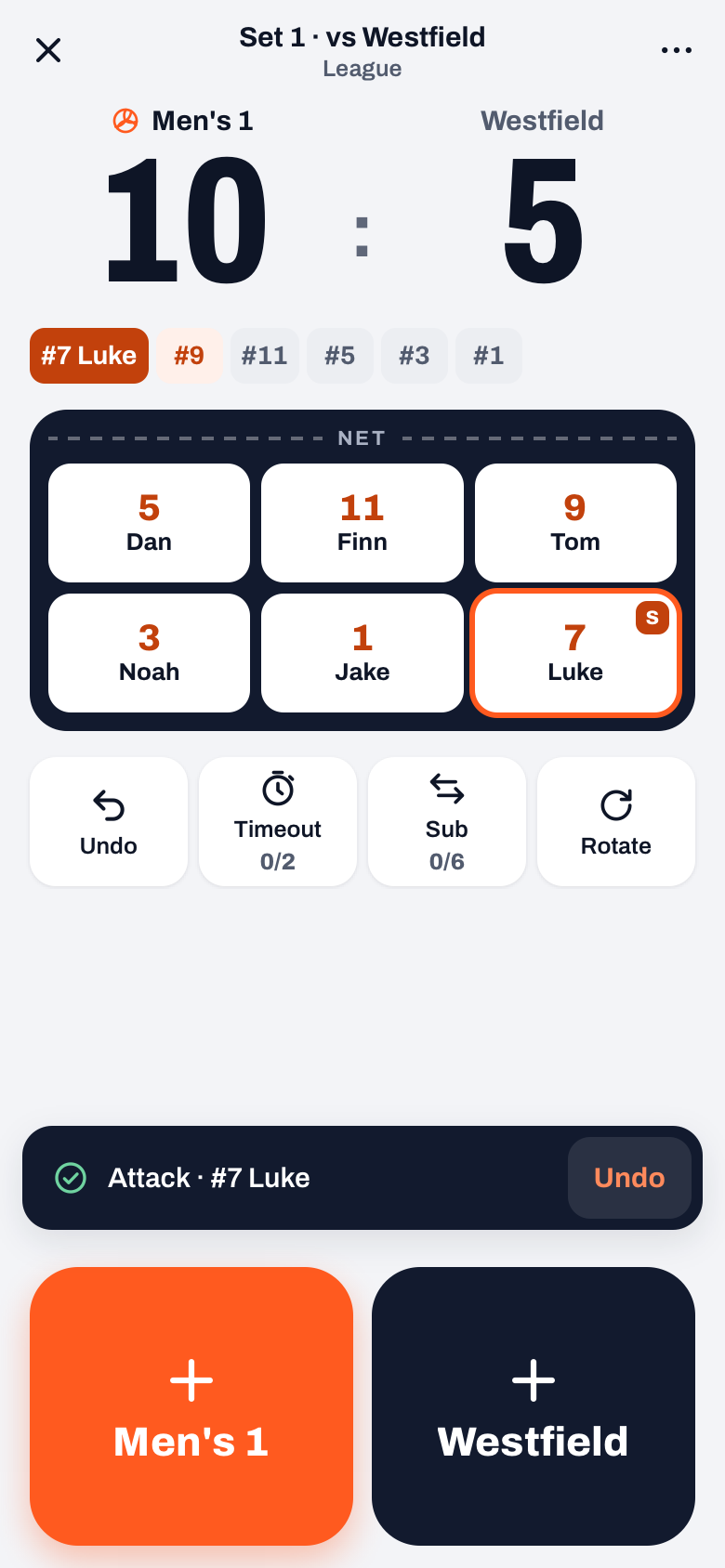
If you track the match live in Koach, you tap nothing after a double fault: the score stays as it is and the server stays at the front of the serving order. If you did tap a point in a hurry, remove it with Undo in the notice that appears after every point, or with Undo in the row of buttons under the court. That button reverses the last action and tells you what was undone.
14 days free, no credit card. Track your next match live and see afterwards where the points came from.
Score your match in KoachWhat Koach costs after the trial period is on the pricing page.
Frequently asked questions
Who serves after a double fault?
The same player as in the rally that was replayed. No point is scored and there is no rotation, so the score and the lineup stay exactly as they were. After the explanation, the first referee indicates the team that serves, and that is the team that also had the previous serve.
Is a joust above the net a double fault?
No. If two opponents touch the ball simultaneously above the net, play continues, even if the ball is briefly held between their hands. The team on whose side the ball comes gets three contacts again. If the ball goes out after such a joust, it is the fault of the team on the opposite side. Only on sand is the rally replayed if the ball then hits the antenna.
What is the difference between a double fault and a double contact?
In a double contact one player plays the ball twice in a row, or the ball touches different parts of their body one after the other. That is an ordinary fault: the opponent gets the point. A double fault is something else: players of both teams commit a fault at the same moment, and then the rally is replayed without a point.
How does the referee signal a double fault?
With both thumbs raised straight up, the official signal for double fault and replay. First both referees show which faults there were and who committed them. Then the first referee indicates the team that serves. You see the same signal for other reasons to replay, such as a ball rolling onto the court from outside.


Track your next match live
14 days free, no credit card. After one match you see where your points came from.
Get started with KoachOr read first what the volleyball coaching app does.