
How to organize a volleyball tournament: format, schedule, plan
The short answer
To organize a volleyball tournament, start three to six months ahead: choose your target group and date, book the gym or courts, set the format and playing time, open registration and arrange referees and volunteers. On the day itself you work from a run sheet in fifteen-minute steps and one table where all results come in.
How to organize a volleyball tournament is about more than making a match schedule. You arrange a gym or courts, a format that fits the time, registrations, referees, volunteers and a day that ends on time. This is the run sheet from the first meeting to the review, for a tournament indoors, on grass or on sand.
What goes into organizing a volleyball tournament?
For a club, a tournament with eight to sixteen teams is a project of a few months and one day of hard work. First-time organizers mostly underestimate the start: the gym is often booked months ahead, and teams plan their summer or preseason well in advance. So work back from the date:
| When | What you arrange |
|---|---|
| 4 to 6 months ahead | Goal, target group and date; book the gym or courts; budget |
| 3 months ahead | Format and tournament rules; open registration; ask referees |
| 6 weeks ahead | Close registration; volunteer roster; equipment and prizes |
| 2 weeks ahead | Match schedule with the final number of teams; information to all teams |
| The week before | Check equipment, arrange first aid, print schedule and score sheets |
| Afterwards | Share results, thank volunteers, review and settle the accounts |
Pick a date that doesn't clash with the league, school holidays and other tournaments in your region; how the rest of the club year runs is in the volleyball season checklist. How to take your own team to someone else's tournament is covered in planning and tracking a tournament.
Start with the goal and the target group
Why are you organizing it? A preseason tournament needs strong opponents and real sets. An end-of-season club tournament is about fun and the social committee. A fundraising tournament mainly has to attract a lot of teams; which other fundraisers work is in raising money for your club. The goal decides the rest:
- Level. Use separate pools per level. A recreational team that loses to league teams all day won't come back next year.
- Age and category. Youth, men, women and coed play at different net heights. Take the heights from your own federation and put them in the rules.
- Coed. Agree on the minimum number of women on court, and whether there are rules about who may attack.
- Outdoors or indoors. A grass or beach tournament needs a plan for bad weather: a backup gym, a rain date or a shorter format. Which rules are common on grass is in grass volleyball rules and tips.
Check in good time what is required legally and for insurance; that differs by country. If you play outdoors on public land or sell food and drinks, the local authority often requires a permit. Ask your federation whether the club insurance also covers players from other clubs, and whether you need to register the tournament.
Courts, gym and equipment
The number of courts decides everything: how many teams you can fit, how long the day lasts and how many referees you need. How to work that out, with the waiting time per team and the length of each block, is in making a match schedule for 5 to 12 teams. The short version: without waiting you need half as many courts as teams, and with one set to 25, count on about half an hour per match, including changeover.
The FIVB rules require a free zone of at least three meters around a court (rule 1.1). On a tournament day with courts side by side you often can't manage that, so at least keep the space between two courts clear of bags, balls and spectators. A loose ball or a bag next to the court is a well-known cause of a rolled ankle on a tournament day.
An equipment list for the day itself:
- Per court: posts, net, antennas, lines (or tape, rope or paint outdoors), two match balls, a scoreboard or flip chart and a whistle.
- For the table: the schedule in large format, score sheets, pens, a results board or screen, an air horn or PA system and an extension cord.
- First aid: a first aid kit, ice or cold packs, tape, and someone who knows how to use them.
- Also: warm-up balls, a measuring stick for the net height, spare pens, garbage bags and the prizes.
Format, playing time and the tournament rules
The format follows from the number of teams and the hours you have. A round robin is the fairest; with more teams you play pools with crossover semifinals. For playing time there are three common options: one set to 25, two sets to 21 where every set won counts, or timed games with one horn for the whole gym. Timed games are the surest way to stay on schedule.
Put all agreements in tournament rules of one page and send them with the confirmation. Then you don't have to explain anything on the day itself:
- The format, the playing time and when a match starts (and how long the warm-up is).
- The order for breaking ties, for example matches won, then set ratio, then point ratio, then head-to-head.
- Net heights per category, the coed rules and which ball is used.
- Who referees, and that the referee's decision stands.
- What happens to a team that is late, and when a match counts as a forfeit.
- Who decides in a dispute: the tournament director, and that decision is final.
- What happens if the schedule runs late, for example shorter sets from a fixed time.
Registration and entry fee
At registration, only ask for what you really need: team name, category and level, a contact person with phone number and email address, and whether the team brings a referee. Add a maximum number of teams that fits your courts, and keep a waiting list. A team is only on the list once the entry fee has been paid; say beforehand what happens if a team withdraws.
To set the entry fee, add up the fixed costs: gym or courts, paid referees, prizes, equipment and first aid. Divide that by the minimum number of teams you expect, not by the maximum, so you don't make a loss if two teams drop out.
Referees, scorekeepers and volunteers
At a recreational tournament the teams referee each other: the team with a bye in a round provides the referee and the scorekeeper. Put that in the schedule, so nobody has to go looking on the day itself. For the finals, ask an experienced referee from your own club if you can. Hold a five-minute briefing before the first round: how the score sheet works, where the result goes, and how strictly double contacts and net faults will be called.
You also need volunteers who don't play:
| Role | Task | Staffing |
|---|---|---|
| Tournament director | Has final responsibility, decides in disputes, doesn't referee | 1, all day |
| Results table | Process results, update standings, make announcements | 2 per shift |
| Setup and teardown | Courts, nets, tables and food stand | 4 to 6, start and end |
| First aid | First aid, ice, contact with parents or a doctor | 1, all day |
| Food stand | Food and drinks, cash register | 2 per shift |
A regular home match day needs fewer people; how to staff one is in organizing home matches. A tournament needs more hands on a single day, so build the roster in blocks of two to three hours, so nobody is stuck all day.
The run sheet for tournament day
Say you have a day from nine to five. The run sheet then looks roughly like this:
- 7:30: set up courts, results table, first aid corner and food stand. Measure net heights.
- 8:30: teams check in at the table, the schedule is posted, referees pick up their score sheets.
- 8:50: welcome and briefing, short: the key rules, the times and where the results go.
- 9:00: first round. After each match the score sheet reaches the table within five minutes, and the standings are updated right away.
- Around 12:00: a half-hour buffer, so a morning that ran late doesn't eat up the afternoon.
- 15:00: semifinals and finals, with a dedicated referee.
- 16:30: prize ceremony, then teardown with the crew assigned to it.
The golden rule: all results come in at one place, the results table, and nowhere else. Two lists side by side guarantee an argument about the standings at the end of the day.
Plan buffer time, not just matches. After every three rounds, put fifteen minutes without matches in the schedule. If the day runs on time, it is a break; if it runs late, you catch up without fuss, and the final starts when you announced it would.
After the tournament: results, thanks and review
Share the final standings with all teams the same evening and thank the volunteers by name. Review within a week with the organizing team: where did it run late, what was missing, did costs and income match, and which teams want to come back next year. Keep the run sheet, the rules and the equipment list with the improvements noted. The second tournament takes much less time if you wrote the first one down well.
What Koach does for a tournament, and what it doesn't
Koach doesn't make a match schedule, doesn't take registrations from other clubs and has no separate planner for tournament volunteers; for that you use a form and the schedule from this article. What Koach does do sits on two sides. Your own teams put the tournament in the app as one tournament with the matches under it, so players sign up for the whole day at once and the results stay together.
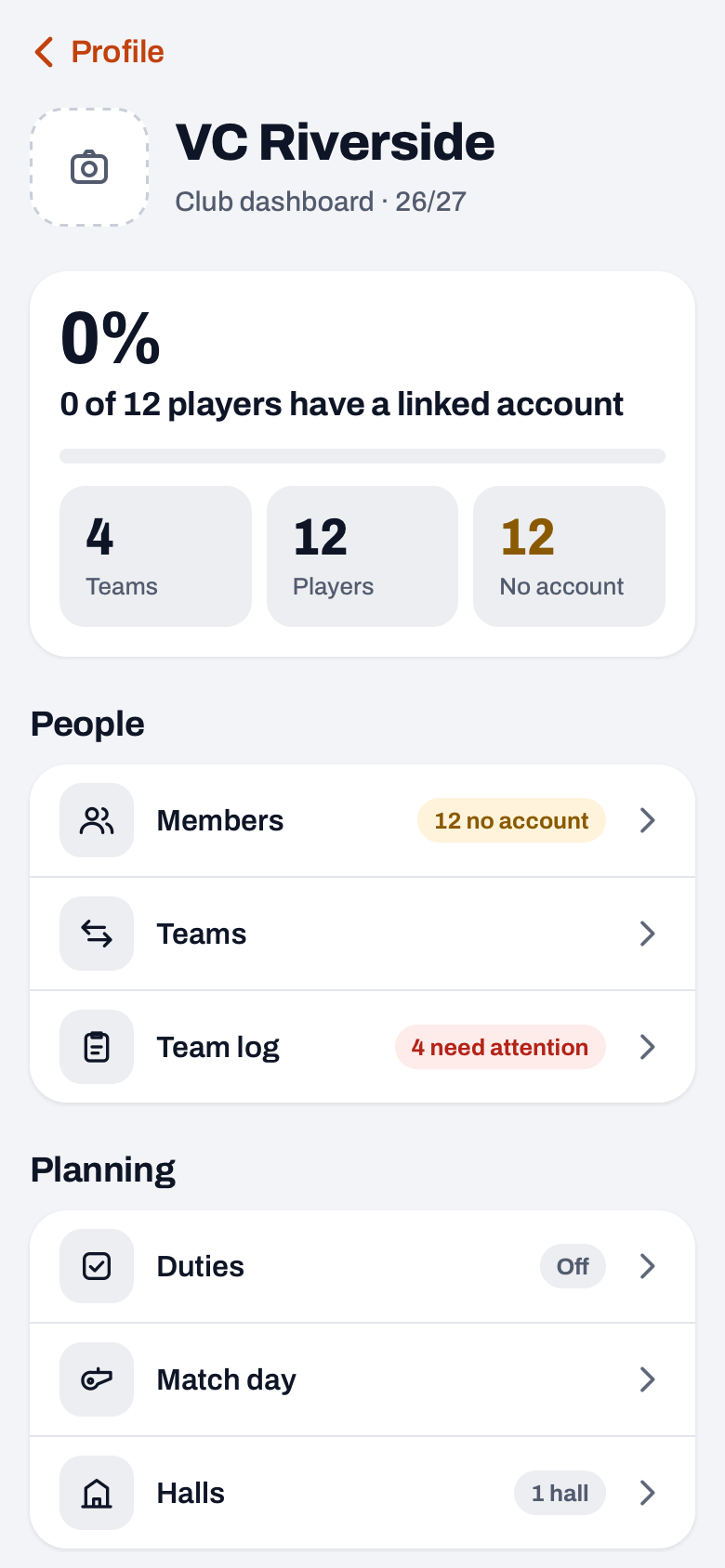
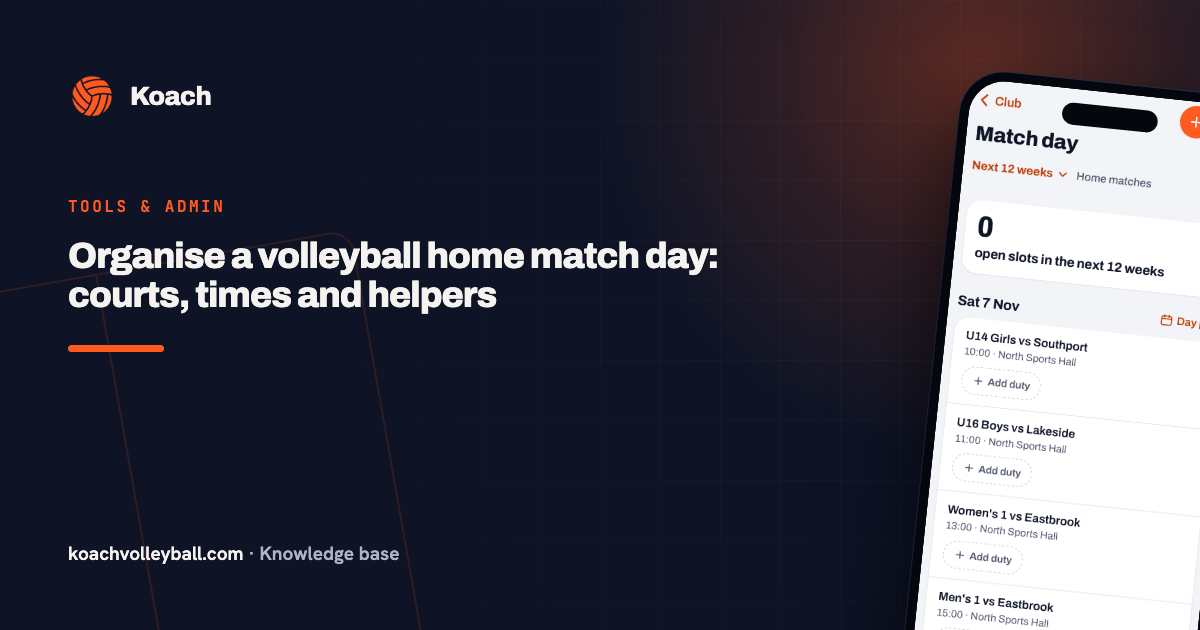
For duties done by your own members, a club on Koach Club has a workaround that works. In Match day, open the Bar duties sheet via the three dots at the top right. With Plan one bar duty you choose a team, a date, a time, the number of people needed and your own title, such as Setup or Morning food stand. Formally it is still a bar duty: the notification to members talks about an open bar duty slot with your title after it, and in the duty tally it counts as a bar duty. Only the members of the chosen team see the open duty in their calendar and sign up there. If Duties is switched on, the duty counts toward their tally once it has been checked off. What else Club does is on the page for clubs, and what it costs on the pricing page.
We set up Club together with you. Club has no trial period: leave your details and we will show you how duties and the duty tally work for your club. If you coach a team yourself, you can try Koach with that team free for 14 days.
Book an introduction Start with your own teamFrequently asked questions
How many teams fit in a volleyball tournament?
That depends on your courts and your hours. With one set to 25, count on about half an hour per match, including changeover. A full pool of eight teams has 28 matches: on four courts that is seven rounds, so three and a half hours of play, but then no team has a bye to referee. On two courts it takes seven hours. If you have more teams than fit in your day, split them into pools with crossover semifinals.
How much should the entry fee for a tournament be?
Add up the fixed costs: gym or courts, paid referees, prizes, equipment and first aid. Divide that by the minimum number of teams you expect, not by the maximum. Then the tournament still covers its costs if a few teams drop out. If it is a fundraiser, the profit mostly comes from the food stand.
Who referees at a recreational volleyball tournament?
Usually the teams themselves: the team with a bye in a round provides the referee and the scorekeeper. Put that in the schedule and hold a short briefing before the first round on the score sheet and the key rules. For the finals, preferably ask an experienced referee, and the tournament director decides in disputes.
Do you need a permit for a volleyball tournament?
That differs by country and by local authority. If you play in a rented sports hall without extra sales, often nothing extra is needed. If you play outdoors on public land, or sell food and drinks, the local authority usually requires a permit. Also ask your federation whether the insurance covers players from other clubs.


Plan the duties for your tournament day
Leave your details on the clubs page, or start with your own team: 14 days free.
Get started with KoachOr read first what the volleyball coaching app does.