
Volleyball shoes: what to look for when buying
The short answer
Good volleyball shoes have a rubber sole that grips an indoor floor without leaving marks, cushioning under the forefoot for jumping and landing, and side support for lateral steps. A running shoe is not a good alternative. Replace them when grip or cushioning noticeably drops off.
Volleyball shoes all look sporty in the shop, but they differ in exactly the things you notice on court: grip when you stop, cushioning when you land and support on a lateral step. This article helps you choose, fit and replace them in time, without recommending a brand or a shop.
What makes a shoe a volleyball shoe?
The FIVB rules are brief on shoes: they must be light and pliable, with rubber or composite soles and without heels (rule 4.3). Behind that are four properties you can check in the shop.
- Grip. A sole of soft rubber with a fine tread, often a herringbone or circular pattern, holds a wooden or synthetic gym floor when you stop and push off. Also check that the sole is non-marking: many sports halls only allow shoes that leave no black streaks.
- Cushioning under the forefoot. After a jump you usually land on the forefoot first. A volleyball shoe has the most cushioning there, a running shoe under the heel instead.
- Side support. Block footwork and defence are lateral movements. A firm upper, a heel counter that holds the heel in place and a sole that sits low to the floor keep your foot on top of the sole instead of next to it.
- Light and pliable. The sole has to be able to bend under the ball of the foot, otherwise you work against your shoe on every take-off.
Volleyball shoe, indoor court shoe or running shoe?
You do not have to buy a shoe with volleyball written on it. What matters is what the shoe is made for.
| Type of shoe | Suitable? | Why |
|---|---|---|
| Volleyball shoe | Yes | Made for jumping, landing and moving sideways on an indoor floor |
| Handball or other indoor court shoe | Yes | Similar grip and support, often a fine choice for young and recreational players |
| Badminton or squash shoe | Yes, if you do not jump much | Plenty of grip and low to the floor, but less cushioning for lots of jumps |
| Basketball shoe | Possible | Lots of cushioning and support, but heavier and higher off the floor |
| Running shoe | No | Thick, soft heel, made for running straight ahead; sideways you sit high and have little support |
| Outdoor shoe or sneaker | No | Brings grit inside and has less grip on an indoor floor |
For a child who is just starting, any clean indoor shoe with good grip is enough; that is also in what your child needs for a first volleyball practice. Real volleyball shoes become worth it once there is a lot of jumping and a player trains several times a week.
High or low: does a high-top shoe protect your ankle?
Volleyball shoes come in low, mid and high. A higher collar feels firmer, but that feeling is not proof. In a randomised study of 622 basketball players (Barrett and colleagues, 1993) the researchers found no clear difference in ankle sprains between high-top and low-top shoes. It is one study, in a different sport and with few injuries, so not the final word. But do not count on a high collar to prevent a sprain.
So choose the height by feel and freedom of movement. A low shoe leaves the ankle the most free, a mid gives more of a feeling of hold; both are fine. If a player has sprained an ankle before, a brace or tape is the logical step, whatever shoe they wear: read ankle brace, tape or nothing at all and then fit the shoe with the brace on. What further prevents sprains is balance, strength and landing work; that is in injury prevention in volleyball.
How to fit volleyball shoes
- Try them on at the end of the day or after a practice, when your feet are slightly bigger.
- Bring what you wear in the gym: your sports socks, any insoles and your ankle brace if you use one.
- Leave about a thumb's width of room for your toes. Less, and your toes hit the front when you stop; much more, and your foot slides around in the shoe.
- Check the heel. It should not slip up when you walk or stand on your toes.
- Move in the shop as you would on court: a few lateral steps, a small jump, push off and land. If the foot feels loose at the side, it is not the right shoe, however good it looks.
For children, check the size every six months. Do not buy two sizes too big to grow into: a shoe in which the foot slides gives less grip and more blisters. If you are buying knee pads at the same time, read volleyball knee pads first; there it is all about thickness and size.
When should you replace volleyball shoes?
Volleyball shoes do not wear out by the calendar but by hours in the gym. Say you train or play three times a week for an hour and a half: that is 4.5 hours a week, and over a 35-week season about 160 hours. The same shoe on someone who plays once a week has done a third of that by the end of the season. So look at the shoe itself:
- The grip drops off. You slide when you stop on a clean floor, or you keep having to wipe your soles.
- The tread under the ball of the foot is smooth. That is where you pivot and push off, so that is where it wears first.
- The midsole has compressed. If you see deep creases in the side, or landing feels harder than it used to, the cushioning is gone.
- The heel counter is soft or the upper is tearing, so the foot slides to the edge on a lateral step.
- The shoe is too small. With young players that is usually the reason, long before the shoe is worn out.
If you get new aches in your feet, shins or knees, a worn shoe may play a part, but that is not a diagnosis. If problems persist, see your doctor, a sports physician or a physiotherapist. A new shoe is not a treatment.
Do the wipe test in the gym. Wipe your hand over the sole and put your foot on a clean spot on the floor. If it squeaks and holds on a short stop, the grip is good. If it still slides after wiping, the tread is worn out.
How to make them last longer
- Wear them only in the gym and only put them on there. Outside, the street grinds the soft rubber smooth and you bring grit inside.
- Wipe a dusty sole with a damp cloth; dust on the sole costs grip straight away.
- Take them out of your bag after practice and let them dry at room temperature, not on the radiator.
- Break new shoes in over a few practices, not on a tournament day.
How many hours are on your shoes?
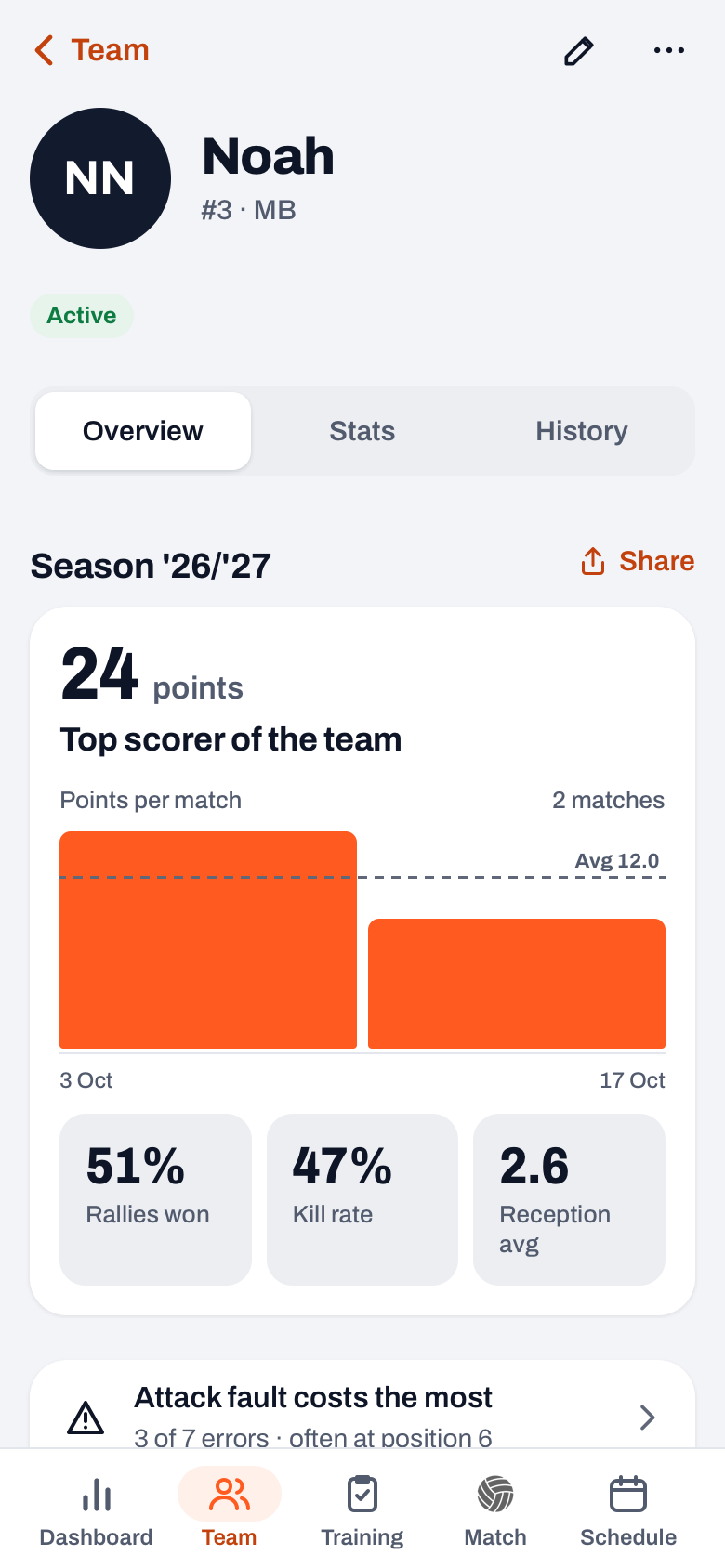
A shoe shop cannot tell you how much you play, but if your team uses Koach, you can see it yourself. In your player profile, under History, you see how many practices you attended this season and which matches you played. Multiply that by the length of a practice and you know roughly how many hours your shoes have done, without guessing. As a player you pay nothing: your account falls under the team's subscription, and your coach invites you. If you are a coach yourself and just starting out, starting as a volleyball coach helps you through the first season.
14 days free, no credit card. Add your team to Koach and let your players look back on their own practices and matches.
Try Koach with your teamWhat Koach costs the coach after the trial is on the pricing page.
Frequently asked questions
Can you play volleyball in running shoes?
For a one-off session, yes, if they are clean and non-marking, but not as your regular shoe. A running shoe is made for running straight ahead, with a thick, soft heel. On lateral steps and landings you sit high above the floor and have little support at the side. A handball or other indoor court shoe is a better alternative if you do not want to buy a volleyball shoe.
How long do volleyball shoes last?
That depends on the number of hours you play in them, not the number of months. Someone who trains three times a week wears them out much faster than someone who plays once a week. Replace them when the grip drops off, the tread under the forefoot is smooth or landing feels hard. With children the shoe is usually too small before it is worn out.
Are high-top volleyball shoes better for your ankles?
Not demonstrably. A high collar feels firmer, but a randomised study of basketball players found no clear difference in ankle sprains between high-top and low-top shoes. If you have sprained an ankle before, a brace or tape is better protection. Choose the height mainly by feel and freedom of movement.
Can you wear volleyball shoes outside?
Better not. The street grinds the soft rubber smooth and you bring grit and dirt into the gym, which means less grip for you and your teammates. Only put them on in the gym and carry them in a bag. Many sports halls also only allow clean indoor shoes.
What is the difference between indoor court shoes and volleyball shoes?
A volleyball shoe is an indoor court shoe made for lots of jumping, with more cushioning under the forefoot. A regular court shoe, such as a handball shoe, has similar grip and lateral support. For most young and recreational players that difference is small; players who attack or block a lot do notice the extra cushioning.



See how many hours your shoes have done
14 days free, no credit card. Your players see their own practices and matches in the app.
Get started with KoachOr read first what the volleyball coaching app does.