
How to build a sand volleyball court: sand, depth and drainage
The short answer
How to build a sand volleyball court, in short: find a level site of at least 22 by 14 meters, the 16 by 8 meter court with a 3-meter free zone all around. Dig it out, lay drainage and geotextile, set the posts in concrete footings and fill it with about 40 centimeters of washed sand without stones.
When you look at how to build a sand volleyball court, most of the work is in the ground. Choose the drainage and the sand well and you have a playable court for years; cut corners there and you have a mud pit after every rainstorm. Here you read how much space you need, how to build step by step, which sand to order and what upkeep it takes.
How much space do you need for a sand volleyball court?
The dimensions are in the FIVB Official Beach Volleyball Rules 2025-2028. The playing court is 16 by 8 meters (52 ft 6 in by 26 ft 3 in), with a free zone of at least 3 meters all around, and there must be at least 7 meters of clear space above the court (rule 1.1). So for one court you need at least 22 by 14 meters of sand, about 72 by 46 feet: 16 plus two times 3, by 8 plus two times 3. The posts go 0.70 to 1.00 meters outside the sidelines, rounded, smooth, padded and without guy wires into the ground (rule 2.5). For the FIVB's own tournaments the free zone is 5 to 6 meters; for a club court that is a guideline, not a requirement.
The Volleyball Canada construction guide works with a sand area of at least 14 by 24 meters, so there is some room around the free zone as well. The dimensions of lines, net and antennas, and what the rules require of the sand, are in beach volleyball court dimensions; the dimensions of the indoor court in volleyball court dimensions.
Where do you put the court?
- Long side north-south. Then nobody looks into the rising or setting sun. Both Volleyball Canada and Volleyball England recommend that orientation.
- No trees overhead. Volleyball Canada advises a spot without large trees and overhanging branches; there must be at least 7 meters of clear space above the court.
- Not at the lowest point. Look at how the surrounding ground slopes: water from outside must not run onto the court and stay there.
- Fenced off. People play barefoot, so glass, bottle caps and dog or cat droppings must stay out of the sand. That is why Volleyball England recommends a fence all around.
- Accessible. According to Volleyball Canada, one court takes 160 to 200 metric tons of sand. So a truck or loader has to be able to get there.
- Permission. Earthwork, a fence or lighting may need a permit or permission from the landowner. What is required differs by municipality and by country: ask before you request quotes.
Step by step: how to build a sand volleyball court
- Lay it out. Mark the sand area with stakes and string and measure the diagonals: if they are equal, the corners are square. At 22 by 14 meters each diagonal is 26.08 meters.
- Dig out. Dig as deep as the sand layer plus the drainage layer. In its guide to beach courts, Volleyball England works with digging out 50 centimeters for 40 centimeters of sand on geotextile. Volleyball Canada mentions 30 to 40 centimeters of sand, and another 30 centimeters if drainage pipes have to go underneath. Include hauling away the soil in your plan.
- Drainage. Give the base a slight slope toward one side and lay perforated drainage pipes in gravel there, or in strips under the court. Carry the water to the lowest point outside the court: a ditch, a storm drain or a dry well of your own. If you leave the pipes out on ground that drains well naturally, Volleyball Canada says to keep the geotextile.
- Geotextile. A layer of filter fabric over the gravel or the ground, with overlapping seams that are sewn or taped. It keeps the sand on top and the subsoil below, so the sand does not sink away and the drainage does not clog.
- Edging. A border around the sand area keeps the sand in place. Volleyball Canada asks for an edge that is soft and rounded, so nobody gets hurt on it.
- Posts. Set sleeves in a concrete footing, so you can take the posts out for maintenance or the winter. Volleyball England works with one cubic meter of concrete per post, Volleyball Canada with posts set one meter deep in concrete. The sleeves sit below the sand surface, so nothing sticks out.
- Placing and leveling the sand. Have the sand delivered in layers, level it and walk it in a few times. Then measure the depth in a few places and top up where it is too shallow.
- Lines and net. Lines made of tape, attached with elastic to buried anchors, so a foot under a line does not cause a fall; that is how both federations describe it. The net hangs from the posts, without guy wires (rule 2.5).
If you only want a net in the backyard or on a lawn, this is too much. How to go about that is covered in a backyard volleyball net.
Test the drainage before the sand goes in. Put the dug-out base under water with a garden hose for half an hour and see where it stays. A puddle now you fix with a shovel; a puddle under 40 centimeters of sand you can no longer fix.
Which sand do you order for a sand volleyball court?
The sand decides whether the court stays soft and safe or is hard after a month. For FIVB tournaments the rules ask for at least 40 centimeters (about 16 inches) of fine, loose, sifted sand without stones (rule 1.2); the federations' construction guides make concrete what you order:
- Washed. Volleyball Canada asks for double-washed sand without silt and clay, because those make it compact. Volleyball England warns that sand that is too fine sticks together and dries hard.
- Grain size. Volleyball Canada mentions grains between 0.5 and 1 millimeter, for good drainage.
- Grain shape. Slightly angular sand compacts less and lets water through (Volleyball Canada). Crushed, ground sand is not suitable according to Volleyball England, and ordinary construction sand is often too coarse.
- Origin and color. Volleyball Canada recommends sand without lime, in a beige color, which according to the guide absorbs less heat and causes little glare.
Ask the supplier for a sieve analysis, the distribution of grain sizes, and compare it with these requirements. If the supplier charges by the ton, ask how much a cubic meter of their sand weighs: 22 by 14 meters times 0.40 meters is 123 cubic meters, about 161 cubic yards.
What does a sand volleyball court cost?
Naming an amount makes little sense: earthwork, sand, transport and labor vary widely by country, by region and by subsoil. What you can do is build your budget from fixed items, so quotes become comparable:
- earthwork: digging out and hauling away the soil;
- drainage: pipes, gravel, outlet or dry well;
- geotextile and edging;
- sand including transport, 160 to 200 metric tons for one court;
- posts with sleeves and footings, net, antennas, lines and anchors;
- fence, access and possibly lighting;
- upkeep: topping up sand, raking and a new net now and then.
There are two well-known ways to make it cheaper. Volleyball England describes converting an unused tennis court or other hard court: the hard surface stays as the base, with geotextile on top, edging all around and 40 centimeters of sand, inside the fence that is already there. And part of the work, such as the edging or the fence, can be done with volunteers. Then record those tasks somewhere they do not get buried; why a group chat is bad at that is covered in why a WhatsApp group doesn't work for a team.
Upkeep: raking, topping up and checking
- Before every practice or match: check the sand for glass, stones and other sharp objects. Players are barefoot.
- Raking: rake away tracks and holes and loosen the top layer, so the sand does not compact.
- Topping up: wind and players carry sand away; Volleyball England names wind as the main cause. Measure the depth a few times a season and top up.
- Covering: for the center court of its tournaments, the FIVB recommends a tarp against rain (rule 1.2.5). Outside tournaments, a cover also keeps rain, leaves and animals out of the sand.
- Winter: net and antennas inside, posts out of the sleeves and the sleeves covered.
The beach court in your club planning
Once the court is in and several teams want to use it, you need a schedule. In the Koach club dashboard you add your beach courts under Halls the same way you add a sports hall: a name, the number of courts and a Rental period for the months when people play. Then you place blocks on the courts per day and publish the schedule. The coaches get a card on their dashboard with which they schedule their block as a recurring practice.
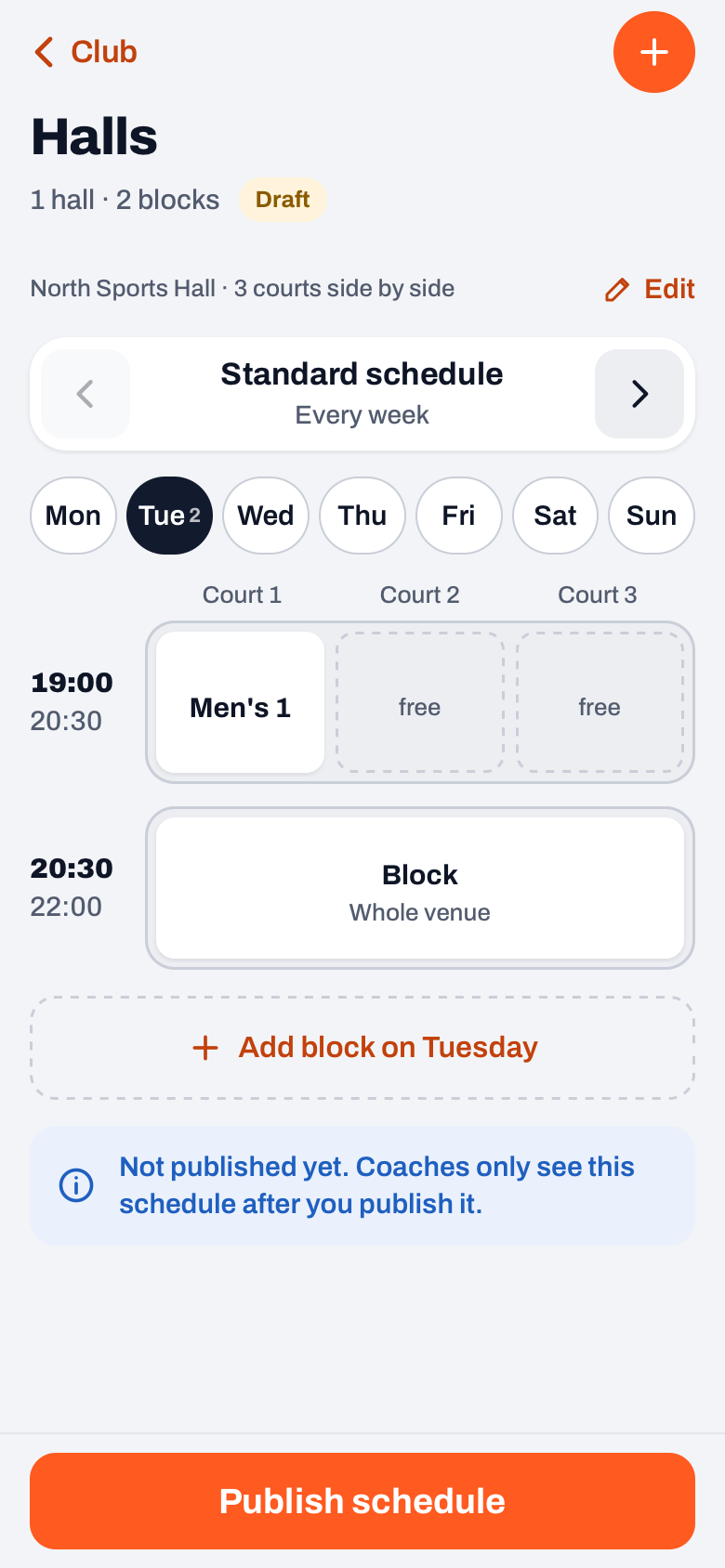
The club dashboard is part of the Club plan; what it includes is on the page for clubs and the prices are on the pricing page.
14 days free, no credit card. Start with your own team; the hall planner and the rest of the club dashboard come with the Club plan.
Try Koach with your teamFrequently asked questions
How deep do you dig for a sand volleyball court?
As deep as the sand layer plus whatever goes underneath. Volleyball England digs out 50 centimeters for 40 centimeters of sand on geotextile; Volleyball Canada mentions 30 to 40 centimeters of sand plus another 30 centimeters if drainage pipes go underneath. For FIVB tournaments at least 40 centimeters of sand is the requirement. Include hauling away the excavated soil in your budget.
How much sand do you need for a sand volleyball court?
Work it out: a sand area of 22 by 14 meters with 40 centimeters of sand is 123 cubic meters, about 161 cubic yards. How many tons that is depends on the sand, so ask the supplier for the weight per cubic meter. Volleyball Canada counts on 160 to 200 metric tons for one court.
What sand is suitable for beach volleyball?
Washed sand without silt, clay, stones or shells, with grains of roughly 0.5 to 1 millimeter according to the Volleyball Canada construction guide. Crushed or ground sand and coarse construction sand are not suitable, and sand that is too fine sticks together and dries hard. Ask the supplier for a sieve analysis.
Can you build a sand volleyball court without drainage?
On ground that drains water well naturally and has no stones, it can work without drainage pipes, Volleyball Canada writes, but the geotextile under the sand is still needed. Test it before the sand goes in: put the dug-out base under water and see whether it drains away. If the water stays, do lay drainage.


Start with your own team in Koach
14 days free, no credit card. The hall planner comes with Club.
Get started with KoachOr read first what the volleyball coaching app does.