
Beach volleyball court dimensions: 16 x 8 m, net and sand
The short answer
Beach volleyball court dimensions are 16 by 8 meters, with a free zone of at least 3 meters all around; in FIVB competitions that is 5 to 6 meters. There is no center line and no attack line. The net is 2.43 meters for men and 2.24 meters for women, and FIVB events have at least 40 centimeters of sand.
Beach volleyball court dimensions are what you look up when you set up a court, organize a tournament or want to know how two players cover all that sand. Here are all the measurements from the FIVB rules for 2025-2028: playing court, lines, free zone, net, posts and sand, plus a way to set up a court square.
How big is a beach volleyball court?
The playing court is a rectangle of 16 by 8 meters, surrounded by a free zone at least 3 meters wide (rule 1.1). The lines are part of the court and lie within that size: so you measure the 16 and the 8 meters to the outside edge of the tapes (rule 1.3). A ball on the tape is in. All the measurements at a glance:
| Element | Size | Rule |
|---|---|---|
| Playing court | 16 x 8 m, measured to the outside edge of the lines | 1.1 and 1.3 |
| Lines | 5 cm wide, tapes in a color that contrasts with the sand | 1.3 |
| Free zone | At least 3 m all around; in FIVB competitions 5 to 6 m | 1.1 |
| Total area | At least 22 x 14 m; in FIVB competitions 26 x 18 to 28 x 20 m | 1.1 |
| Free playing space above | At least 7 m; in FIVB competitions 12.5 m | 1.1 |
| Service zone | 8 m wide behind each end line, to the end of the free zone | 1.4 |
| Net | 8.5 m long and 1 m wide, 10 cm mesh | 2.2 |
| Antennas | 1.80 m long, 80 cm of it above the net | 2.4 |
| Posts | 0.70 to 1.00 m outside the sideline, 2.55 m high | 2.5 |
You can work out the total area yourself: 16 meters plus twice the free zone in length, 8 meters plus twice the free zone in width. The FIVB sizes of 26 by 18 to 28 by 20 meters are also in court diagram 1 at the back of the rules.
No center line and no attack line
On sand there is only the playing court, the service zone and the free zone (rule 1.4). There is no center line (rule 1.3), so you may go under the net into the opponent's court, as long as you don't interfere with them. There is no attack line at 3 meters either: positions and back-row players don't exist in beach volleyball, so anyone may attack and block from anywhere. What that means for the game is in the beach volleyball rules.
For comparison: the indoor court is 18 by 9 meters, with a center line and two attack lines; all its measurements are in volleyball court dimensions, and the indoor rules in all volleyball rules at a glance. The beach court is smaller, but bigger per player. A half court of 8 by 8 meters is 64 m² for two players, so 32 m² per player. Indoors, a half court of 9 by 9 meters is 81 m² for six players, or 13.5 m² per player. So a beach player covers more than twice as much sand as an indoor player covers floor.
The net: height, size, posts and antennas
The net is as high as indoors: 2.43 meters for men and 2.24 meters for women. For youth it may be lower: 2.24 meters for 16 and under, 2.12 meters for 14 and under and 2.00 meters for 12 and under, the same for boys and girls (rule 2.1). You measure the height in the middle of the court with a measuring rod. Above both sidelines the net must be at the same height, and no more than 2 centimeters above the official height there.
- The net itself is 8.5 meters long and 1 meter wide, with a tolerance of 3 centimeters, and has a 10 by 10 centimeter mesh. At the top and bottom there is a band 7 to 10 centimeters wide (rule 2.2). In FIVB competitions a net of 8.0 meters is allowed.
- Two side bands 5 centimeters wide and 1 meter long hang directly above the sidelines and are part of the net (rule 2.3).
- The antennas sit on the outer edge of the side bands, extend 80 centimeters above the net and have 10-centimeter stripes in two colors (rule 2.4).
- The posts stand 0.70 to 1.00 meters outside the sidelines, exactly 1 meter in FIVB competitions. They are 2.55 meters high, rounded and smooth, fixed to the ground without guy wires and padded (rule 2.5). So the posts are 9.40 to 10.00 meters apart.
The sand: what the rules require
The rules require leveled sand, as flat and uniform as possible, free of rocks, shells and anything else that could cut or injure players (rule 1.2). FIVB competitions have stricter requirements: at least 40 centimeters deep, with fine, loose grains, sifted, not too coarse and not so fine that it blows around and sticks to the skin. In case of rain, a tarp to cover the center court is preferably on hand.
For evening matches in FIVB competitions the rules require 1,000 to 1,500 lux, measured 1 meter above the sand (rule 1.6). The game is played barefoot, but the first referee may allow socks or shoes (rules 4.3.2 and 4.4.2), which helps on hot sand. How to build a court with the right base layer, drainage and sand depth is in building a beach volleyball court.
Court sizes for 4v4 and for youth
The FIVB rules only cover two-on-two. For 4v4 the organizer decides the size; in practice it is often just 16 by 8 meters, sometimes 18 by 9 meters because four players can cover more court. What else differs in that format is in the rules for 4v4 beach volleyball.
For youth, the rules only lower the net; a smaller court is not in them. Federations and clubs do often let young kids play on smaller courts, with fewer players and a lighter ball. How to approach that is in beach volleyball for kids.
How to set up a beach volleyball court
- Set the posts. They stand on the imaginary center line, 0.70 to 1.00 meters outside where the sidelines will be. The line between the posts is the middle of the court, where the net will hang.
- Measure out the corners. From the line under the net, measure 8 meters to each end line, and 4 meters to either side of the middle for the sidelines.
- Check with the diagonals. From corner to opposite corner it is 17.89 meters, and that must be true for both diagonals. If they are the same length, the court is square. For each half court the diagonal is 11.31 meters. Both measurements are also in court diagram 2 of the rules.
- Lay the tapes with the outer edge on your measuring line. The line is part of the court, so the outer edge of the tape is the boundary of the 16 by 8 meters. Use anchors of soft, flexible material; hard pegs that stick out don't belong there (rule 1.3).
- Hang the net at the right height. Measure in the middle, check above both sidelines, and put the side bands and antennas directly above the lines.
- Clear the free zone. Bags, bottles and chairs stay at least 3 meters from the lines. Rake the sand before play starts.
Bring a second measuring tape. With two tapes you measure both diagonals at once and see right away whether the court is crooked. After an evening of play the tapes have often shifted: put a marker at each corner just outside the court, and you can straighten them again in a minute.
Taking your indoor team to the sand
Koach is made for indoor volleyball, but many indoor teams train on the beach court for a few weeks in summer. Put those evenings in the calendar in one go: under More in the Schedule you choose Recurring trainings, and with Every, From, Until and Time the whole summer series is in. At Focus you note that it is a beach session. Players sign up or cancel for each practice, so you know beforehand how many courts to book.
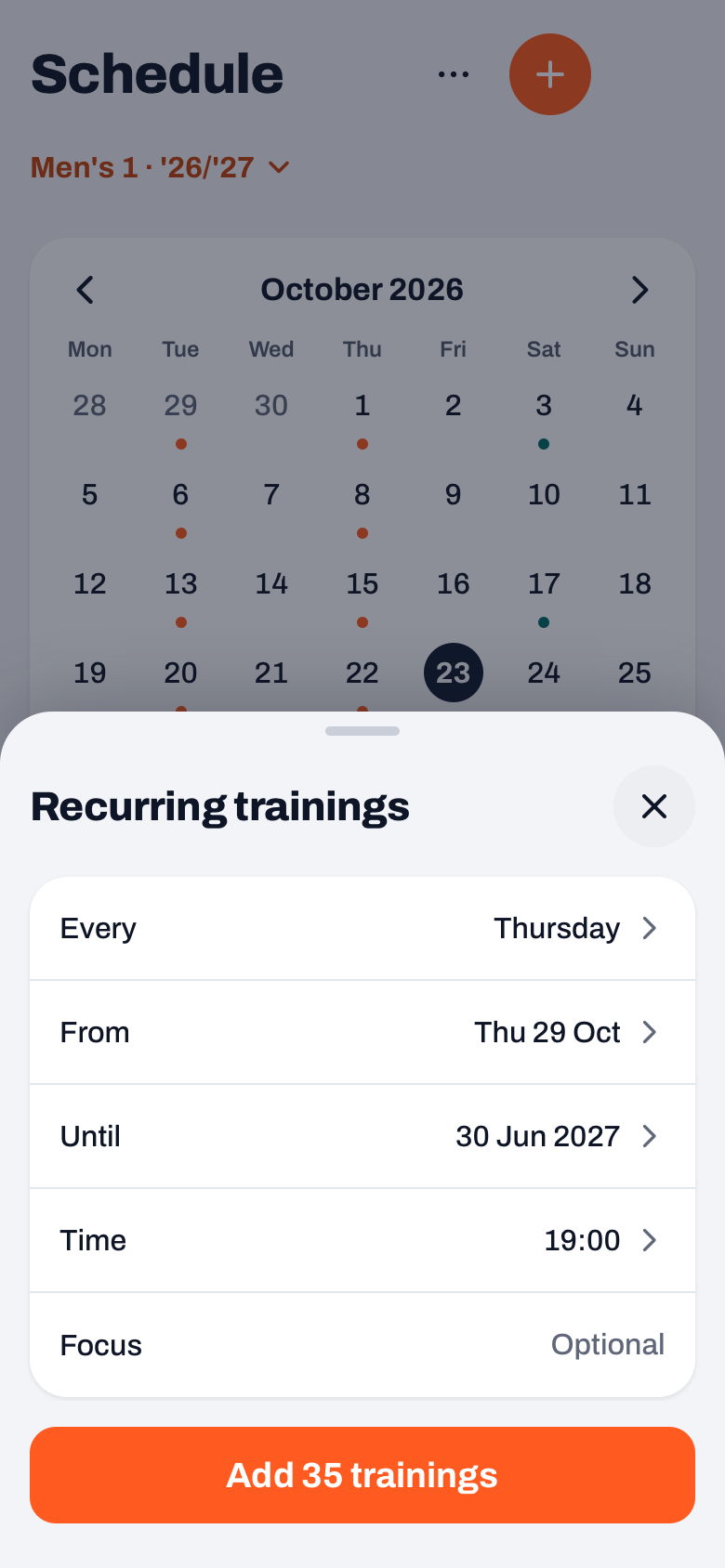
14 days free, no credit card. Put your summer practices in the schedule and see for each evening who is coming.
Plan your summer in KoachWhat Koach costs after the trial period is on the pricing page. All measurements in this article come from the FIVB Official Beach Volleyball Rules 2025-2028.
Frequently asked questions
How big is a beach volleyball court in meters?
The playing court is 16 meters long and 8 meters wide, measured to the outside edge of the lines. Around it is a free zone of at least 3 meters, so in total you need at least 22 by 14 meters. In FIVB competitions the free zone is 5 to 6 meters and the whole area 26 by 18 to 28 by 20 meters.
Is a beach volleyball court smaller than an indoor court?
Yes. The beach court is 16 by 8 meters, the indoor court 18 by 9 meters. Because there are only two players per team, a beach player still covers more than twice as much area as an indoor player. The beach court has no center line and no attack lines.
How deep should the sand on a beach volleyball court be?
For FIVB competitions at least 40 centimeters, with fine, loose, sifted grains without stones. For other courts the rules require leveled sand, as flat as possible and without stones or shells. How deep you make the layer on a club court and what goes underneath depends on the ground and the drainage.
How high is the net in beach volleyball?
The same as indoors: 2.43 meters for men and 2.24 meters for women, measured in the middle of the court. For youth it may be lower: 2.24 meters for 16 and under, 2.12 meters for 14 and under and 2.00 meters for 12 and under, the same for boys and girls.

Put your summer practices in Koach
14 days free, no credit card. After one evening you know who will be on the sand.
Get started with KoachOr read first what the volleyball coaching app does.