
How to set up a volleyball net: measure in the middle
The short answer
Here is how to set up a volleyball net: tension the top cable first, then measure the height in the middle of the court with a measuring rod. Over both sidelines the net must be the same height, at most 2 cm above the official height. The side bands sit directly above the sidelines, with the antennae on their outer edge.
Knowing how to set up a volleyball net sounds like a five-minute job, until the referee comes out with the measuring rod and the middle turns out to be three centimeters too low. This is the order that works: posts, top cable, measuring in the middle, side bands and antennae, and how to switch from one net height to another within a single gym slot.
What you need before you start
The FIVB rules describe exactly what a net has to meet (Rule 2). For a regular indoor practice not everything needs to be right to the centimeter, but if you set the net up properly from the start, you don't have to change anything before a match. You need:
- Two posts 2.55 meters high, preferably adjustable, rounded and smooth, and fixed to the floor without wires (Rule 2.5). They stand 0.50 to 1.00 meter outside the sidelines; in FIVB World and Official Competitions it is exactly 1 meter and the posts are padded.
- The net itself: 1 meter wide (3 centimeters either way) and 9.50 to 10 meters long, with square black mesh of 10 by 10 centimeters. At the top is a white band of 7 centimeters with a cable inside, at the bottom a band of 5 centimeters with a rope (Rule 2.2).
- Two side bands 5 centimeters wide and 1 meter long. They are part of the net (Rule 2.3).
- Two antennae: flexible rods 1.80 meters long and 10 millimeters thick, with 10-centimeter stripes in two contrasting colors, preferably red and white, on the part above the net (Rule 2.4).
- A measuring rod, a straight stick with the net heights marked on it. A tape measure works too, but only if someone holds it straight.
With two people you are done in ten minutes. You can do it on your own, but then you walk back and forth between the posts a lot more.
How to set up a volleyball net in seven steps
- Secure the posts. Put them in the floor sockets and lock them the way the manufacturer says. Push hard against them: a post that moves loses its tension as soon as the net is tight. Put the padding on.
- Lay the net out along the center line. White band on top, and check that the net isn't twisted anywhere. If the side bands are already attached, they now lie roughly at the sidelines.
- Attach the top cable. First to the post without the tensioning mechanism, then to the post with the winch or ratchet. Tighten until the white band runs in a straight line from post to post.
- Set the rough height on both posts. Slide the cable to the same position on both sides. This is a first setting, not a measurement yet.
- Measure in the middle. Stand the measuring rod upright on the center line, in the middle of the court, and check whether the top of the band is exactly at the mark: 2.43 meters (7 ft 11 5/8 in) for men and 2.24 meters (7 ft 4 1/8 in) for women (Rule 2.1). If the net is too low, adjust both sides by the same amount and measure again.
- Measure over both sidelines. There the net must be exactly the same height on both sides, and no more than 2 centimeters above the official height (Rule 2.1). If one side is higher than the other, the net is crooked: adjust only that side and then measure the middle again.
- Tighten the bottom and position the side bands and antennae. Pull the bottom rope tight, slide the net so the side bands hang directly above the sidelines, and fasten the antennae. Then measure the middle one more time: the bottom rope can pull the net down a little.
Why you measure in the middle and not at the posts
The rules measure the height from the center of the playing court (Rule 2.1), and there is a reason for that. A ten-meter net always sags a little, even when it is tight. So the position on the post tells you something about the ends, not about the place where most balls cross the net. On top of that, the marks on posts often don't match the net that is up today: a different net, a different cable or a little less tension, and you are a few centimeters off.
A few centimeters sounds like nothing, but at the net you feel it: an attacker hits the ball just above or just into the band, and a blocker just does or just doesn't get over it. How high the net goes for each age group and competition is covered in all volleyball net heights. This article is about putting it up.
Keep the measuring rod with the net, not in the storage room. Use tape to mark the two heights your gym uses most on the rod. Whoever puts up the net then measures in the middle without thinking about it, because the rod is already there.
How tight should a volleyball net be?
The rules give no number for the tension. They only say that the cable inside the top band keeps the net taut, and that the bottom rope keeps the lower part taut (Rule 2.2). In practice there are three quick checks:
- The band is a straight line. Look along the top band from one post. If you see a clear downward curve, the cable is too slack, and the difference between the middle and the sides is probably more than 2 centimeters.
- The net springs back. Push the band down in the middle with your hand and let go. A tight net springs back straight away.
- A ball in the net comes back out. Throw a ball into the upper part of the net. A tight net bounces it back into the court; with a slack net it drops dead down the net. That makes it hard to play a ball off the net, in practice and in a match.
Don't crank the winch further than needed. Too much tension can bend posts and floor sockets; follow the manufacturer's manual if it gives a limit.
Side bands and antennae: exactly where they go
The side bands hang vertically, directly above the sidelines. The antennae go on the outer edge of each side band, on opposite sides of the net: one antenna on your side of the net, the other on your opponent's side (Rule 2.4). The top 80 centimeters stick out above the net.
The antennae are part of the net and mark the edges of the crossing space the ball has to pass through. If an antenna is shifted inward or outward, the width within which a ball is good changes too. What happens to a ball that crosses outside the antenna is covered in the ball outside the antenna.
Two net heights in one gym slot
In a lot of gyms a women's team practices at 2.24 meters at seven o'clock and a men's team at 2.43 meters at half past eight, on the same court. Or a youth team plays at a lower height set by the youth rules of your own federation. Then you want to switch in a few minutes instead of spending a quarter of an hour searching. Here is how:
- Measure both heights carefully in the middle once, with this net and this tension.
- Mark the position for each height on both posts with tape in two colors, for example white for 2.24 and red for 2.43.
- When you switch: release the winch, move both sides to the other color, tighten again, and do one check in the middle with the rod.
- Agree who does it. The team leaving the court or the team coming on, it doesn't matter, as long as it is fixed. Otherwise the net is still at the previous height at half past eight and the second group loses ten minutes.
After a change in tension or a different net, always put the rod against it first: the tape is a shortcut, not a measurement. And with three courts side by side this applies per court; the youth team on court 3 often plays at a different height than the senior team on court 1.
Setting up and taking down safely
- Take the crank handle off the winch or turn it away from the court, so nobody runs into it on a dive.
- Don't let anyone hang on the net or the top cable. A tightly tensioned cable is under a lot of force.
- When taking it down, release the tension first, then unhook the cable, and only then lift the posts out of the sockets.
- Store the antennae separately, not rolled up in the net: they break easily.
A net outside on grass or in the backyard needs different posts and anchors; that is covered in a volleyball net for your backyard. All the rules around the net and the rest of the game are in all the volleyball rules at a glance, and the official text is in the FIVB Official Volleyball Rules 2025-2028.
Who changes the net? The hall schedule in Koach
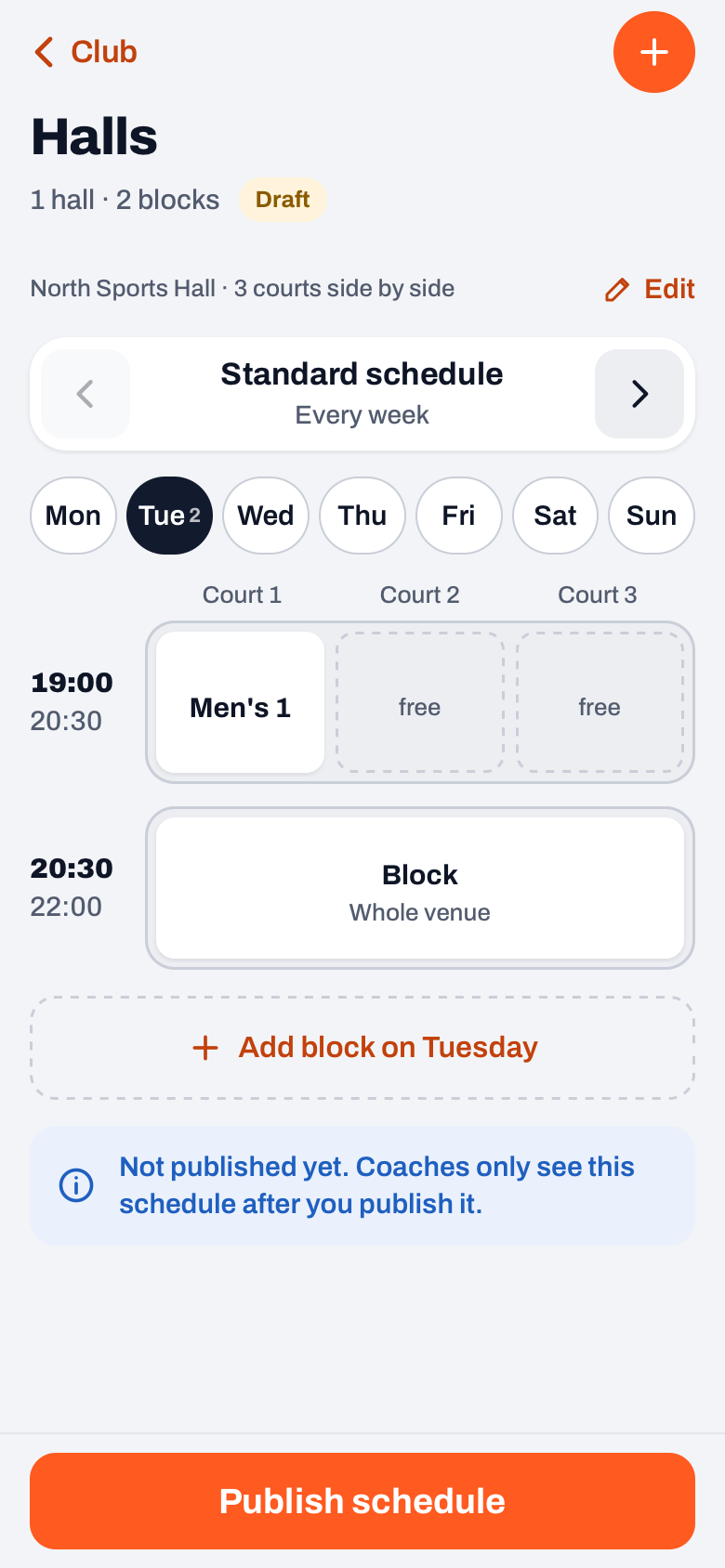
No app puts up a net for you. What does help is knowing who is on which court after whom. In the club section of Koach (the Club plan) you set up, under Halls, the courts for each hall and the fixed blocks for each evening: which team practices on which court from when to when. That way you see at a glance where a women's team and a men's team follow each other, and so where the net changes height. How to set up that schedule is covered in setting up your club's weekly venue schedule.
What else the club section does and how to request it for your club is on the page for clubs; there is no trial period on Club. What the plans cost is on the pricing page.
14 days free, no credit card. Start with your own team; the hall planner and the rest of the club dashboard come with the Club plan.
Try Koach with your teamFrequently asked questions
How far are volleyball net posts from the sideline?
Under the FIVB rules the posts stand 0.50 to 1.00 meter outside the sidelines. In FIVB World and Official Competitions it is exactly 1 meter and the posts must be padded. The posts are 2.55 meters high, rounded and smooth, and fixed to the floor without wires.
Can a volleyball net be lower in the middle than at the sides?
In the middle the net must be exactly at the official height, because that is where it is measured. Over the two sidelines it must be the same height on both sides and may be no more than 2 centimeters higher. Because a net always sags a little, the sides are in practice often a centimeter or two higher than the middle.
Which side of the net do the antennae go on?
Each antenna goes on the outer edge of a side band, so directly above the outside of the sideline. The two antennae are on opposite sides of the net: one on your side, the other on your opponent's side. The top 80 centimeters stick out above the net and have 10-centimeter stripes, usually red and white.
Who checks the net before a match?
Before the match the first referee inspects the playing area and the equipment (Rule 23.3.1.1); in practice one of the referees measures the net with the measuring rod. If your team doubts the height during the match, the game captain may ask for the net to be checked while the ball is out of play (Rule 5.1.2.2).


Start with your own team in Koach
14 days free, no credit card. The hall schedule comes with the Club plan.
Get started with KoachOr read first what the volleyball coaching app does.