
Visualization for volleyball: rehearse your serve in your head
The short answer
Visualization for volleyball means performing a movement in your head, with what you see, feel and hear, without actually doing it. A player can rehearse their serve this way: at real speed, with the gym and the whistle included and a short cue word as self-talk. It works alongside real repetition, not instead of it.
Visualization for volleyball sounds like something for Olympians with their own mental coach, but it is simply practice without a ball: you play an action through in your head before you do it. Together with self-talk, the short phrases you say to yourself, it is a tool every volleyball player can learn in practice.
What visualization in sport is, and what it is not
With visualization you perform a movement in your head. Not just the picture, but everything that goes with it: the weight of the ball in your hand, the sound of the whistle, the tension in your shoulder as you draw back, the ball skimming low over the tape. Sport psychologists call it imagery or mental practice. It is something different from positive thinking or dreaming about a championship: you rehearse an execution, not a result.
You can do it in two ways. From the inside you look through your own eyes and feel the movement; that helps with technique and timing. From the outside you see yourself as if in a video; that helps you check your body position. Most players switch between the two, and that is fine.
Does it work? A meta-analysis by Simonsmeier and colleagues (2021), which pooled the results of a large number of sport studies, found that imagery improves athletes' performance and motivation, and also how they feel. Imagery combined with physical practice did better than physical practice alone, and the effect was larger the more intensively athletes worked with it. For volleyball there is a small study of an American college team that followed a mental program around the serve (Shoenfelt and Griffith, 2008): players who used more imagery by the end of the season had a higher percentage of good serves, and the same held for a consistent pre-serve routine. With eleven players that is a correlation and not proof, but it points the same way.
How to rehearse a serve in your head
A useful recipe comes from Holmes and Collins (2001): the PETTLEP model. The idea behind it is simple. The more your image resembles the real action, the more it delivers. The seven letters, applied to your serve:
| Letter | What it asks | For your serve |
|---|---|---|
| P, physical | Your body takes part | Stand in your serving stance, with the ball in your hand and your shoes on |
| E, environment | The real place | See the gym, the end line and the net, hear the whistle |
| T, task | Exactly your action | Your toss, your contact, the zone you choose |
| T, timing | Real speed | As long as a real serve, not in slow motion |
| L, learning | The image grows with you | Adjust the image as soon as your technique changes |
| E, emotion | The feeling of the moment | Feel the tension of a serve at 23-23 |
| P, perspective | From inside or outside | Through your own eyes for the feel, from outside to check your form |
An image of a float serve takes about as long as the real one. It can look like this:
- You stand behind the end line, feet in their usual spot, and feel the seams of the ball under your fingers.
- You bounce the ball twice, look at the zone it has to go to and say your word, for example "high and flat".
- You toss: the ball hangs in front of your hitting shoulder, just above your reach.
- You hit it with a firm, open hand right behind the ball and keep your wrist still.
- You see the ball travel low over the tape and drop into the zone you chose.
Now and then also imagine that it goes wrong, and above all what you do next: breathe out, reset, next ball. Keep the error itself short and the recovery long. A player who keeps seeing the ball go into the net in their head is rehearsing exactly the image they want to get rid of.
When and how often to visualize
- Short and often. Three to five clear images beat ten minutes of vague daydreaming. A few minutes, a few times a week, is enough to start with.
- In practice: first the image, then the ball. In a serving drill, have players do one serve in their head first and then the real one. That way they link the image straight to the feel.
- At home or on the way. Eyes closed, in your serving stance if you can. A player who cannot practice for a week keeps the feel of their serve this way.
- Just before the serve. In a match there is time for one short image of a second: the path of the ball to your zone. Longer is a distraction.
- Before the match. Playing a few actions through in your head is part of a calm preparation. What else to do the night and the hour before is in how to calm nerves before a volleyball game.
Visualization comes easiest with a movement you already know, because then you know how it should feel. If you are learning a new technique, such as the overhand serve, hit real balls first until you have that feel, and bring in the image after that. With kids, keep it short and concrete: "see the ball go over the net and land by the cone."
Self-talk: what you say to yourself counts
Self-talk is everything you say to yourself, out loud or in your head. There are two kinds. Instructional self-talk is about execution: "toss high", "feet first". Motivational self-talk is about effort and confidence: "come on", "this one's mine". A meta-analysis by Hatzigeorgiadis and colleagues (2011) found that self-talk improves performance, especially on precise tasks and on tasks that are still new. Instructional self-talk worked better than motivational self-talk on precision tasks, and it helped most when athletes had actually practiced their self-talk.
For volleyball that means: on the serve, the pass and the set you choose an instructional cue; on blocking, defense and the last points of a set it can be motivational. A good cue is short (one to three words), says what you do want to do and comes from the player themselves.
| Action | Instructional cue | Motivational |
|---|---|---|
| Serve | "high and flat" | "my ball" |
| Serve receive | "feet first" | "got it" |
| Set | "hands up" | "easy" |
| Attack | "hit high" | "go for it" |
| Block | "hands over" | "stand tall" |
| Defense | "low and still" | "every ball" |
Also pay attention to what you already say. "Not in the net" sounds like an instruction, but puts the net in your head. Replace it with what you do want: "high and flat". After an error, "I always mess this up" then becomes "next ball, my zone". Notice, stop, replace: that is the whole technique, and it takes a few weeks of practice.
Visualization and self-talk together in your serve routine
The serve routine itself, with the breathing, is in mental training for volleyball. Visualization and self-talk fit into it as two short steps:
- Bounce the ball, breathe out calmly.
- Look at your zone and see the path of the ball: one image, one second.
- Say your word.
- Toss and hit, without thinking any more.
Do it on every serve, also at 5-1 in the first set and also in practice. A routine that only comes out at 23-23 feels strange at that moment instead of familiar.
Start with one word, not a script. In practice, have every player choose one instructional cue for the serve and say it on every serve for a week. Only once that comes naturally does the image get added.
What you do as a coach
Explain it once in ten minutes, let players come up with their own word and then schedule a few minutes a week, for example as a fixed part after the warm-up. Do not stop at explaining: self-talk and imagery only work once they are practiced. If a player sees few images, have them start with the feel and the sound; for most players the image gets sharper by doing it. If you are a new coach, this is not a topic for week one: the basics of your first season are in starting as a volleyball coach.
Visualization and self-talk are tools to perform better, not therapy. If a player freezes for weeks, dreads every match or starts playing it safe out of fear of making mistakes, read about the player who plays it safe and bring in a sport psychologist if the problems persist.
Measuring whether it works: serve errors in the closing phase
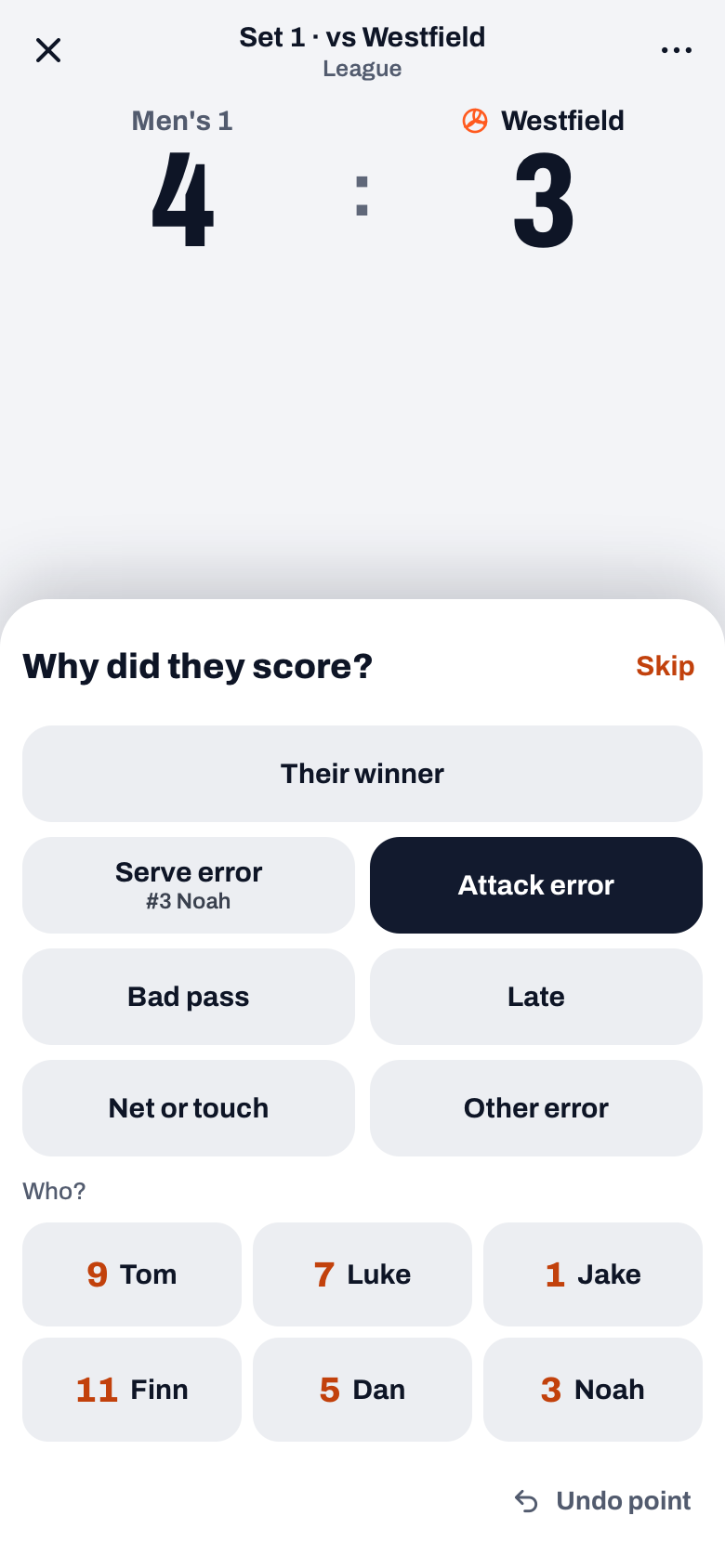
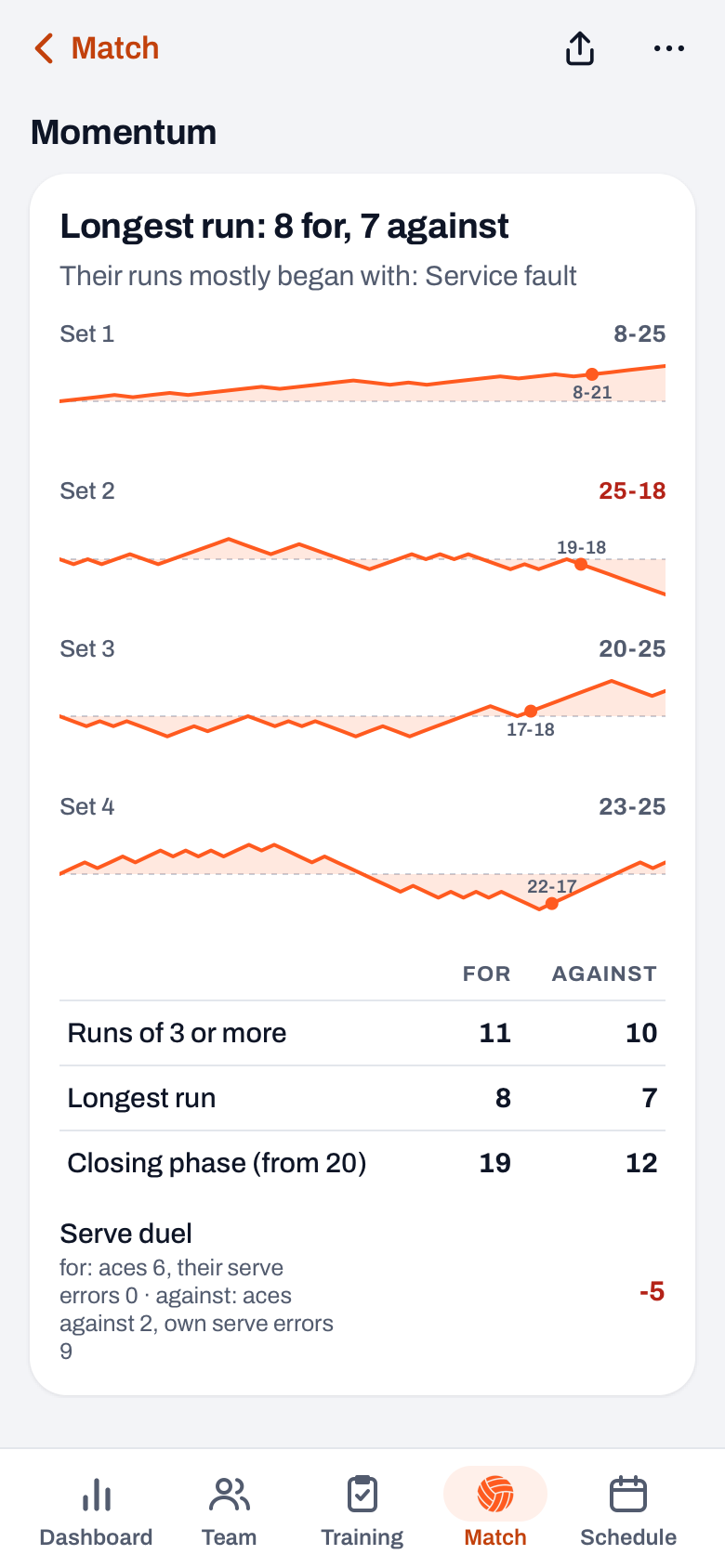
Whether a player serves better since they started using a word and an image, you will not see from one match. If you track your matches live in Koach, then on a point for the opponent you tap Serve error in the Why did they score? drawer, with the server already shown underneath. After the match, Momentum shows how your team did in the Closing phase (from 20) and in the Serve duel: aces against serve errors. Note: in Simple the app counts serve errors, not the number of serves. If you want to give every serve a rating, choose Expert, also in a practice game with the focus on Serve.
Compare a few weeks before and after. What you see in practice goes in the report under Focus for next time, so your assistant coach knows what the group is working on. What Koach costs after the 14 free days is on the pricing page.
14 days free, no credit card. Track your next matches live and see whether the serve errors in the closing phase go down.
Try Koach with your teamFrequently asked questions
Does visualization really work in sport?
Yes, as long as you practice it and do it alongside physical training. Research that pools many studies shows that imagery improves performance and that imagery plus physical practice delivers more than physical practice alone. It comes easiest with a movement you already know, at real speed and with the feel of the real situation included.
How long should you visualize before a game?
Briefly. A few clear images of your serve, your pass or your attack are enough; more than a few minutes tends to make you restless rather than sharp. In the match itself there is only time for one image of a second, as a fixed step in your serve routine.
What is the difference between visualization and self-talk?
With visualization you play an action through in your head, with picture, feel and sound. Self-talk is what you say to yourself, out loud or silently. They complement each other: the image shows what you are going to do, the word puts your attention on the one point that matters.
What if I do not see any images when I close my eyes?
That is normal and no reason to stop. Start with what you feel and hear: the ball in your hand, the toss, the sound of the contact. Standing in your serving stance and doing the movement small also helps. For most players the image gets sharper the more often they do it.
Can you use visualization and self-talk with kids?
Yes, if you keep it simple. Have kids make one concrete image, such as the ball landing by a cone, and choose one word of their own. Keep it to a few repetitions just before the real ball, and do not turn it into a long exercise with their eyes closed.


See whether your serve holds up in the closing phase
14 days free, no credit card. After a few matches you see the serve errors per player.
Get started with KoachOr read first what the volleyball coaching app does.