
How to calm nerves before a volleyball game: what helps
The short answer
Nerves before a volleyball game are a normal reaction of your body and make you sharp. To calm them, sort out everything you can the night before, follow a fixed routine with warm-up and hitting in the hour before, and focus on one task in the first rallies instead of on the score.
How to calm nerves before a volleyball game is something every player wonders about: an unsettled stomach, a bad night's sleep, the first serve you have already missed in your head. This article is for the player who wants to know what to do about it, the night before and the hour before, with a part for the coach who helps them.
Why you are nervous, and why that is not a problem
Nerves are your body getting ready for something that matters. Your heart beats faster, your breathing gets higher, your stomach churns, you need the bathroom one more time, you yawn or your hands are cold. That is not a sign that things are going wrong. It is the same reaction that makes you quick and alert in the match.
It only gets tricky when your attention shifts from what you need to do to what might go wrong: from "high toss" to "if I miss this one, we lose". Then movements that come naturally in practice start to stall. How that works and how to train it is in mental training for volleyball players. So the goal of this article is not to make your nerves go away, but to use them.
One simple lever is what you call it. In experiments by the American researcher Alison Wood Brooks, people who told themselves before a stressful task that they were excited performed better than people who tried to calm themselves down (Brooks, 2014). The tasks were singing, public speaking and math, not sport. But it costs nothing: "I'm excited" fits a pounding heart just as well as "I'm nervous".
Nerves before the game: what to do the night before
The night before, the point is to leave as little as possible to sort out tomorrow. Every thing you still have to look for is one more thing to worry about.
- Pack your bag. Shoes, knee pads, jersey with your number, shorts, socks, a full water bottle, a snack and anything else you always use, such as tape or a brace.
- Know where and when. The meeting time, the address of the gym and who is driving. If you are taking public transport, look up the route tonight, not tomorrow.
- Eat as you always do. No experiments with new food. How to time your meals to the start time is in what to eat before a volleyball match.
- Pick one or two tasks. Concrete and within your control: "high toss and serve to zone 1", "first pass high to the middle". Write them down. After that you are done thinking about the match.
- Go to bed at your usual time. If you lie awake, do not add extra worry about it: many athletes sleep worse before an important match, you are not the only one. Lying quietly is better than playing the match in advance on your phone.
The hour before the game
In the last hour your head needs something to do. A fixed order helps: if you know what comes next, you do not have to decide anything.
- Arrive on time. Rushing gives you tension you do not need. If you are ten minutes early, you can change in peace.
- The same routine as always. Get changed, shoes on, tape, water ready, in the same order as for every match. A routine is not superstition: it gives your hands and your head something familiar.
- Moving helps. The warm-up and the hitting warm-up take a lot of the restlessness out of your body. Touch the ball as often as you can, and hit your first serves in the warm-up with exactly the same routine as in the match. How the pre-match warm-up is built is in the volleyball pre-match warm-up.
- Breathe out longer than you breathe in. A few times calmly in through the nose and slowly out, just before the team talk or before your first serve. That takes some of the tension away.
- Say your cue words. Short phrases that keep you on task: "high and through", "feet first", "bring it on". How to work with phrases like that and with pictures in your head is in visualization and self-talk.
- Nothing new. No new shoes, no new serve, no energy drink you never drink. Anything new gives your head one more thing to think about.
Plan your first two balls. Decide with yourself what your first serve will be (the safe one you put in nine times out of ten in practice) and where your first pass goes. A first ball that works does more against nerves than any intention to stay calm.
The first rallies: from your head to your task
For many players the tension drops as soon as the first balls have been played. So keep those first actions simple: a serve you can do, a pass that above all is high, an attack that lands in the court. You do not have to show what you can do in the first rally. You only have to get into the match.
If something goes wrong, a fixed reset moment helps: a moment of frustration is fine, then one breath, hands along your shorts or a tap on your shoe, and you think about your next task. Not about the error, and not about the score. If you practice that in training, you have it ready in the match.
What the coach does for a nervous player
- Do not say "don't be nervous". That plants the very thought. "Stay calm on the serve" works the same way. Give one task instead: what they should do, not what they should avoid.
- No last-minute surprises. Who starts and who does not, you tell them before match day or on arrival, not in the huddle just before the first serve.
- Let them touch the ball early. Put a tense player at the front of the line in the warm-up, not at the back.
- Talk about tasks afterwards. Ask whether their first serve went the way they planned, not whether they were nervous.
- With youth, the parents too. Agree that no more tactics get discussed in the car on the way to the gym. A calm ride does more than one last instruction.
If a player keeps playing clearly worse in matches than in practice, check whether it is really nerves or something in the training; that question is worked out in good in practice, bad in games. If you are on the sideline for the first time yourself, you have nerves too; what else comes your way in your first season is in starting as a volleyball coach.
When nerves become too much
Tension you feel before every match that fades in the first rallies is part of sport. It is different if you have to throw up before every match, if you start avoiding matches, if you get panic attacks, or if the tension takes over your sleep, your eating or your school or work for days beforehand. Then talk to your doctor or a sport psychologist. That is not weakness; it is the same step as seeing a physiotherapist with an injury.
Less to think about: the match in your schedule
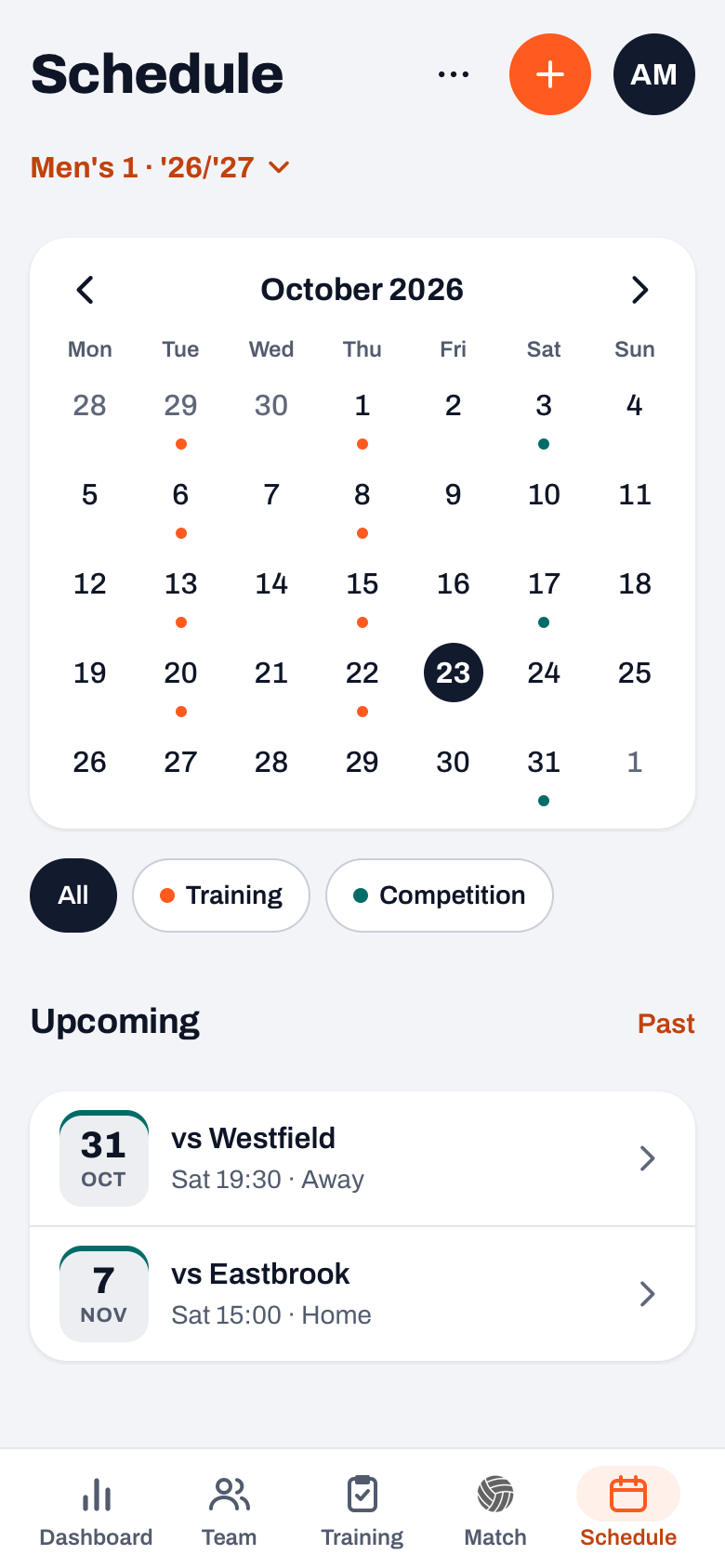
A lot of match-day tension comes from things that are not about volleyball: what time, where, who is driving. If your team uses Koach, the match is in your Schedule under Upcoming, with the day, the time and whether it is home or away, and you sign up with the check mark. If there is a carpool plan for an away match, you see the ride on your dashboard, with the venue, the address and the drivers. With the sync icon in the Schedule you put all practices and matches into your phone's calendar; if the calendar feed is not switched on yet, ask your coach to open it once.
As a player you pay nothing: your account falls under your team's subscription. Your coach can try Koach free for 14 days, and what it costs after that is on the pricing page.
14 days free, no credit card. Put your matches and practices in the schedule, so your players know the night before where and when.
Try Koach with your teamFrequently asked questions
How do I get rid of my nerves before a game?
Usually you cannot make them go away completely, and you do not need to: a bit of tension makes you sharp. What helps is sorting everything out the night before, following a fixed routine in the hour before, breathing out longer than you breathe in and focusing on one task for the first balls. Tell yourself you are excited rather than that you need to calm down.
Is it normal to feel sick before a game?
An unsettled stomach is part of the tension your body builds up before a match, and it often settles during the warm-up or the first rallies. Eat on time and the way you are used to. If you throw up before every match or the nausea lasts a long time, talk to your doctor about it.
What should you do if you cannot sleep the night before a game?
Do not add extra worry about it: many athletes sleep worse before an important match. Stay lying quietly instead of looking at your phone, and go to bed at your usual time on the nights before. If you lie awake for nights before every match, talk about it with your coach or your doctor.
What should a coach say to a nervous player?
Give one concrete task, such as where their first serve goes, and do not tell them not to be nervous. Let them touch the ball early in the warm-up, and do not announce lineup decisions just before the match. Afterwards, talk about that task, not about their nerves.



Put the match in everyone's schedule
14 days free, no credit card. Your players know the night before where and when.
Get started with KoachOr read first what the volleyball coaching app does.