
Good in Practice, Bad in Games: Drills or Nerves?
At the last practice before the match they pass twenty balls neatly to the setter. In the match the first serve is on the floor. Good in practice, bad in games — the same players, the same gym, a few days in between. The answer is rarely 'nerves' and rarely 'they don't want it', but it isn't one answer either. This piece helps you work out which of the two it is for your team, before you change anything.
Good in practice, bad in games: the short answer
It almost always comes down to one of two things, and they call for opposite responses. Either your drills ask for something different from the match, so that what works in practice doesn't exist in the match. Or a player loses something under pressure that they do have in practice. The first you solve in your practice, the second in how you handle that player. Tackle the wrong one and you often make it worse: a player struggling with pressure gets even more pressure in practice, and a team with a drill problem is told not to let itself go like that.
For anyone looking this up as a player or a parent: it is not a question of character. A player who shows in practice that they can serve a ball into the court can do it. The question is not whether they want to, but what is different in the match compared with practice.
What follows is a diagnosis, not a solution. How to set up drills so that they do transfer is worked out in game-like drills. This piece first helps you decide whether that is the page you need.
The fork in the road: does the whole team drop off, or one player?
The first question almost always separates the two: who drops off, and on which skill?
- If the whole team drops off on the same skill — serve receive is worse in the match than in practice for almost everyone — it is the drill format. Six players don't happen to get nervous at the same time on exactly the same ball.
- If one player drops off who otherwise trains normally, while the rest roughly achieve what they show in practice, it is the pressure. Whatever the drill format lacks, that player would not be the only one to miss it.
Two things make it messier than this scheme. It can be both at once: a team that drops off in serve receive, with one player within it who struggles especially badly. Then start with the team, because that affects that player too. And sometimes the opponent is simply better than what you face in practice. A serve that comes in harder and flatter than your own teammates' is not a pressure problem — but it is something to remember when you plan your next practice.
Don't decide on one match either. One bad day can be anything: an early start time, an ill setter, an opponent in form. Look at three or four matches in a row and at what keeps coming back in them.
Three signals that point to your drills
- It goes wrong on the ball that doesn't exist in practice. In practice your serve receive gets a serve from a teammate who wants the drill to run, or a toss from the coach. In a match it comes from someone who wants your pass to fail. If serve receive goes well in practice and badly in matches, look honestly at where that practice ball came from — and count straight away how many real serves a player gets per evening. In a line at one net that is often fewer than you think; see more ball contacts per practice.
- The error is in the moment before, not in the execution. In practice players are in the right place, because they know where the ball will come. In the match they are late or in the wrong spot, and the technique that goes wrong afterwards is a consequence. If you mainly see balls that are just not reached or come off the arms at an angle, it is neither technique nor pressure. If it is mainly in the switch from defence to attack, there is a separate piece on that: practising transition.
- It goes wrong as soon as something is at stake, for everyone at once. Not in the first rallies, but from the moment the score gets tight or the set goes on for a long time. If your practice never has a score that means something, your team has never practised with a ball that counts. That is not pressure on one player, but a missing piece in everyone's training.
Three signals that point to pressure
- You see it in what they choose, not in what they can do. The hitter who hits hard in practice tips every ball in the match. The setter who uses the middle in practice plays everything high to the outside in the match. The technique is still there; the choice has become safer.
- It is on the ball they face alone. The serve is the clearest example: everyone is watching, nobody can help and you have time to think. If one player's serve falls away in the match while their serve receive carries on as normal, that is a strong signal.
- One error drags two more behind it. In practice they let an error go; in the match a second and a third follow within a few rallies. Sometimes it starts even earlier: they arrive at the gym already tense and the warm-up is sluggish. How to set up the warm-up so players get something out of it is in the pre-match warm-up.
One sentence keeps the two apart. Drills: one skill that drops off, for everyone. Pressure: one person who drops off, across different skills. If what you saw in the match fits neither, look first at the opponent and at your lineup before you change anything.
What you write down during the match to see the difference
You don't have to become a statistician. Three things per lost rally are enough: on which skill it ended, with which player, and at what score. After one match that says little. After three or four you see whether the errors are spread across the team on one skill — the drills — or pile up with one name at the moments that count — the pressure.
On top of that, write one line per week about practice: what was the focus, and how did the ball come in during those drills? You need that line to see later whether the match asked for something practice didn't offer. How to build that focus up over weeks is in structuring your practices.
If you score live in Koach, you get the match side as well: errors per player broken down by type, the reception rating, the side-out per rotation, the momentum line per set and a match note. On the practice side you record a focus per practice, choose drills for it and give each player a rating. The CSV export has attendance, average effort, attack, block, serve, points and errors by type per player on one line — that is where practice and match sit side by side. What the app doesn't do: it doesn't calculate a transfer score, doesn't automatically compare your practice with your match and doesn't track a success rate per drill. You make the comparison yourself. And "game awareness" is a rating you fill in as the coach, not a measurement.
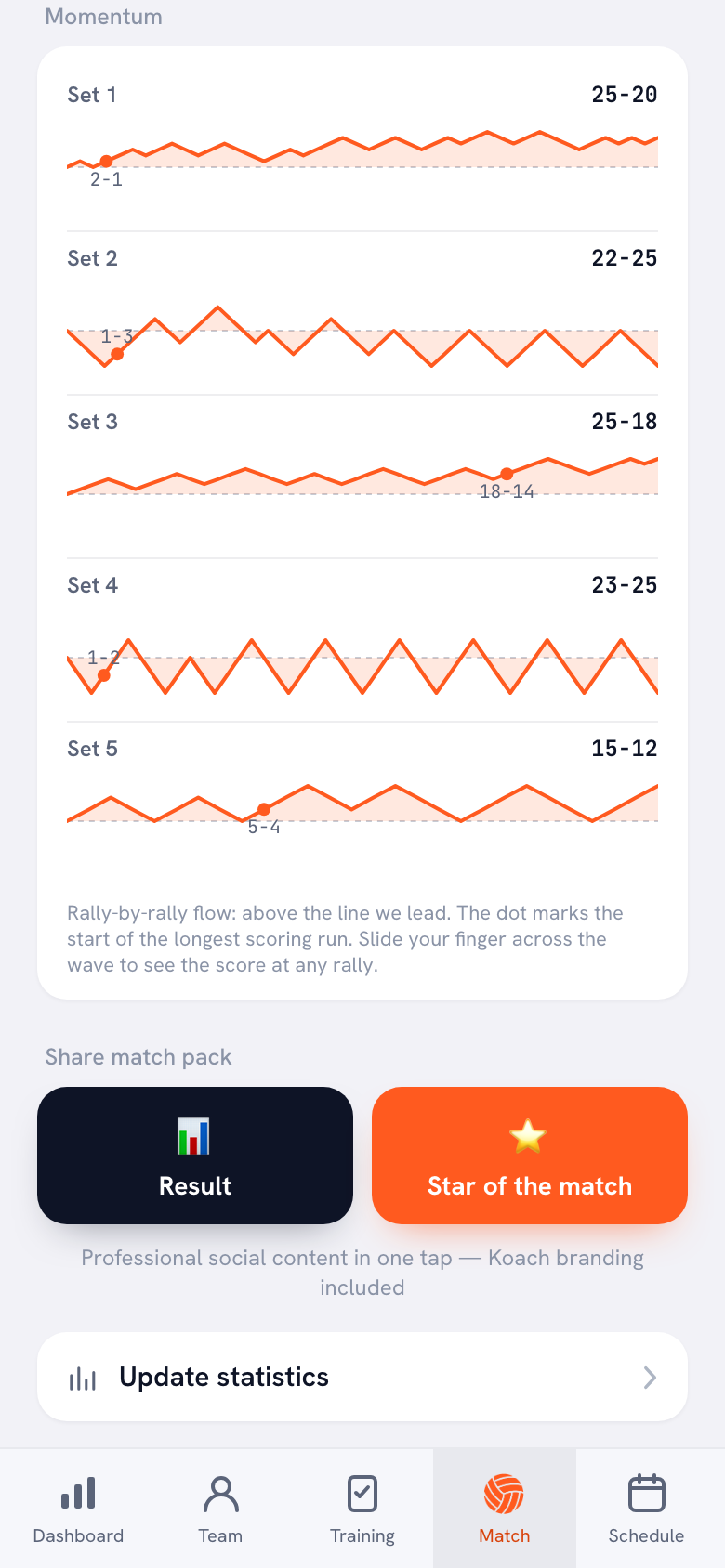
How to read errors per player without turning them into a ranking is in error load per player; how to read the rest of the player numbers is in reading player stats. Where the match tips is shown by the momentum line. If the team keeps dropping off in the same lineup, look first at your weakest rotation — that is a third explanation that can look like either of the other two. And discuss what you find with the group in a way that doesn't turn into a reckoning; see the match debrief with data.
It is the drills: this is the next step
If the signals point to the drills, don't change your whole practice in one go. Choose the skill that dropped off most often in recent matches and tackle only that one. Why transfer goes wrong, what to change in a drill and how to check whether it works is worked out in game-like drills: why practice doesn't transfer.
It is the pressure: this is the next step
If the signals point to one player, don't start with your drills, and not with a conversation about character or willpower either. Which way you go depends on how it shows. If they start playing safer, the player who starts playing it safe is the next piece. If it is mainly about the serve, the routine and breathing, that is mental training. And if someone on the sideline shouts something after every error, that is part of the picture; see parents on the sideline.
Try it yourself in Koach
Score your next matches live in Koach and record a focus for every practice. After a few matches you have errors by type per player and what you practised per session, and you answer the fork in the road above with what happened instead of with what you remember. The trial lasts fourteen days, and you start a friendly live in the same way as a league match — handy if you want a second match sooner to put next to the first.
Frequently asked questions
Is it nerves when my team plays better in practice?
If the whole team drops off, usually not. Six players rarely get nervous at the same time on exactly the same skill; then it is more likely that your drills are missing something the match does ask for. Nerves more often explain why one player drops off while the rest roughly reach their practice level.
How do I know whether it is my drills and not the players?
For three or four matches, write down for every lost rally on which skill it ended, with which player and at what score. If the errors are spread across the team on one skill, it is the drills. Then look at where the ball came from in your practice drill for that skill: from an opponent or from a teammate who wanted it to work.
Does a friendly help to see the difference?
Yes, it is the cheapest test there is: a real opponent, but less at stake. If the team also drops off in the friendly on the same skill, that points to the drills. If one player holds up there and drops off in the league, that points to pressure. How to set one up is in creating a friendly match.
What should I say to my child after a match like that as a parent?
As little as possible about the match, and not straight away. Ask later what they noticed themselves, and leave the analysis to the coach. Above all, don't say 'but you can do it in practice': that sentence puts the problem in their character and makes the next match heavier instead of lighter.


Try it yourself in Koach
Less admin, more coaching.
Get started with KoachOr read first what the volleyball coaching app does.