
Body language in volleyball: what your team shows after an error
The short answer
Body language in volleyball is what you show without words: head up or down, toward your team or away from it. Because play stops briefly after every rally, teammates, opponents and the coach see it again and again. You work on it with a few fixed team habits after every point and every error.
Body language in volleyball is easy to see. After every rally play stops for a moment, and in those few seconds everyone sees how you react: your teammates, the opponent on the other side of the net and your coach on the sideline. What you show then sometimes says more than what you shout.
Why body language in volleyball is so visible
A set to 25 points has at least 25 rallies, and after every rally play stops until the next whistle. In that pause six players stand close together on a small court, with the opponent a few meters away on the other side of the net. There is no ball to hide behind and no field to run away on.
That the opponent reads your posture has been studied too. Sport psychologists showed people silent three-second clips of athletes during a break in play, in table tennis, basketball and handball, without the score (Furley and Schweizer, 2014). Adults could often judge well whether an athlete was ahead or behind, and children aged four to twelve managed it too, if less accurately. Volleyball was not included, so it is no proof for our sport, but the idea is the same: what you show after an error can be read on the other side of the net.
What you see after an error, and what it says
Body language stands out most after an error. A few recognizable reactions, what others read into them and what you do instead:
| What you see | What others read | What you do instead |
|---|---|---|
| Head down, eyes on the floor | They have checked out for a moment | Chin up, eyes to the huddle |
| Hands on hips or on knees | Tired, or given up | Hands free, walk to the middle |
| Turning away from the huddle | Leave me alone | Be the first in the huddle |
| Arms spread toward a teammate | It was their fault | Own your part: "my ball" |
| Shrugging at the referee | Someone else is to blame | Turn toward your team |
| Saying sorry five times | Stuck on the error | Raise your hand once, then the next task |
It is not about acting. Being frustrated after an error is fine, briefly. What matters is what comes after that first second. If you see one player's posture sag week after week, at practice too, it is often more than body language alone; then read about the player who has lost their confidence.
After a point: celebrate with your team, not at the opponent
Celebrating is body language too. In a study of penalty shootouts at World and European football championships, players who celebrated a converted penalty exuberantly, especially with both arms, were more often on the team that eventually won the shootout, and the opponent's next taker missed more often afterwards (Moll, Jordet and Pepping, 2010). The researchers see this as emotions spreading to teammates and opponents. Here too it is a correlation, and not about volleyball.
For a volleyball team it means: celebrate a point together and briefly, toward your own team. Cheering with your face under the net at the opponent is provocation, and that does not fit with sportsmanship in volleyball. Pay attention to who you celebrate, too. A team that only slaps the hitter's hand forgets the passer who made the attack possible. In the huddle everyone gets a hand.
The coach's body language on the sideline
After an error players often look at the bench first. What they see there counts: crossed arms, a hand over your eyes, turning away or a deep sigh are easy to see from the court. The rules allow the coach to give instructions while standing or walking in the free zone in front of their own bench, from the extension of the attack line (rule 5.2.3.4 of the Official Volleyball Rules 2025-2028). That also means you are in view for the whole match.
- After an error. A neutral face and a short forward gesture: next ball. Save the correction for the timeout or for practice.
- After a good play. Show that you saw it, even for a good pass that did not lead to a point.
- On a referee's call. No arms in the air. Your team copies your reaction.
- When you are behind. Stand at 15-22 the way you would at 22-15. Players read the score from your face.
What you say counts too, of course. How to correct without raising your voice is in correcting without yelling.
Team agreements on body language, and how to train them
You don't change body language by shouting "heads up". Agree as a team on a few habits that are concrete enough to see and count:
- To the middle after every rally. Within a few seconds everyone is in the huddle, after an error too. Why volleyball players form that huddle is in why volleyball players wipe their shoes and other habits.
- "My ball". Whoever made the error briefly raises their hand. Then it is done.
- A hand for everyone. Including, and especially, the player who just made the error.
- Eyes forward. After the huddle everyone looks at the next serve, not at the bench or the stands. What exactly to look at then is in concentration in volleyball.
- The bench joins in. Substitutes react visibly to a point and make themselves heard, especially after a teammate's error.
Train those habits in scrimmages, the way you train a technique. Have an assistant or an injured player tally per set how often someone stays outside the huddle or hangs their head after an error, and discuss that number with the team, not the names. In a scrimmage, give a bonus point to the side that is complete in the huddle first after every rally. If you have just started coaching, put these agreements on your list for the first weeks; what else belongs on it is in starting as a volleyball coach.
Look at yourself too. Ask your assistant or a parent to note for one set what you do after your team makes an error: a sigh, crossed arms, turning away from the court. What you ask of your players, they first need to see from you.
Reviewing body language in Koach
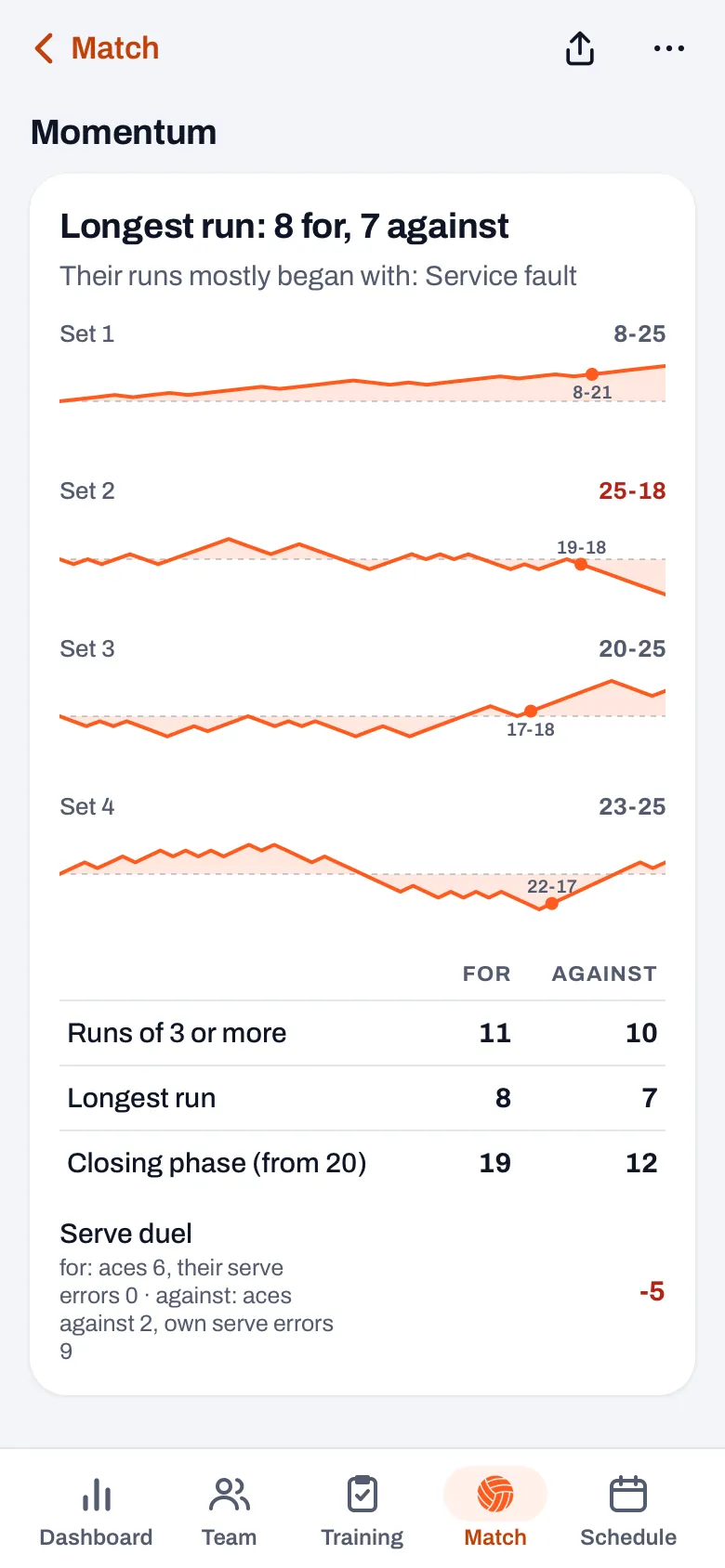
We make Koach, an app for volleyball coaches. The app does not measure body language. What it does show after a match is where the match turned, and that helps you think back to what you saw at that moment.
- Momentum. If you track the match live, afterwards under Stats, at Momentum, you see the Longest run for and against, a wave of the score for each set, the number of runs of 3 or more and which type of point the opponent's runs usually started with, for example your own service error. If a run against started with an error and heads dropped after that, you know where your agreements are needed first.
- Player notes. What you notice about one player you write in the training screen under Report as a player note, with the Follow up switch if you want to come back to it later. Players and parents do not see those notes; the team's coaches do, and if the team belongs to a club, so does the club board.
14 days free, no credit card. Track your next match live and look afterwards at where the runs against started.
Try Koach with your team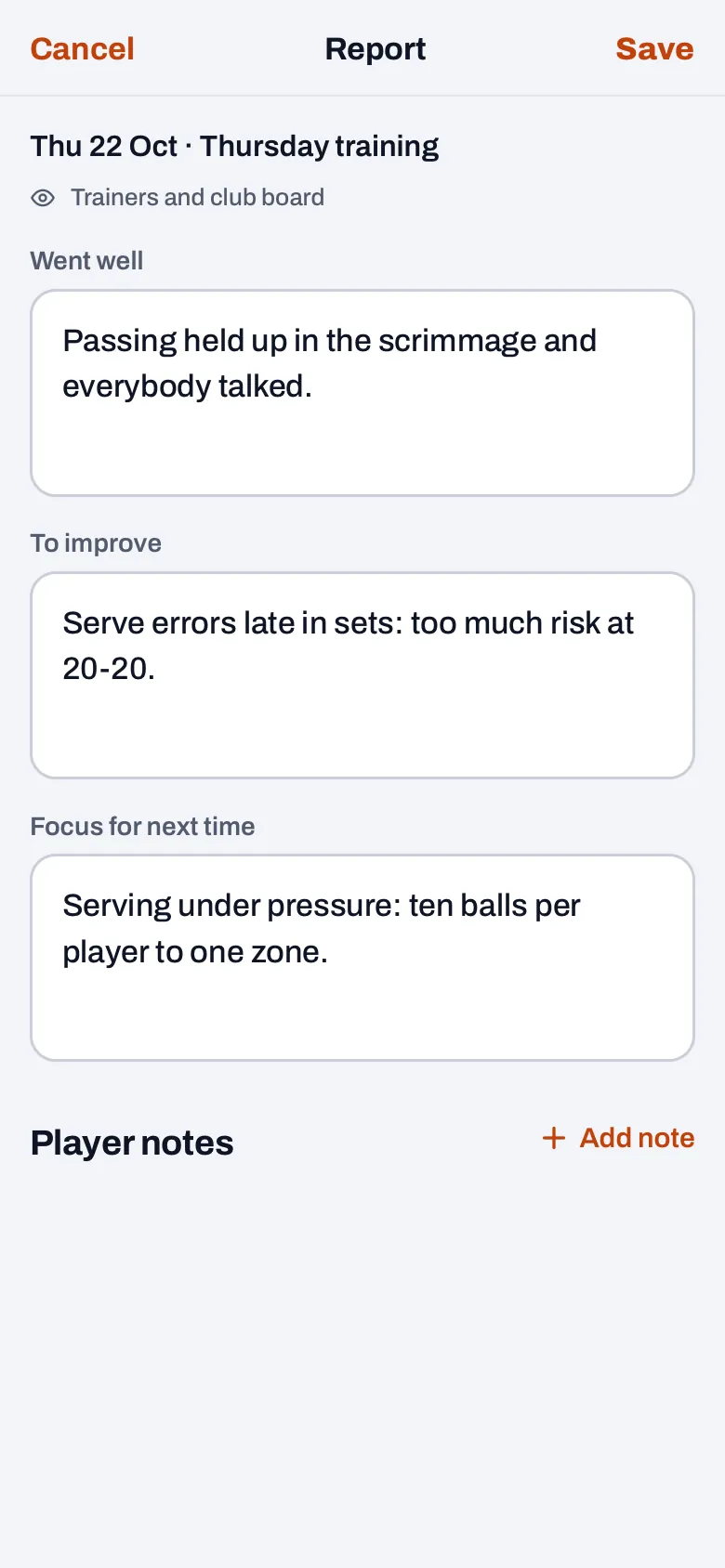
What Koach costs after the trial is on the pricing page.
Frequently asked questions
Why is body language important in volleyball?
Because play stops briefly after every rally and everyone then sees how you react. Teammates read from it whether they can count on you, opponents whether your team is off balance, and a coach whether a player is still in the match. A team that stands together in the huddle after an error shows something different from six players each looking a different way.
How do you improve your team's body language?
With a few visible agreements instead of general appeals: to the huddle after every rally, whoever made the error briefly raises their hand, everyone gets a hand and then everyone looks at the next serve. Train those habits in scrimmages, count how often it goes wrong and discuss that number. And model it yourself on the sideline.
What do you do when a player storms off angrily after an error?
Don't react from the bench in the moment, but let the team catch them in the huddle. Talk one on one after the match: what did you see, what does it do to their teammates and what do you agree for next time. If it keeps happening, at practice too, look wider than body language alone, for example at their confidence or at what is going on outside the gym.
Can you celebrate toward the opponent in volleyball?
Celebrating is fine, provoking is not. The FIVB rules ask players to behave respectfully and courteously toward the opponent, and a referee can sanction misconduct. So celebrate a point with your own team, in the huddle, and not with your face under the net toward the other side.



See where your match turned
14 days free, no credit card. After your next match you see the runs for and against.
Get started with KoachOr read first what the volleyball coaching app does.