
Sportsmanship in volleyball: fair play you model as a coach
The short answer
Sportsmanship in volleyball means accepting the referee's decisions, treating opponents, officials and spectators with respect and not covering up your own team's faults. The rules ask for exactly that. As a coach you teach it to your team mainly by modeling it and naming it when it happens.
Sportsmanship in volleyball seems to go without saying: there is a net between the teams and nobody touches an opponent. Yet every week you see arguments over a touch, arms raised at the referee and a team that skips the handshake under the net. A team learns fair play, and the coach is the example.
What is sportsmanship in volleyball?
Fair play is written into the rules of the game. Chapter 7 of the FIVB's Official Volleyball Rules 2025-2028 covers the conduct of participants: players, substitutes and staff. Four rules together make up what you could call fair play:
- Know the rules and abide by them (rule 20.1.1).
- Accept the referees' decisions without disputing them. In case of doubt, only the game captain asks for an explanation (rule 20.1.2).
- Don't try to influence the referees and don't cover up your own team's faults (rule 20.1.3).
- Behave respectfully and courteously, in the spirit of fair play, toward the referees, the other officials, the opponents, your teammates and the spectators (rule 20.2.1).
The rules also give the captain a related task: at the end of the match they thank the referees and sign the scoresheet (rule 5.1.3.1). What happens when a player or coach crosses the line is in the yellow and red card in volleyball; this article is about everything that comes before that.
A club code of conduct puts agreements for all members on paper. That is something else, and there is a sample code of conduct for a sports club for it. Sportsmanship is what your team shows of it on the court.
A touch nobody saw: do you call it?
Volleyball has its own kind of honesty question. The blocker feels the ball brush their fingertips, but the referee calls it out. The middle touches the net on the landing, and nobody sees it. What do you do?
The rules do not oblige you to report your own fault, but they do forbid covering it up (rule 20.1.3). So a player who loudly protests after a touch that they felt nothing is doing exactly what the rule does not want. As a coach, pick a clear line and agree on it in advance:
- Without a referee, you call it yourself. At practice, in a scrimmage or at a tournament where teams referee themselves: whoever touched the net or tipped the ball raises their hand. An agreement you can add: when in doubt about in or out, the point goes to the opponent. That is not in the rules; it is a habit you choose as a team.
- With a referee, you don't protest a correct call. No arms in the air and no "didn't touch it!" when you know you did.
- If a player raises their hand after a touch on their own, praise it. The decision stays with the referee.
Not every coach thinks a player should point out their own fault in a match with referees. That is exactly why you agree on it beforehand, so it is not a debate in the moment. When touching the net is actually a fault is explained in the net fault in volleyball.
How do you deal with the referee?
At many levels a volunteer referees, sometimes a player from another team in the club, and often without line judges. They miss things, just as your players miss balls. One thing the rules settle themselves: when the ball is out of play, only the game captain speaks to the referees, for example to ask for an explanation of how a rule was applied (rule 5.1.2). The rest are agreements you make with your team:
- After a whistle you turn toward your own huddle, not toward the referee.
- No gestures: no hands on hips, no shrugging toward the referee's stand, no pointing at the line.
- After the match it is not just the captain who shakes the referees' hands, but the whole team.
The same goes for the bench. The coach can get a card too, and your players see exactly how you react to a call.
The opponent: small gestures that count
- The handshake under the net. After the match both teams walk along the net and shake hands, after a loss too. Many teams also do it before the first set.
- Returning the ball properly. If the ball is on your side and the opponent is serving, roll it under the net to their server. Smashing it over the net or kicking it away is small, but everyone sees it.
- Celebrating toward your own team. Celebrate a point in your huddle, not with your face under the net toward the opponent. What that looks like is in body language in volleyball.
- Acknowledging a good play. A nod or a short round of applause for a great dig by the opponent costs nothing.
- No time-wasting. Don't dawdle on a substitution or when returning the ball to throw the opposing server off their rhythm. The rules penalize delays too: the first time with a warning, after that with a point and the serve to the opponent (rule 16).
Sportsmanship in youth volleyball
Children learn sportsmanship the way they learn an overhead pass: by seeing it and doing it often. A few things work well with youth teams:
- Refereeing themselves. At practice, let them decide for themselves in small-sided games whether a ball was in. Anyone who notices how hard that is talks differently about a referee afterwards.
- Naming it when it happens. "Nice that you raised your hand on that net touch." That says more than a talk at the start of the season.
- Bringing in the parents. What gets shouted from the sideline is part of the team's climate. Agreements about that are in parents on the sideline.
- Taking a fair play award seriously. If a tournament has one, tell your team it exists and what it is awarded for.
How to teach sportsmanship as a coach: model, agree, name
- Model it. Your team watches you on every call. Stay calmly standing or seated, shake the referees' hands afterwards and don't talk about "the ref" in the debrief.
- Agree on it. At the start of the season make three to five agreements with the team, in their own words. For example: we shake everyone's hand after the match, only the captain talks to the referee, without a referee we call our own touches, we return the ball under the net. What else to sort out for your first season is in starting as a volleyball coach.
- Name it. Say it in the debrief when someone was sporting, as concretely as with a good pass: who, what, and why it mattered.
- Reward it without a trophy. Recognition from the group is enough. After a tournament, for example, let the team choose and name a sporting moment from that day themselves.
- Step in one on one. If a player behaves unsportingly, talk to them about it after the match and not in front of the group. If it happens again, a consequence follows that you named in advance, such as a set on the bench.
Start with yourself. Ask your assistant or a parent to tally for one match how often you react to a referee's call, with a gesture, a comment or a sigh. That number is your first fair play agreement.
Your team agreements in one place in Koach
We make Koach, an app for volleyball coaches. The app does not measure sportsmanship, and there is no fair play award in it. What does help is putting your agreements somewhere the whole team sees them.
- An announcement on the dashboard. Under Announcements you tap + New, choose Message and put your agreements in it. After Post, the message appears on the dashboard of the team's players and linked parents.
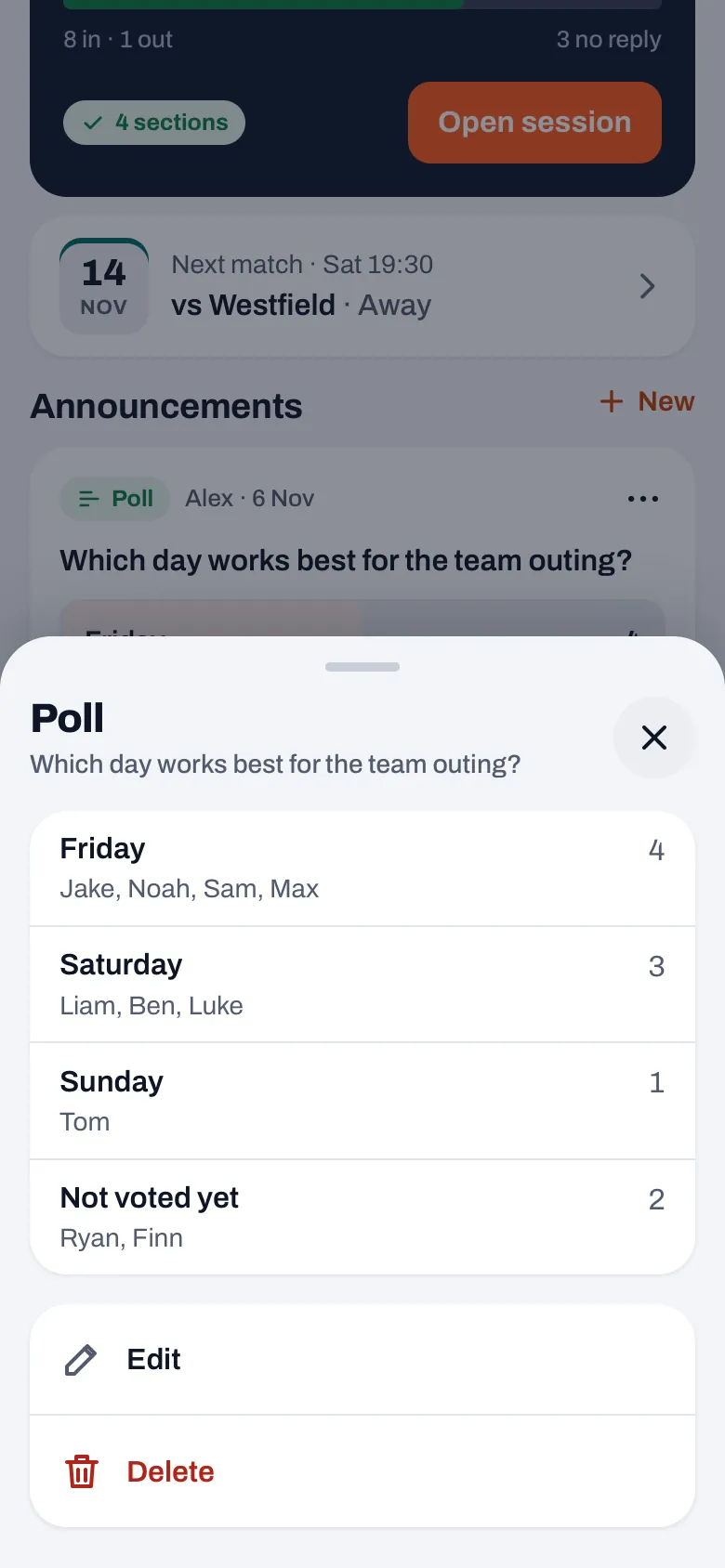
- A poll. In the same sheet choose Poll and add two to six options. Note: the parents of your active players vote too, each with their own account. So a poll suits a question for players and parents together, such as how you cheer from the sideline; the agreements on the court you make with the team itself, at practice. Since version 3.1, as a coach you see under the three dots on the poll who picked which option and who has not voted yet; below the poll everyone sees that the coach can see this.
- Player of the Match in Koach is a vote among the players for the best player of the match, not a sportsmanship award. If you want to reward sporting behavior, name it yourself in the debrief.
14 days free, no credit card. Put your team agreements in an announcement tonight, so players and parents have seen them before the first match.
Try Koach with your teamWhat Koach costs after the 14 free days is on the pricing page.
Frequently asked questions
What does sportsmanship mean in volleyball?
Playing fairly within the rules and with respect for everyone in the gym. The FIVB rules ask you to accept the referees' decisions without disputing them, not to cover up your own team's faults and to behave respectfully toward referees, officials, opponents, teammates and spectators. In practice you see it in the handshake under the net, a ball that is returned properly and a team that turns toward its own huddle after a whistle.
Do you have to say you touched the net in volleyball?
The rules do not oblige you to report your own fault, but they do forbid covering up your team's faults. Without a referee, such as at practice or at a tournament where teams referee themselves, it is sporting to call a touch yourself. In a match with referees the referee decides; agree as a team what you do, and in any case don't protest a correct call.
Can a player talk to the referee during a volleyball match?
When the ball is out of play, only the game captain may speak to the referees, for example to ask for an explanation of how a rule was applied. Other players leave that to the captain; for substitutions and timeouts the coach deals with the second referee. Arguing about a call is not part of it: the rules ask you to accept decisions in a sporting way.
How do you teach kids good sportsmanship in volleyball?
Mainly by modeling it and naming it when it happens. Let children referee themselves in small-sided games at practice, praise it when someone raises their hand after a touch, and agree with the parents that the sideline is only for encouragement. A few fixed team habits, such as a handshake for the opponent after every match, make it normal.


Put your team agreements in one place
14 days free, no credit card. Players and parents see them before the first match.
Get started with KoachOr read first what the volleyball coaching app does.