
Sports club code of conduct: free template in Word and PDF
The short answer
A sports club code of conduct sets out how players, parents, volunteers and visitors treat each other, who to go to with a concern and what happens when someone crosses the line. Below you can download a free template in Word and PDF to adapt. With Koach Club you can then point every member to the code in the app.
You don't have to write a sports club code of conduct from a blank page. Here is a template written for a volleyball club, free in Word and PDF, with what goes in it and how to fill it in. And because a code nobody knows does nothing, you'll also find out how to share it and keep it easy to find.
Download: sports club code of conduct template in Word and PDF
First, what you probably came for: a sample code of conduct for a sports club, written for a volleyball club, free and without handing over your email address. There are two versions with the same text:
- Sports club code of conduct template (Word): to adapt yourself, with blanks for your club's name and contact people. The declaration to sign is on a page of its own.
- Sports club code of conduct template (PDF): four A4 pages to print. Three pages of code and one sheet with two declarations to sign.
You are free to use, copy and adapt the template. If you want to change the wording, start with the Word version. The PDF is handy for reading through with the board or putting up on the notice board.
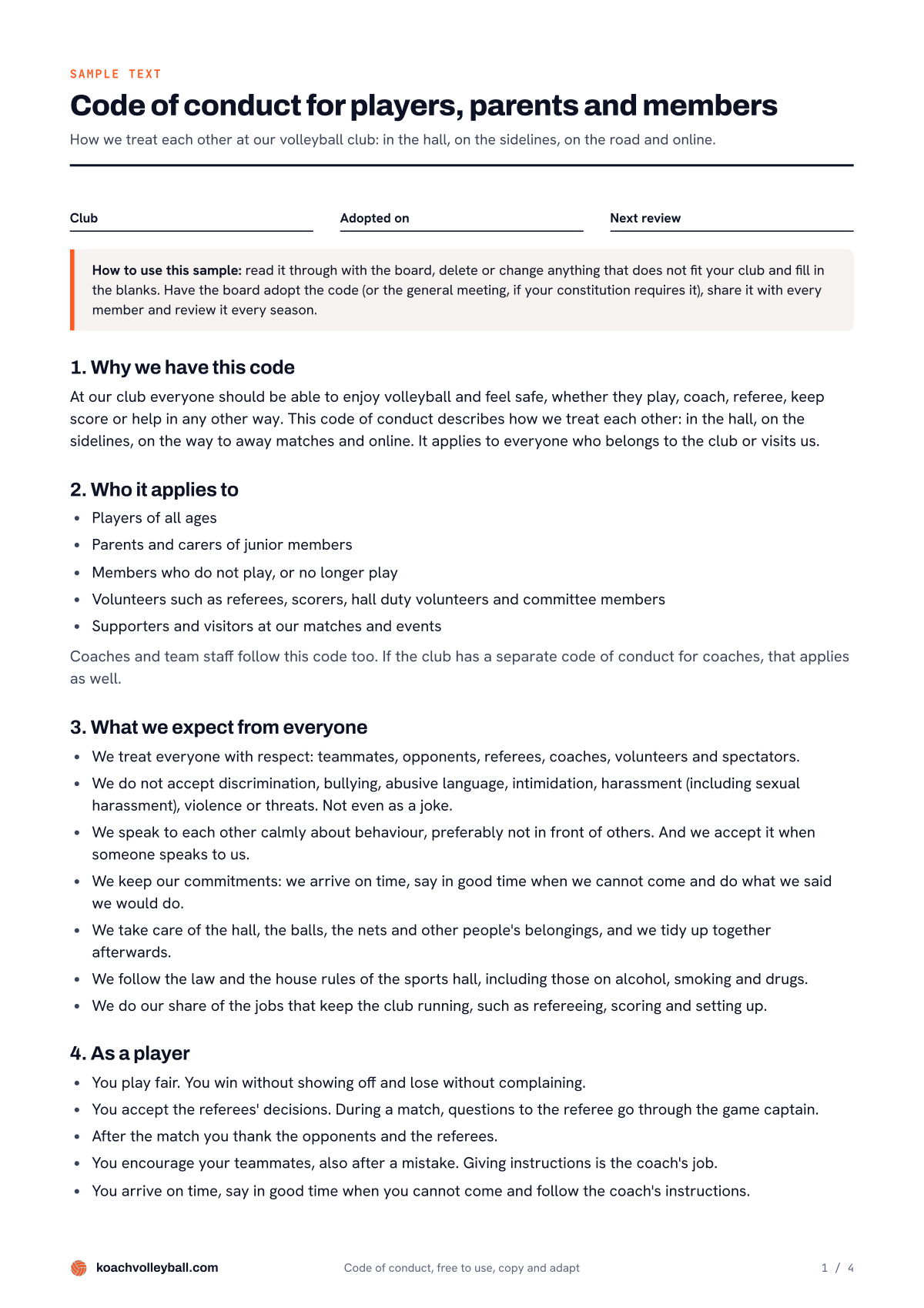
Page 1 of the PDF: at the top you fill in the club, the date the code was adopted and when you will review it.
What goes in a sports club code of conduct?
A code of conduct describes how everyone who belongs to the club treats each other: in the hall, on the sidelines, on the way to away matches and online. The template has eleven sections:
- Why we have this code. One paragraph: everyone should be able to enjoy volleyball and feel safe, whether they play, coach, referee, keep score or help out in any other way.
- Who it applies to. Players of all ages, parents and carers of junior members, members who don't play or no longer play, volunteers and visitors. Coaches follow it too.
- What we expect from everyone. Respect, no discrimination, bullying or harassment (not even as a joke), speaking to each other calmly about behaviour, keeping commitments, looking after the hall and equipment, and doing your share of the jobs.
- As a player. Playing fair, accepting the referee's decisions (questions go through the game captain), thanking the opponents and no photos in the changing rooms.
- As a parent or carer. Cheering on the whole team, leaving the coaching to the coach, leaving referees and scorers alone and raising playing time at a calm moment. How to agree on this with parents is covered in ground rules for parents on the sideline.
- As a member, volunteer or visitor. Respecting volunteers, taking complaints about their work to the board afterwards and following the instructions of the hall duty volunteer.
- Online and on social media. What you wouldn't say in the hall, you don't post online either. You only share photos of other people with their permission, and for junior members with a parent's permission too.
- Contact with junior members. Rules for every adult who has contact with players under 18 on behalf of the club: messages go through the team channel or with a parent included, no private messages, and never going into a changing room alone.
- Raising a concern. Who to contact, with a table for the confidential adviser (often called the welfare officer), the board and the youth coordinator.
- Measures. From a conversation and a warning to a suspension and, for serious or repeated behaviour, ending the membership. The person concerned first gets the chance to tell their side of the story.
- How we make this code known. A checklist to tick: website, club handbook, joining, notice board and an email at the start of every season.
A few things are deliberately left out. How a coach treats their players belongs in a separate code of conduct for coaches. The wider policy, with background checks, a reporting procedure and rules on photos and privacy, is a safeguarding policy; the code of conduct is one part of it. And what a team agrees about dropping out or turning up late is something each coach sorts out with their own team.
How to fill in the template and adopt your code of conduct
- Read the text through with the board. Cut what doesn't fit your club and add what matters to you. A rule nobody enforces is better left out than left in.
- Fill in the blanks. At the top, your club's name and the two dates. In section 9, the names and phone number or email of the confidential adviser, the board and the youth coordinator. A contact table without names doesn't work: anyone who wants to raise a concern has to know who to go to. How to choose that person is covered in the welfare officer at your sports club.
- Have the code adopted. Usually by the board, or by the general meeting if your constitution or bylaws require it. Check the measures in section 10 against what your constitution says about suspension and ending a membership.
- Decide whether members sign. The last sheet is a declaration to sign, with a second signature from a parent or carer for members under 18. Whether you ask people to sign, and who, is up to you.
- Tick how you'll share it. That's section 11. Put a date in the calendar straight away to review the code every season.
A code of conduct nobody knows doesn't work
Most clubs have the text somewhere. The problem is getting it seen: the code is adopted, goes on the website and is never read again. A new member might get it when they join, but the parent who has stood on the sideline for years has never laid eyes on it. So put the code in more than one place. Here is how those places compare:
| Where the code is | Who sees it | Where it falls short |
|---|---|---|
| Club website | Everyone, including new parents and visitors | Only people who go looking |
| Club handbook | Coaches, committee members and volunteers looking something up | Gets consulted, not read through |
| Joining the club | Every new member, once | Not existing members |
| Notice board or screen in the hall | Everyone in the hall, including the away team | Only a short version fits |
| Email to all members | Members with a known email address | Outdated lists and the spam folder |
| Club announcement in Koach Club | Coaches, players and parents with an account in one of the club's teams | Not members without an account |
On the website and in the club handbook, the code is there for anyone to look up. A message at the start of every season makes sure everyone actually sees it. How to send that message without it landing in spam or leaking addresses is explained in sending an email to all members of your sports club.
How to share your sports club code of conduct with Koach Club
We make Koach, an app for volleyball coaches and their club, so read this part as an explanation of our own product. Koach doesn't write your code of conduct and doesn't track who has signed it. What it does is reach the members who are already in the app, and one rule from the code is already built into how the app works.
A club announcement to all members
With the Club plan, anyone with a club role, such as a board member or the club manager, can send a club announcement. Under Profile, tap Club announcements and then the +. Write a subject, for example "Our code of conduct for this season", and say in the message where the code can be found. Tap Send to all members and it appears under Club announcements for every coach, player and parent in the club's teams. Anyone who has the Club announcements switch turned on in the iPhone or Android app also gets a push notification. The details are in sending club announcements.
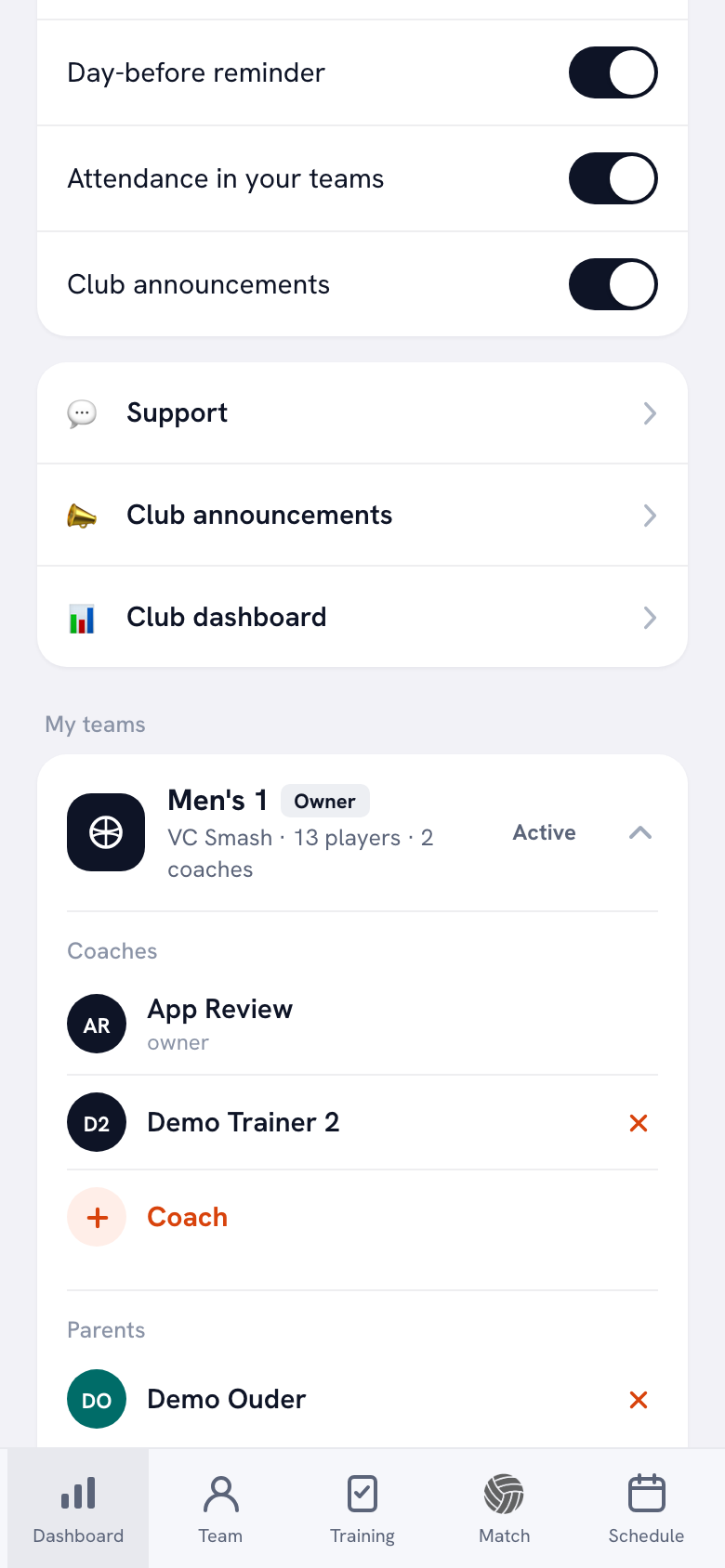
We set up Koach Club together with you. There is no free trial on Club: use the form to tell us how many teams you have, and we'll show you how club announcements and club email work. If you coach a team yourself, you can start in the app with that team right away.
Book an intro call Start with your own teamClub email, for example to parents only
The Club dashboard has an Email section. Under To, choose All club members, or for example Parents only if you want families to read the rules for junior members at home. The email goes out from your club's own domain, which the club manager connects once. Before you send, you see how many recipients have an email address: members without a Koach account get nothing. For them, you still need the website and the notice board.
No private messages in the app
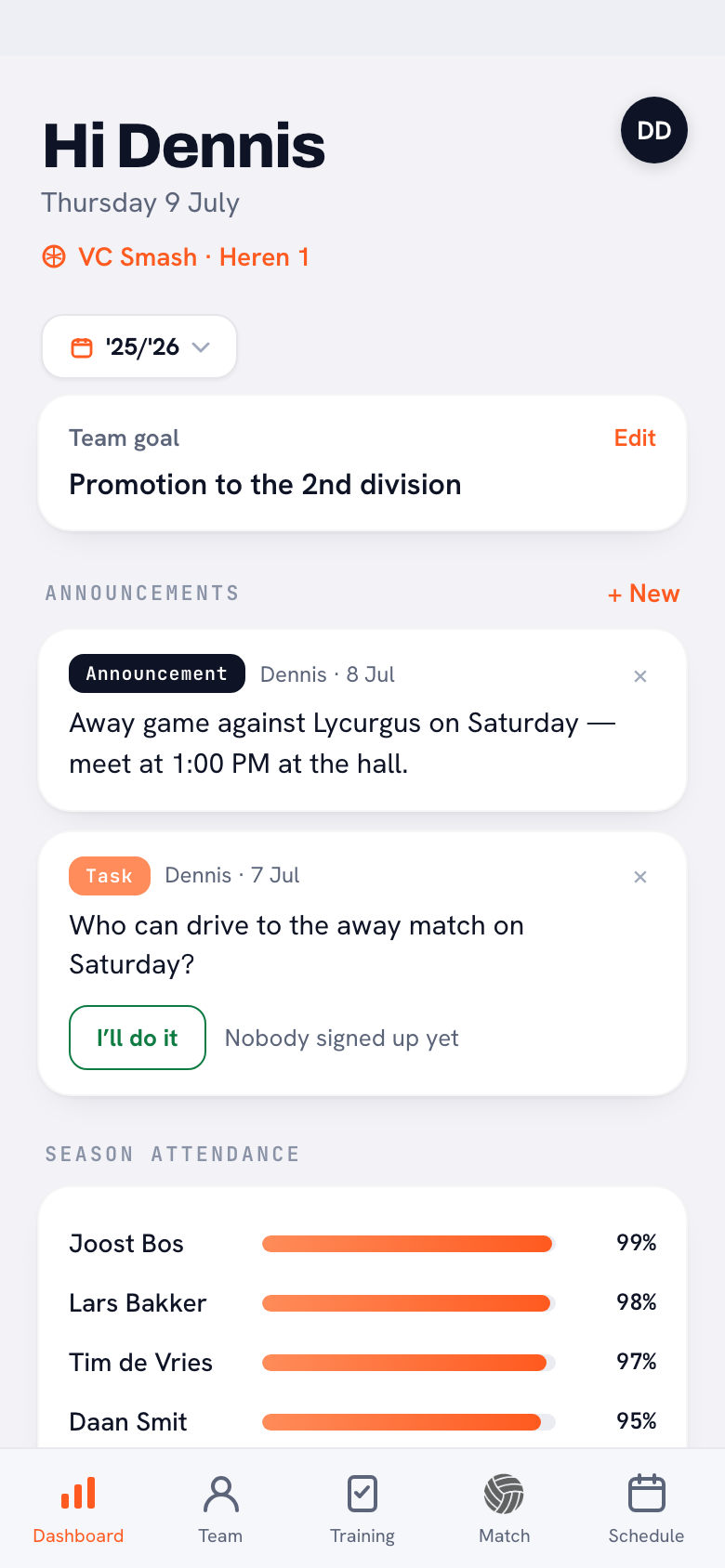
Section 8 of the code asks that messages to junior members go through the team channel, not as a private message. In Koach, that is the only option there is. A coach posts an announcement, poll or task under Announcements on the dashboard, and the coaches, players and linked parents of that team see it. Players and parents don't post messages themselves, and there is no chat and no private messaging. In Koach Club, your welfare officer can also get a club role of their own, Confidential adviser.
What Koach doesn't do
- No documents in the app. A club announcement or club email has no attachment. Put the code on your website or in your club handbook, and say in the message where to find it.
- No signing. You collect the signed declarations on paper and keep them yourself.
- No reporting system. A concern goes to the people in your contact table, not through the app.
- No oversight outside the app. Koach can't see what someone sends in another messaging app. For a team's group chat, the code is the only thing you have to go on.
Which clubs is this right for, and what does it cost?
The template is free and works for any sports club, with or without an app. Koach Club is a good fit if the coaches of your teams already use Koach or are about to: then players and parents are already in the app and you reach them all with one club announcement. If most of your teams still run on paper and a group chat, Koach Club won't add much just for sharing the code. In that case, start with the website, the club handbook and an email.
Koach Club costs €9.99 per month, or €8.33 per month if you pay yearly, for unlimited teams and coaches. Players and parents use Koach for free. In the App Store and Google Play you see the price in your own currency. There is no free trial on Club: use the form on the clubs page to book an intro call, and we'll set up your club together with you. The Coach plan (€2.99 per month, one team) comes with a 14-day free trial, but club announcements and club email are only in Club. All prices are on the pricing page. For everything else on the board's list at the start of a season, see the volleyball season checklist.
Don't send the code in the off-season; send it in the first week of practice. By then the new members have joined, the teams are set and parents are reading their messages again. Introduce your welfare officer in the same message: a name with a face sticks far better than a line in a table.
Frequently asked questions
Does a sports club need a code of conduct?
Whether it's required depends on your country and your national governing body, and sometimes on your own constitution. So check with your governing body and in your constitution or bylaws. Either way, an adopted code gives the board something to point to when someone crosses the line. Without written rules, a warning or a suspension is hard to explain, both to the member concerned and to the rest of the club.
Who approves a sports club's code of conduct?
Usually the board. If your constitution says rules and policies are adopted by the general meeting, take the code there. Let coaches, the youth coordinator and a few parents read the text first: people who helped review it can also explain it. Put the date it was adopted at the top, and when you'll review it. The template already has fields for both.
Do members have to sign the code of conduct?
That's usually up to the club. A signature does make it clear that someone has read the code, and you can refer back to that later. The template has a declaration to sign on the last page, two per sheet in the PDF and one per page in Word. For members under 18, a parent or carer signs too. You can also ask only new members to sign when they join.
How do you make sure all members know the code of conduct?
Put it in more than one place: on the website and in the club handbook to look up, in the joining process for new members and on the notice board in the hall. On top of that, send it round at the start of every season. With Koach Club you do that with a club announcement to all members or a club email, for example to parents only. Members without an account you reach through the website and the hall.
What does Koach Club cost, and can I try it first?
Koach Club costs €9.99 per month, or €8.33 per month billed yearly, for unlimited teams and coaches. Players and parents use the app for free. There is no free trial on Club: use the form on the clubs page to book an intro call, and we'll set up your club together with you. The code of conduct template is free, even if you don't use Koach.



Point every member to your code of conduct in one go
There's no trial on Club: book an intro call via the clubs page and we'll set up your club with you. Coach a team yourself? Start below.
Get started with KoachOr read first what the volleyball coaching app does.