
Safeguarding policy for sports clubs: free Word and PDF template
The short answer
Sports clubs set out safeguarding in a written policy: a code of conduct, a welfare officer, a clear way to report concerns, checks on volunteers and rules for messages and photos. Below you can download a free template in Word and PDF. In Koach there is no private chat: a coach always messages the whole team.
Safeguarding starts with rules that everyone in the club knows. Your committee wants those rules on paper, but often doesn't know where to begin. This page explains what a safeguarding policy for sports clubs should cover, gives you a template to fill in and shows which of its rules you will find in Koach.
What is safeguarding, and why put it in writing?
Safeguarding means that everyone in the club can play safely and enjoy it: players, coaches, volunteers, parents and visitors. A policy is there for the moment something goes wrong. At that point you want a coach to know what to do when a player confides in them, parents to know who they can turn to, and the committee not to be making up rules in the middle of a crisis.
A policy also works before anything happens: a new coach gets a few clear rules from day one. What the club's point of contact does is covered in the welfare officer at your sports club. This article is about the policy around that role.
What should a safeguarding policy for sports clubs include?
A workable policy answers eight questions. If one is missing, you only notice when you need the answer.
- Why and for whom. What you mean by abuse and poor practice (bullying, discrimination, intimidation, violence and sexual harassment, online too) and who the policy covers, in the gym, on the road and at camps.
- Who does what. The committee has final responsibility. Then there is a welfare officer, a deputy for when the welfare officer is involved, and someone who keeps track of checks and training.
- Code of conduct. The heart of it, for coaches and volunteers and for players among themselves. The full code can be a separate document; there is an example in the code of conduct for your sports club.
- Recruitment and checks. An introductory conversation, references and a criminal record check that follows the rules of your country, before anyone starts working with children.
- Messages, social media and photos. Which channel coaches and young players use to reach each other, who sees contact details and how you record consent for images. That last point is worked out in photos of young players and consent.
- Away matches and overnight stays. Who supervises, how people travel and who sleeps where.
- Reporting a concern. What someone does when they see, hear or suspect something: listen, write it down, report it to the welfare officer, and who decides what happens next. Plus support for the player.
- Sharing and reviewing. Where the policy can be found, how new members receive it and when the committee looks at it again.
Download the safeguarding policy template in Word and PDF
You don't have to start from a blank page. We have worked those eight parts into a template for a volleyball club, free and without an account:
- Safeguarding policy template for your volleyball club in Word (.docx): to fill in and adapt to your club.
- Safeguarding policy template to print (PDF, A4): ten pages with the full policy and the appendices.
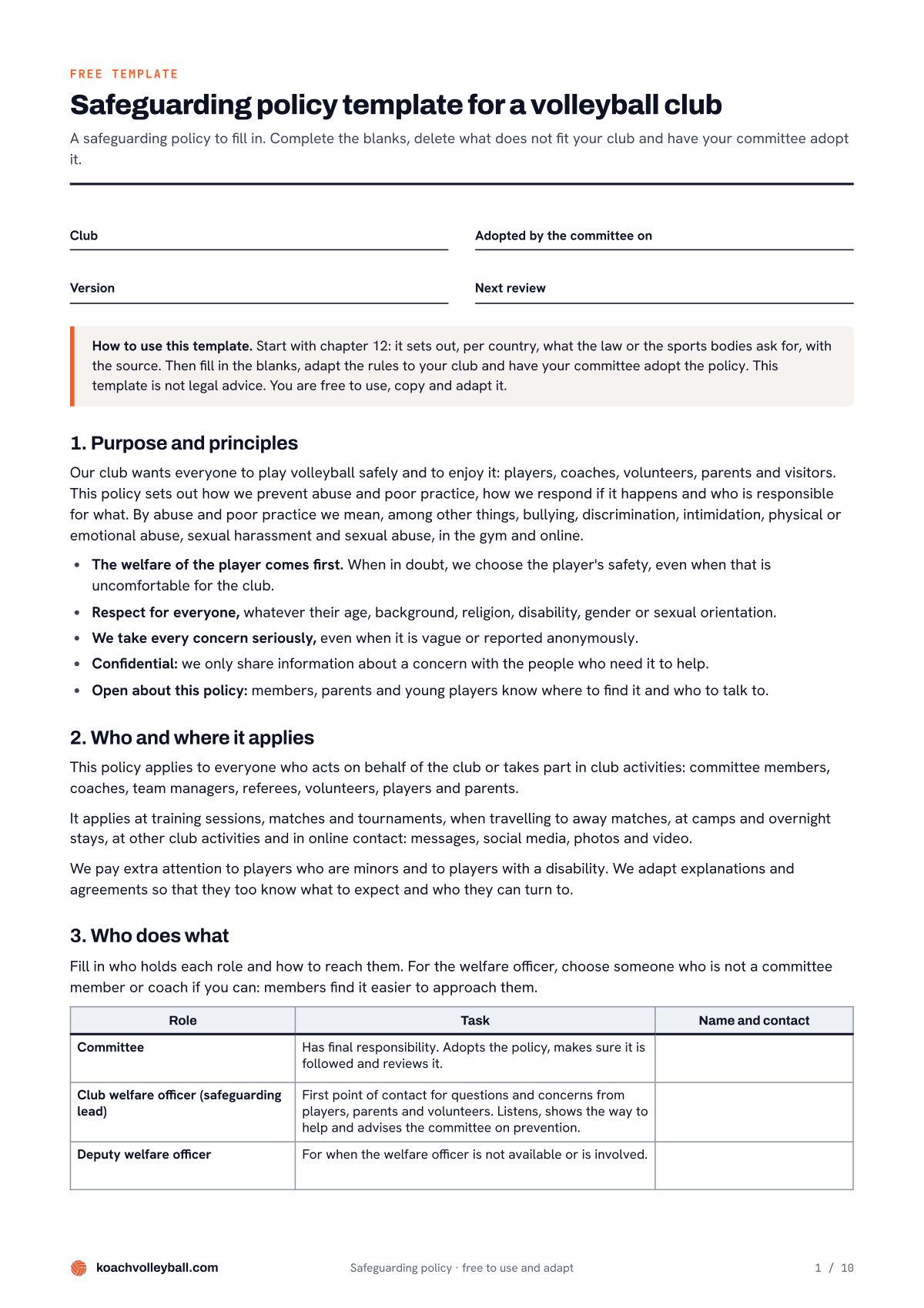
At the top you fill in the club name, the date the committee adopts the policy, the version and the next review. Below that are twelve chapters, from purpose and code of conduct to reporting a concern, key contacts and the rules per country. At the back are five appendices: a short version for young players to put on the wall, a form to record a concern, an overview of checks, a declaration for coaches and volunteers and a risk check.
How to fill in the template
- Start with chapter 12. It sets out what the law or the sports bodies ask for, with the source. Check it first: rules change.
- Fill in the roles table with names and contact details. For the welfare officer, ideally pick someone who is not a committee member or coach.
- Fill in the blanks and delete what doesn't fit. A rule nobody follows undermines the rules that do matter.
- Go through the risk check with the committee, the welfare officer and a few coaches: changing rooms, transport, one-to-one situations, messages and photos.
- Have the committee adopt the policy and put the next review in the club calendar, next to the other fixed points in the volleyball season checklist.
The template is not legal advice. You are free to use, copy and adapt it.
Write your own, use your governing body's model or a template?
There are three ways to get a policy, and each has its place.
- Material from your governing body or sports council. Look here first: it matches the rules in your country. It is often written for every sport at once, though, so translating it to training sessions, away matches and a changing room full of juniors is up to you.
- Writing your own. Then every word fits your club. But whatever you forget, such as a deputy welfare officer or how long you keep notes, you only discover at the first concern.
- A template like the one above. Complete and quick to fill in, but general: it doesn't know your club, nor every rule in every country. That's why checking the rules is step one.
Combining them is often wisest: use the template as the outline and keep your governing body's material next to it.
The rules in the UK, Ireland and the US
Checked in October 2026 against the sources below. This is not legal advice: ask your governing body what applies to your club.
- England and Wales: DBS checks. According to gov.uk, a coach of children's sport can be eligible for an Enhanced DBS check with a Children's Barred List check when they coach children on more than 3 days in any 30-day period or overnight, paid or unpaid. From 1 September 2026, being supervised no longer takes someone out of regulated activity in England, Wales and Northern Ireland (gov.uk). The template has a place for this in chapter 5 and appendix C.
- Northern Ireland and Scotland. In Northern Ireland, criminal record checks go through AccessNI. In Scotland, Disclosure Scotland runs the PVG scheme; joining it is a legal requirement for regulated roles with children. NSPCC Sport, funded by the UK sports councils, offers advice and tools for sports clubs.
- Ireland. According to the Garda National Vetting Bureau, a relevant organisation may not let anyone do relevant work with children on its behalf unless it has received a vetting disclosure for that person.
- United States. Clubs that are members of USA Volleyball follow its SafeSport programme. Its Minor Athlete Abuse Prevention Policies (MAAPP) set training requirements and limit one-on-one interactions with minor athletes. Sexual misconduct is reported to the U.S. Center for SafeSport; child abuse is also reported to local authorities.
Does your club play somewhere else? Ask your federation or sports council which rules apply there and adapt chapter 12 to match.
Messages and privacy: where your policy shows up in Koach
We make Koach, an app for volleyball coaches and clubs, so read this part as an explanation from the maker. Two topics from the policy, messages to young players and who sees which data, are set up in the app so that the rule and the channel say the same thing. On top of that, you can send the policy round through the app.
Messages go to the whole team
The template says: team messages go through a channel that coaches, players and parents share, and if a personal message to a player who is a minor is needed, a parent is copied in. Koach has no chat and no private messages. A coach posts an Announcement, a Poll or a Task under Announcements on the team dashboard, and for a task someone signs up with I’ll do it. Everyone in the team sees the same message. How the three work is explained in announcements, polls and tasks.
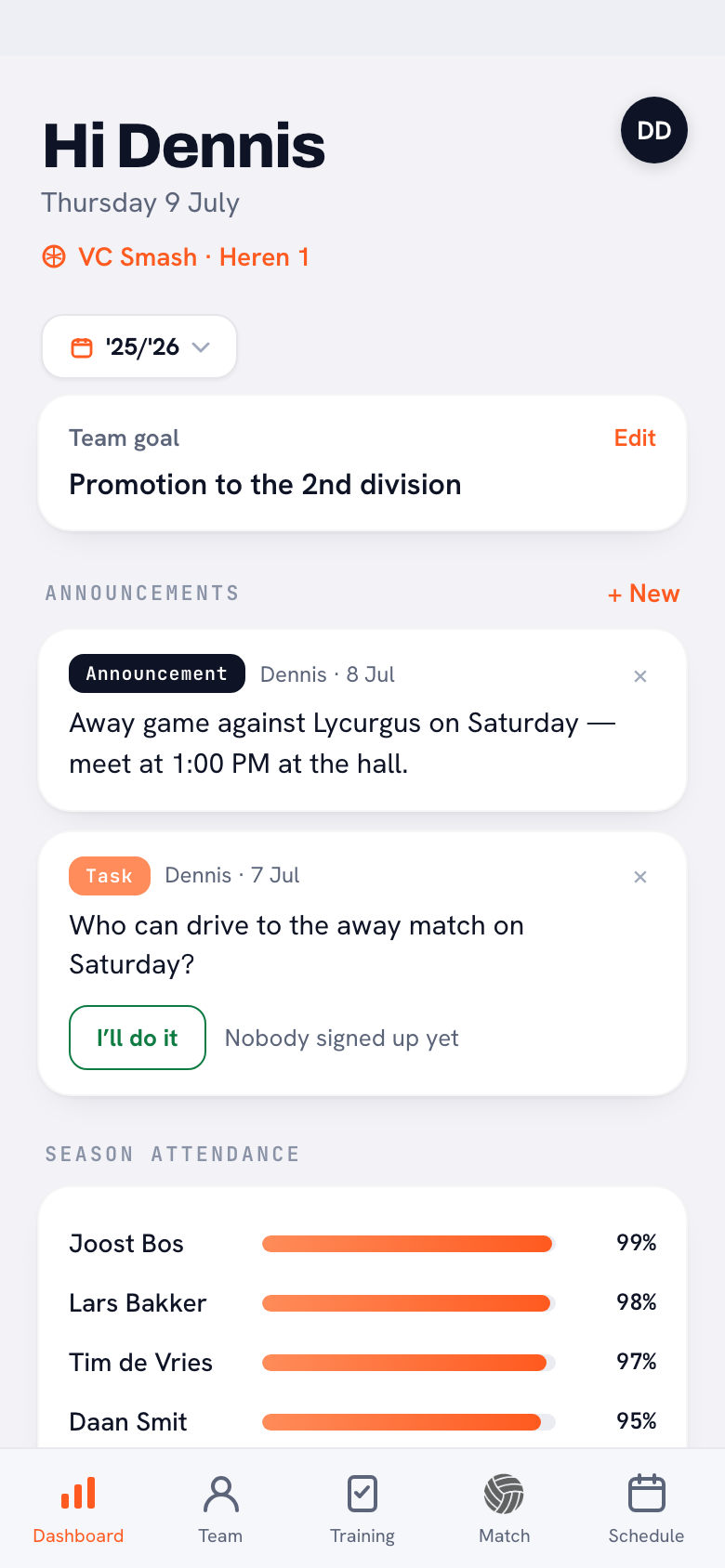
To be fair: an app doesn't stop anyone from sending a message outside it. In an ordinary group chat on a phone, a coach can always message a player one-to-one as well. So the rule itself belongs in your policy; the app just makes it easier to stick to.
We set up Club with you. There is no trial on Club: leave your details and we'll show you how the club roles and club announcements work, then set up your club together with you. Want to see the app for yourself first? Try it free for 14 days with one team.
Book an intro call Try the app with one teamContact details of junior members only for those who need them
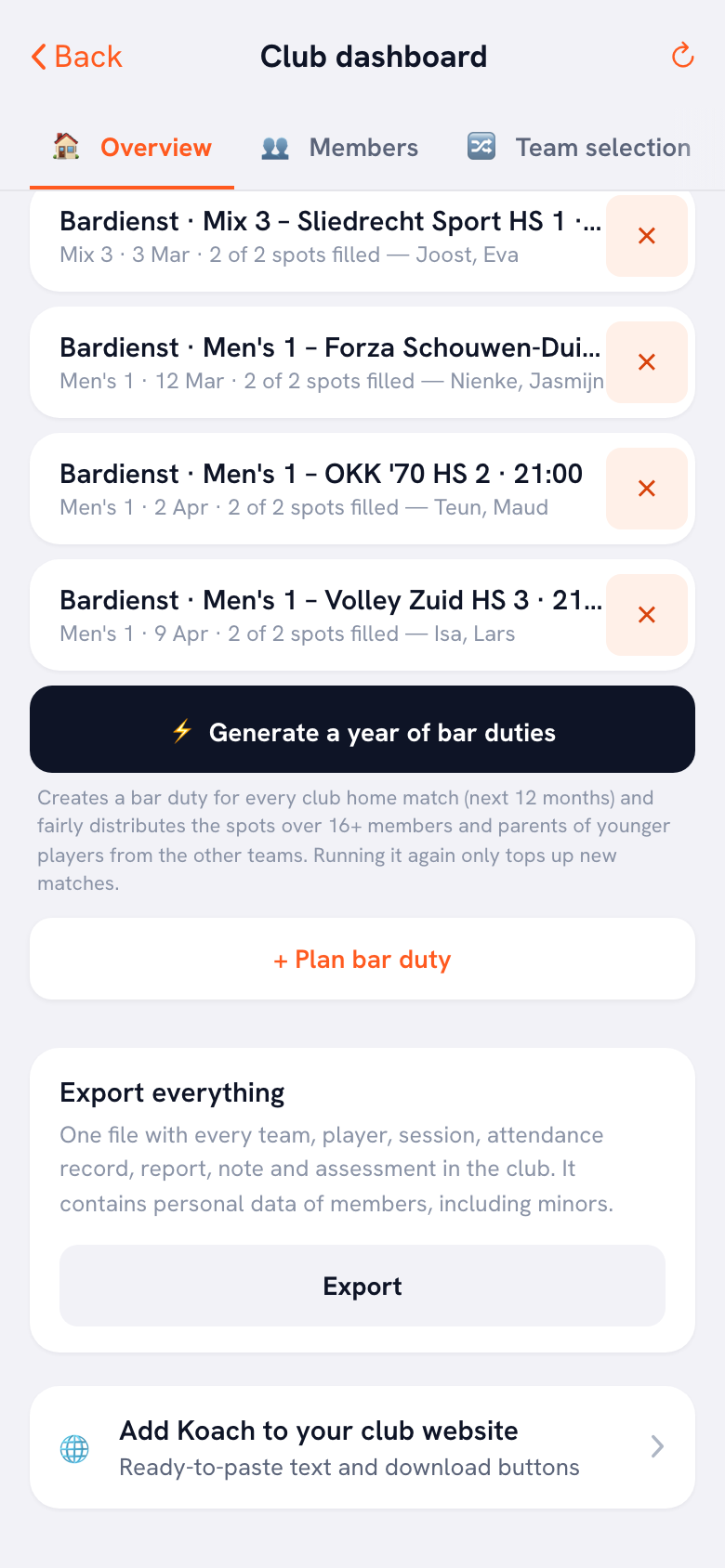
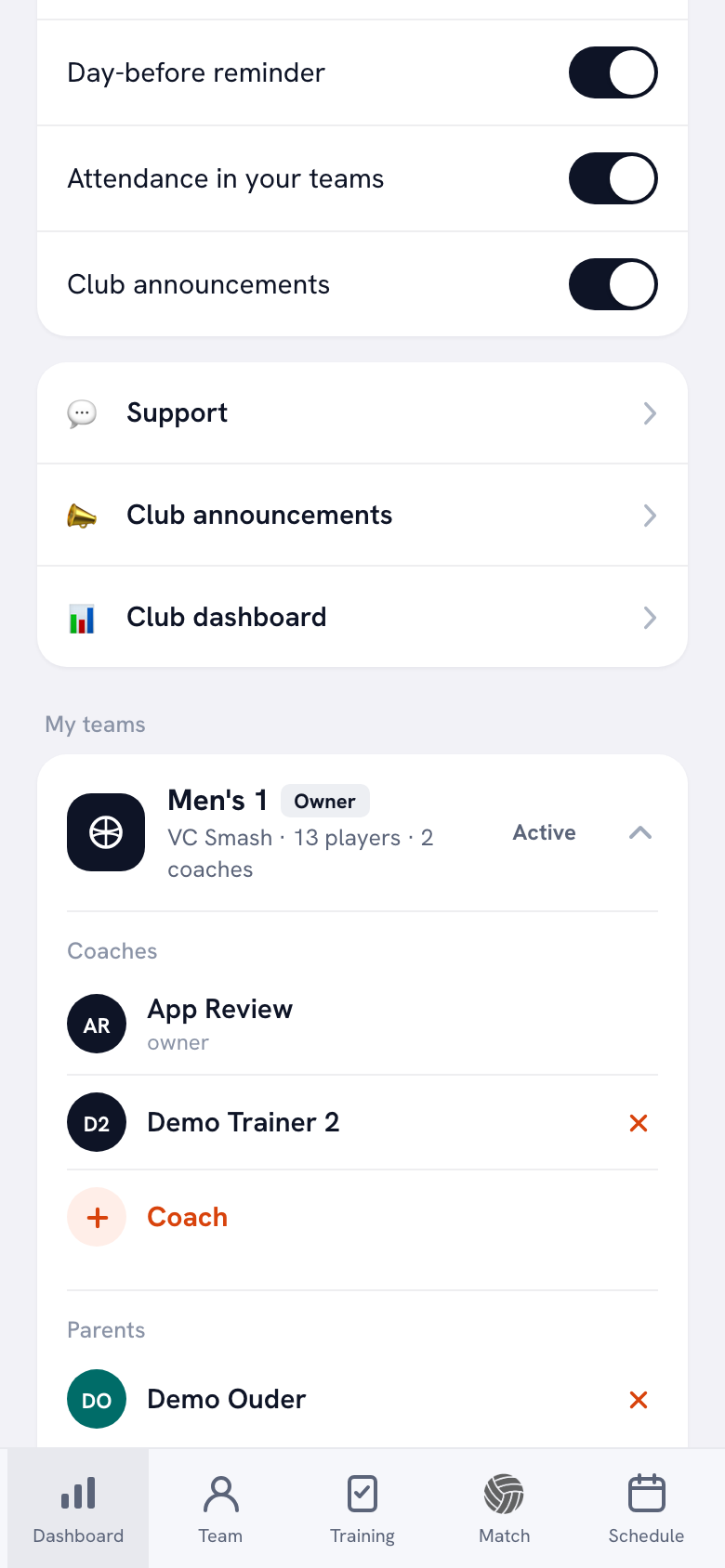
Within the team, the coach sees the details a player fills in under Contact & emergency; a teammate doesn't. Koach Club, the plan for the whole club, has five club roles, each with its own permissions. In the club's member list, only the Club manager, the Board member and the Treasurer see email addresses, linked parents and ages. The Confidential adviser (the role for your welfare officer) and the Technical manager see names and teams, but no contact details. Export everything, one file with the data of the whole club, can only be used by the club manager and the board. That lock sits on the server: whatever a role isn't allowed to see is never even sent to their phone. Which role is meant for what is explained in adding club admins, and which data a club should keep at all in GDPR for sports clubs.
Sharing the policy
A policy sitting in a drawer protects no one. With Koach Club you can send it round in two ways. For a club announcement, go to Profile, tap Club announcements and then the plus sign, write your message under New club announcement and tap Send to all members. Members with the app get it as a push notification. The club manager, the board member, the treasurer and the confidential adviser can send a club announcement. For a club email, the club manager or the board opens the Email tab in the Club dashboard and picks recipients such as Coaches only or Parents only; the email goes out from the club's own domain, which the club manager links there once. Attachments aren't included, so put the policy on the club website and say in your message where to find it. Members without a Koach account won't get it this way, so the website and registration still matter.
What the policy asks for, and what Koach does with it
| From the policy | In the template | In Koach |
|---|---|---|
| Messages to young players through the group | Chapters 4 and 6 | Yes, no private chat |
| Contact details only for those who need them | Chapter 6 | Yes, per club role |
| Sharing the policy | Chapter 10 | Yes, club announcement and club email |
| Recording consent for photos | Chapter 6 | No |
| Recording a concern | Appendix B | No |
| Overview of checks | Appendix C | No |
| Declaration for coaches and volunteers | Appendix D | No |
What Koach doesn't do
Koach is not a safeguarding case management system. There is no reporting form, no case file and no place to record conversations: for that you use appendix B and a secure folder kept by the welfare officer. Koach doesn't track checks or declarations for coaches and volunteers, doesn't record photo consent and doesn't replace your membership system. And Koach is only for volleyball: if your multi-sport club wants one system for every sport, it isn't the right fit.
Who Koach Club is for, and what it costs
Koach Club suits a volleyball club with several teams that wants the rules in its policy to apply in the everyday channel too. Club costs €9.99 per month for the whole club, or €8.33 per month on a yearly plan, with unlimited teams and coaches. The five club roles are included, and players and parents use Koach for free. There is no trial on Club: you leave your details on the clubs page and we set up the club together with you. If you coach one team, you can try Koach free for 14 days, no credit card, and then choose Coach for €2.99 per month. All prices are on the pricing page; in the App Store and on Google Play you pay the store price in your own currency.
Put appendix A up in the gym. The short version for young players fits on one sheet. Go through it briefly with every youth team at the start of the season and add the welfare officer's name: a child who knows that name knows who to turn to.
Frequently asked questions
Is a safeguarding policy a legal requirement for sports clubs?
That depends on your country and your governing body, and this is not legal advice. In Scotland, joining the PVG scheme is a legal requirement for regulated roles with children. In Ireland, a relevant organisation may not let anyone do relevant work with children on its behalf without a vetting disclosure. In the US, clubs that are members of USA Volleyball follow its SafeSport programme. Ask your governing body what it expects from your club.
Can a coach send a private message to a youth player?
The template on this page says no: team messages go through a channel that coaches, players and parents share, and if a personal message to a minor is needed, a parent is copied in. That way nobody can later doubt what was said. Koach has no private chat: a coach posts an announcement, poll or task that the whole team sees. Outside the app it is still possible, so the rule belongs in your code of conduct.
Who should see the contact details of junior members?
Only people who need them for their role. In Koach the coach sees the contact details of their own team, and a teammate doesn't. In Koach Club, only the club manager, the board member and the treasurer see email addresses and linked parents in the club's member list. The confidential adviser and the technical manager see names and teams. What a club should keep at all is covered in GDPR for sports clubs.
Can I use and adapt the safeguarding policy template for free?
Yes. You download the template for free, without an account or email address: in Word to fill in and as a PDF to print. You are free to use, copy and adapt it to your club, so delete rules, add your own and put your club name in. It is not legal advice. Check the rules in chapter 12 and have your committee adopt the policy.
How much does Koach Club cost, and is there a free trial?
Koach Club costs €9.99 per month for the whole club, or €8.33 per month on a yearly plan, with unlimited teams and coaches and all five club roles. There is no trial on Club: leave your details on the clubs page and we'll get in touch and set up the club together with you. A coach of one team can try Koach free for 14 days. Players and parents use Koach for free.
Make your policy work in the app too
There is no trial on Club: book an intro call through the clubs page and we will set up your club with you, with messages through the team and permissions per role. Coaching a team yourself? Start your 14-day free trial below.
Get started with KoachOr read first what the volleyball coaching app does.